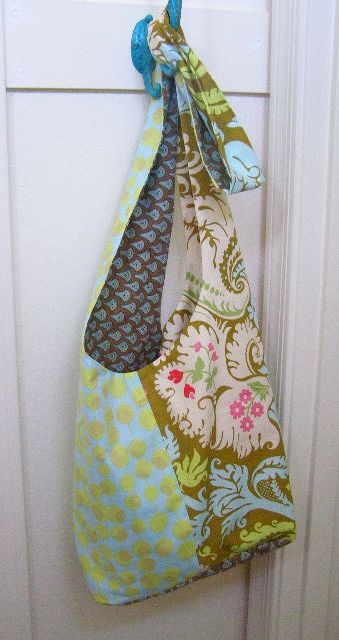
“I Can’t Sew a Straight Line” No Measure Modern Quilt Tutorial

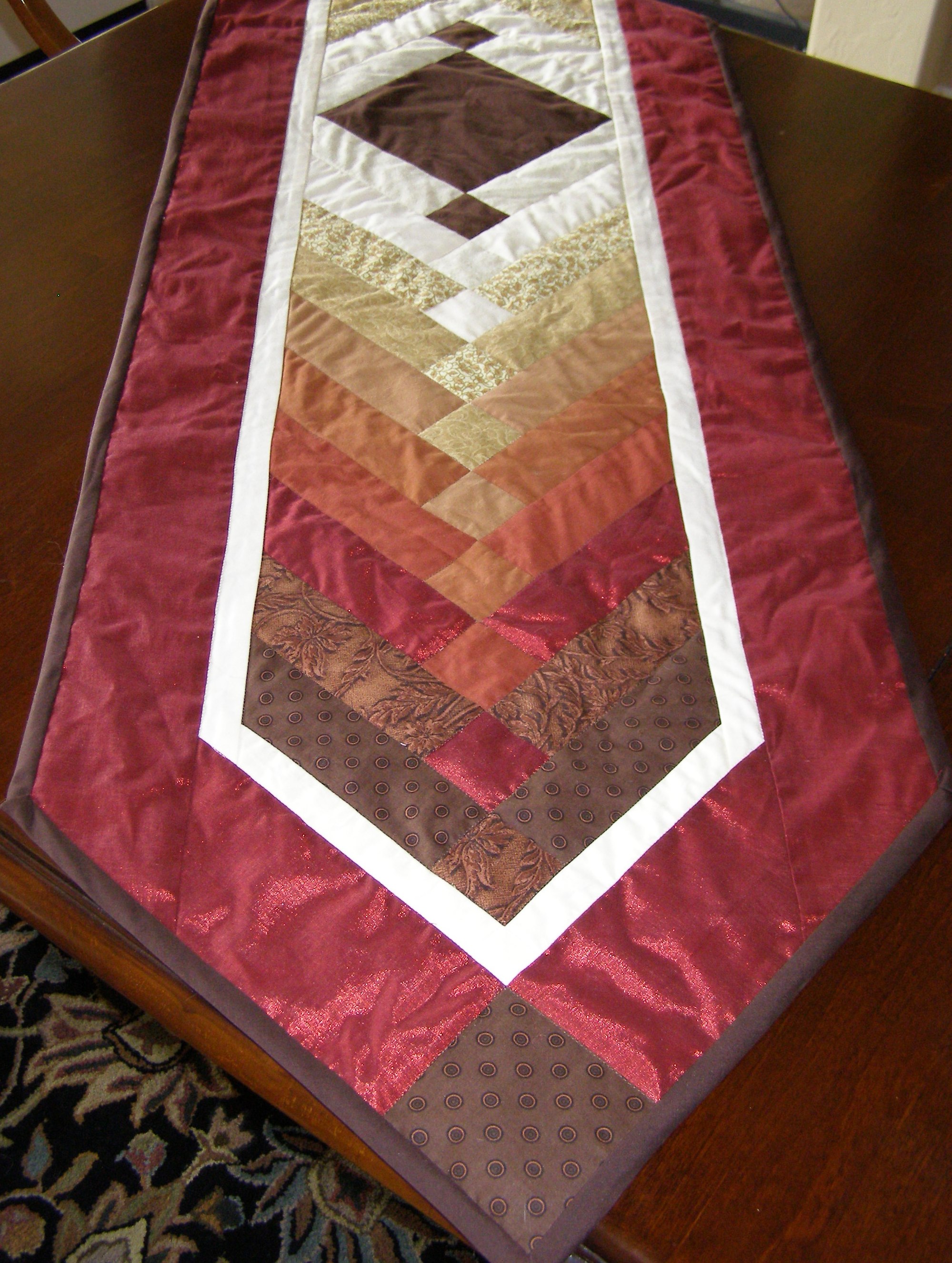
Modern No Measure Quilt ready to go to the Long Arm Quilter

Photo 1: Modern No Measure Quilt ready to go to the Long Arm Quilter

This quilt is designed to guarantee a beautiful modern quilt – with perfectly straight lines – by even a beginning sewer!

The twenty-something daughter is visiting and wanted some help with apartment decor. Her bedroom needed some color – and curtains.  The Stash shall provide!

A modern quilt – simple lines and beautiful colors – will balance perfectly against the copper brown we decided to use for the curtains.

To refresh her sewing skills, I thought she should make it.   Thus the protestation: “But I can’t sew a straight line!”

Fabric will do the work for you!

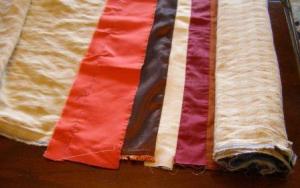
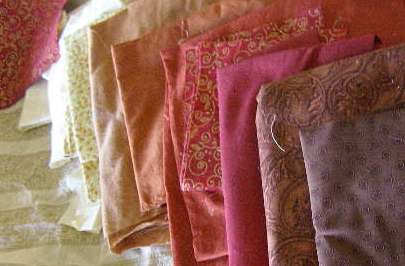
Photo 2: Foundation Fabric. Look at all those straight lines! The fabric will do the work for you!

Oh, but anyone can!

The key is the foundation fabric – which will not show.  A striped or checked fabric in a 55″ – 60″ width does all the hard work!

Choosing a Foundation Fabric

The fabric used here was a 55″ wide tablecloth check (1/2″ wide) in a medium weight polyester.  The beige on white check has limited contrast – which will not show through most fabrics.

A stripe or check with high contrast might be visible through some of the design fabrics – especially white or very light colored fabrics.

A gingham check fabric or even a striped sheet are also good choices for the foundation fabric.

The size of the foundation fabric will determine the size of the quilt.  This one is 55″ wide because that is how wide the fabric was.  Its length is approximately 65″.  Straighten the top and bottom edges by cutting along one of the lines created by the checks in the fabric.

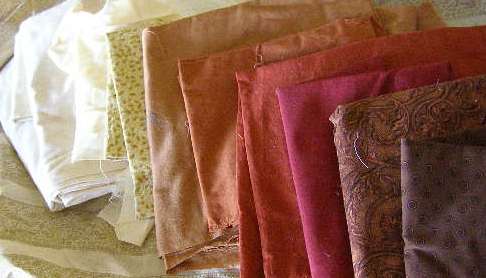
Laying out selected fabrics

Photo 3: Laying out selected fabrics

Select Design Fabrics

Choose  fabrics in colors that speak to you.  Much like deciding the colors and order in the Destashification Table Runner, this step gives you an opportunity to enjoy the colors and tactile sense of the fabrics.

As this is a modern design, the selected fabrics were solids.  My daughter chose a medium blue for the main color.  The copper brown fabric to be used for the curtains was included.

Then, if your memory is anything like mine – take a photo.  It will help when trying to remember what color is next!

First Seam

1.  Iron the foundation fabric.

2.  Really, it has to be ironed.  Skipping the ironing will not work.  Go back to Step 1.
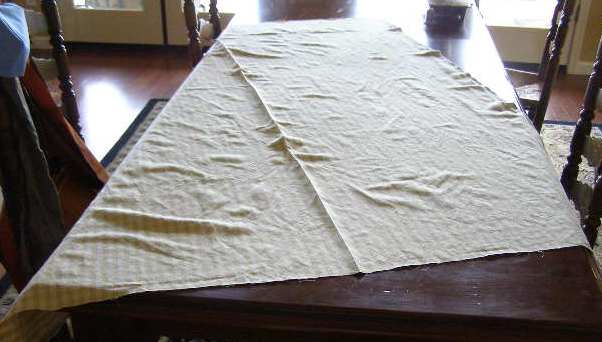
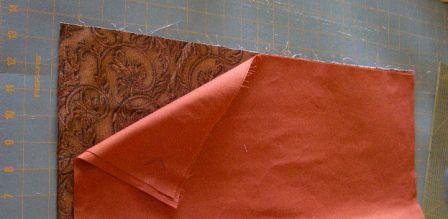
Foundation Fabric:  approx. 55" by 65".  Ironed.

Photo 4: Foundation Fabric: approx. 55" by 65". Ironed.

3.  Lay the ironed foundation fabric flat on the floor if your knees allow it – or on a large table if the knees determine it to be a better option.

4.  Iron the fabric selected for the first design stripe. This stripe should be rather wide (a minimum of 6″ ).
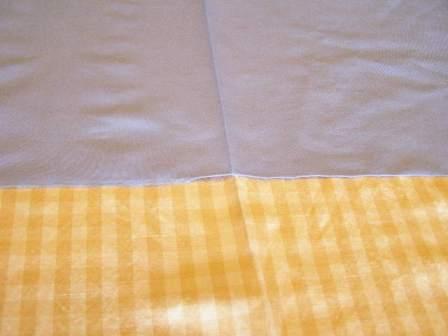
Blue Fabric (first stripe) placed on top of Foundation Fabric.

Photo 5: Blue Fabric (first stripe) placed on top of Foundation Fabric.


5. Place the first design stripe on top of the foundation fabric.   Use one of the checks in the Foundation Fabric to keep the stripe straight.  It is difficult to see from Photo 5, but the Foundation Fabric extends completely under the blue fabric.

6.  Pin the first stripe fabric to the Foundation Fabric – every 3″ or so.

First Stripe Fabric pinned to Foundation Fabric

Photo 6: First Stripe Fabric pinned to Foundation Fabric

This requires A LOT of pins, but is necessary to prevent any shifting of the fabrics – which then might cause puckers – which can result in small creases – which then leads to having to rip out seams.  So, lots of pins.

Second stripe fabric placed on top of first stripe and Foundation Fabric.

Photo 7: Second stripe fabric placed on top of first stripe and Foundation Fabric.

7.  Place fabric for second stripe (olive green) on top of first fabric.  This creates a “sandwich” with the second stripe (olive) on top, the foundation on the bottom and the first stripe (blue) in the middle.  Align edges and pin as shown in Photos 7 and 8.

Stripe 2 on top of First Stripe - all pinned to Foundation Fabric

Photo 8: Stripe 2 on top of First Stripe - all pinned to Foundation Fabric

Photo 9 indicates the approximate location of the seam, but it is not sewn on the design fabric side.  It is sewn on the  Foundation Fabric side. 
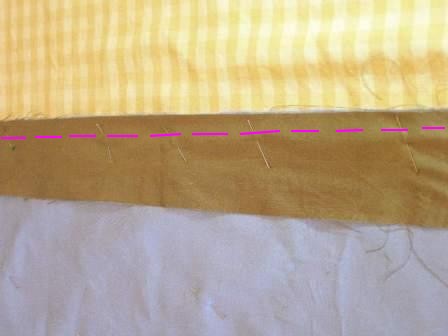
Photo 9: Approximate Location of Stitching Line

Photo 9: Approximate Location of Stitching Line


8.  Turn entire piece over.  Select a Foundation Fabric check line that is approximately 1/2″ to 1″ from the edge of Stripes 1 and 2.  Sew along that check line.

Blue Line - edge of stripe.  Pink Dashed Line - sewing line.

Photo 10: Blue Line - edge of design stripe. Pink Dashed Line - sewing line.

Photo 10 illustrates how the location of that seam is chosen.

The location of the edge of the design fabric stripes (which are now on the underside) are represented by the blue line.

The dashed pink line represents the location of the seam.  The check line of the foundation fabric provides a nice straight line to follow for that seam.
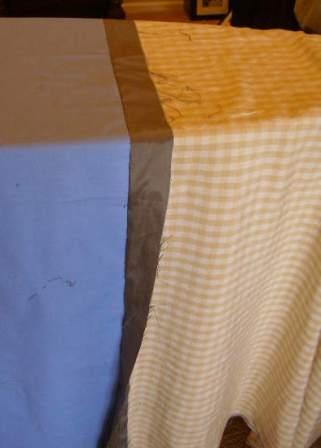
Flip the second stripe over and iron.

Photo 11: Flip the second stripe over and iron.

9.  Turn the piece back over and remove pins.  Flip the second stripe and iron.

The Rest of the Seams

Foundation piecing is also called “sew and flip”.
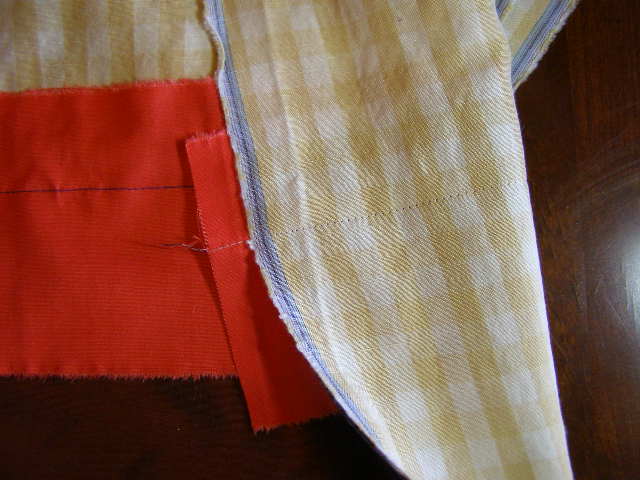
Seam from both design and Foundation Fabric (stitching) sides

Photo 12: Seam from both design and Foundation Fabric (stitching) sides

10.  Each stripe is pinned in place, sewn along a check line in the Foundation Fabric, and then flipped and ironed!

Sewing along a check line in the Foundation Fabric produces a very straight seam!

Photo 12 shows the seam from the sewing/Foundation side and from the design fabric side.

Just keep pinning, sewing and flipping design fabric stripes until the entire Foundation Fabric is covered!


A Few Helpful Hints:

  • Vary the widths of the designs stripes, especially adjacent stripes.
  • Separate similar colors with at least one dissimilar or contrasting color.
  • First and last stripe should be at least 6″ wide.
  • If the stripe fabric is not long enough, simply sew two pieces together, but try not to have all the seams occur on the same side of the quilt top.
  • Rolling end of quilt for ease of sewing.

    Photo 13: Rolling end of quilt for ease of sewing.

    Always sew from the same edge (right to left or left to right).  Changing directions may cause puckers.

  • Rolling the quilt as shown in Photo 13 will make it easier to feed through the sewing machine.
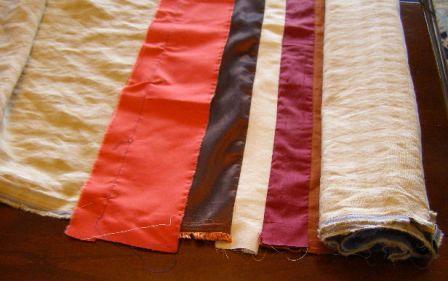
Four stripes done - Look at those straight seams!

Four stripes done - Look at those straight seams!

Look at those straight lines!
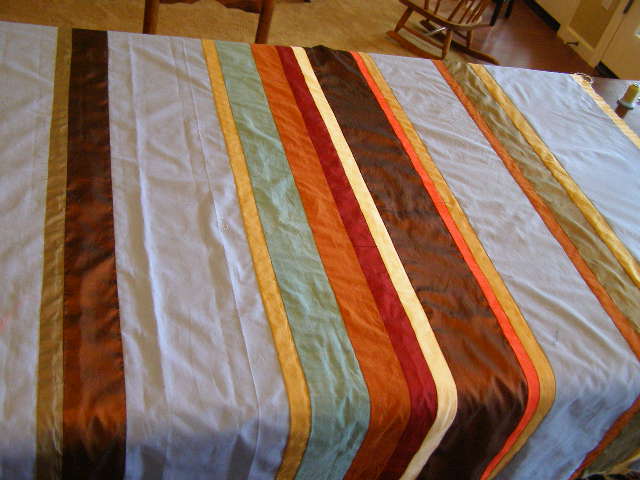
Modern No Measure Quilt Top ready for Long Arm Quilter!

Modern No Measure Quilt Top ready for Long Arm Quilter!

So simple!  So straight!

Your Foundation Fabric does all the work required to keep those lines straight!

No measurements!  No 1/4″ seams!

Just pin, sew, flip, and repeat!  The entire quilt top can be completed in a morning!

Ready for Long Arm Quilter magic!
Posted in Beginner Sewing Projects, Home Decor, Quilting, Sewing, Sewing for a Teenager, Tutorial | 3 Comments

Monkey Wrench

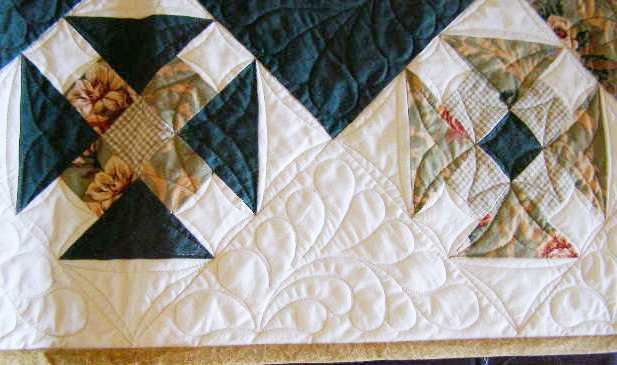
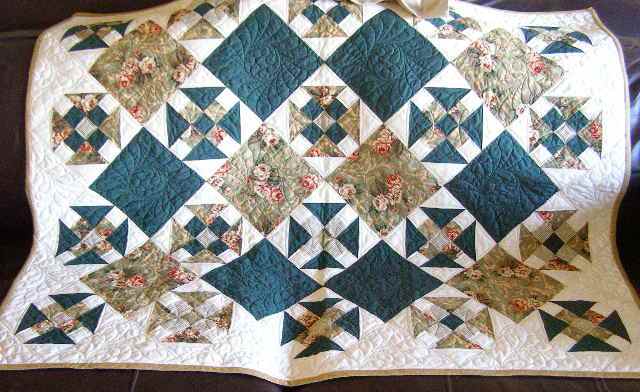
Monkey Wrench Quilt

Monkey Wrench Quilt

The Long-Arm Quilter Extraordinaire returned the Monkey Wrench Quilt a few months ago, but I waited to post it until today as it was a gift for my sister.

Dark green square beautifully quilted

Dark green square beautifully quilted

With a large fabric stash, there will be fabrics whose colors and patterns harken from a past decade.

The dark green fabric hails from the 1980’s. It was commonly paired with pink and maroon then.  As beautiful a color as it was – and is –  it and the one time ubiquitous “Colonial Blue” are fairly difficult colors to find now.

The dark green color really emphasizes the beautiful feathered quilting.

Cabbage Rose Fabric

Cabbage Rose Fabric

To keep the green theme, but balance the somewhat masculine dark green, an olive green cabbage rose print was incorporated.

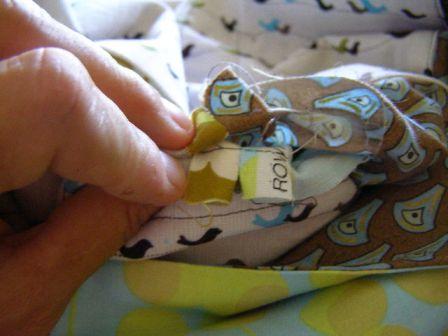
The Monkey Wrench Blocks were placed on point – which (I realized too late) caused all edges of the quilt to be on the bias.  After careful (and seemingly endless) measurements, sheer ribbon was used to anchor the edges and prevent stretching and skewing.


Monkey Wrench Squares and feathered quilted muslin - on the bias!

Monkey Wrench Squares and feathered quilted muslin - on the bias!
I have always loved the Monkey Wrench Pattern.  Simple geometric shapes – with large offset blocks to show off beautiful quilting!

A free rotary cut Monkey Wrench Block pattern and instructions can be found here.

Feathered Quilting on quilt back.

Feathered Quilting on quilt back.

Sometimes the quilting is just as beautiful on the quilt back.

Posted in Beginner Sewing Projects, Home Decor, Quilting, Sewing | 1 Comment

Destashification Table Runner – Part 3

The piecing is complete.  Part 1 and Part 2.

1.  Piecing completed.  Ready for quilting.  Trim foundation fabric to 1" extra.

1. Piecing completed. Ready for quilting. Trim foundation fabric to 1" extra.

The colors flow beautifully.

Trim the excess foundation fabric(s) to 1″ larger than top.

Step 10:  Layers:

Now its time to quilt!  First step.  Build a sandwich.

The bottom layer is the backing fabric – ironed nicely and laid down right side DOWN.  Some quilters use tape to keep the backing flat and tight.

Next layer is the “filling”. I like to use either flannel or linen. As my projects have a Destashification Goal, for this project I used a green linen I had several yards of in The Stash – also ironed nicely.

The top layer is the pieced runner top.

Pin the center square of the top through all layers.

2.  "Stitch-in-the-Ditch" follow the arrows.

2. "Stitch-in-the-Ditch" follow the arrows.

Using your hands, smooth the top, moving from the center square towards the ends, pinning as you go.  Safety pins are a wonderful option here.  Saves the hands when sewing!

Pins should be placed in every other square in the design and then in every other strip.  Pins should also be placed approx. every 6 inches in both the narrow and wide borders.

Yes, that is a lot of pins.  But the end result is worth it!

Step 11:  The Quilting

There are numerous options for quilting. Hand quilting. Long arm quilting.  Choose one that works for you.

Photo 2 illustrates one option for quilting.  Continuing the quilting pattern shown by the arrows will quilt half the pieced design without having to stop and start in another location.

Then quilt the seam between the inner and outer borders – starting at the center square and sewing towards the end points.

Repeat the quilting on the other side of the top.

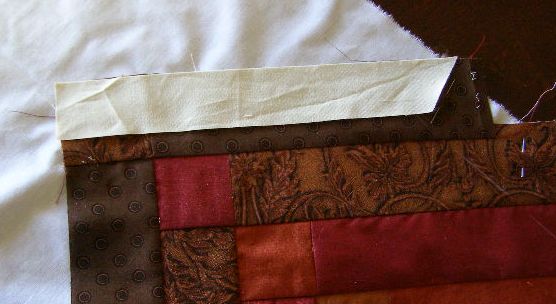
I then finish the sandwich edges with a serger (shown in Photo 2 – I forgot to take pictures before I serged).  However, a serger is not necessary.  A straight seam sewn 1/4″ from the edge of the wide border is fine. Trim edges even with edge of wide border with a rotary cutter.

Final Step:  Binding

My Stash also contains bias binding, seam tape, rick rack and every thing Wrights.  I found two packages of dark brown wide double fold bias binding – perfect color!

Sewing the binding on to the straight sections is rather “straightforward”, but the corners can seem challenging.

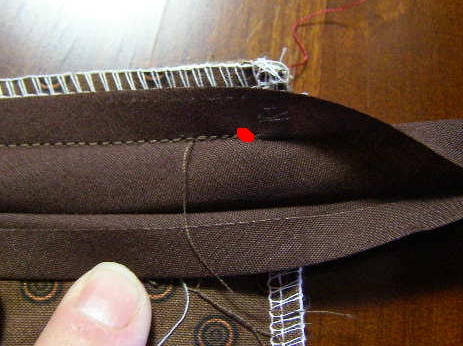
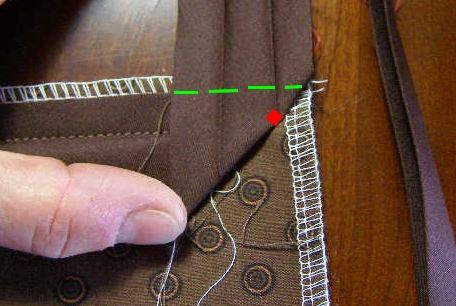
4. End seam at red dot.

3. End seam at red dot.

For the end points (90 degree angles) sew along stopping 3/8″ from the edge of the corner.

4.  Fold bias binding straight up to form a 45 degree angle.  Then fold down along green dotted line.

4. Fold bias binding straight up to form a 45 degree angle. Then fold down along green dotted line.

Fold the bias binding upwards to form a 45 degree angle as shown in  Photo 4.

5.  Start sewing a red dot to form a perfecdt 90 degree corner!

5. Start sewing a red dot to form a perfecdt 90 degree corner!

Then fold bias binding down.  Pin.  Start sewing approx. 3/8″ from upper edge of fold.

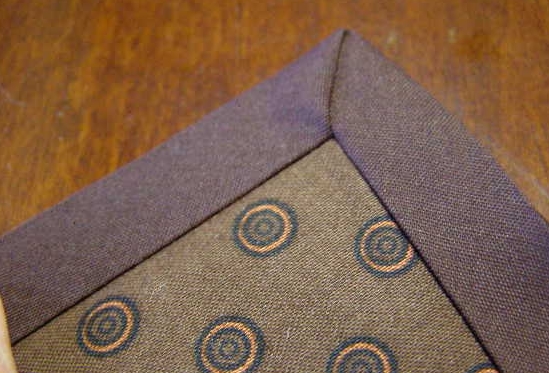
6.  Nice corner!

6. Nice corner!

Finished corner looks sharp and precise!

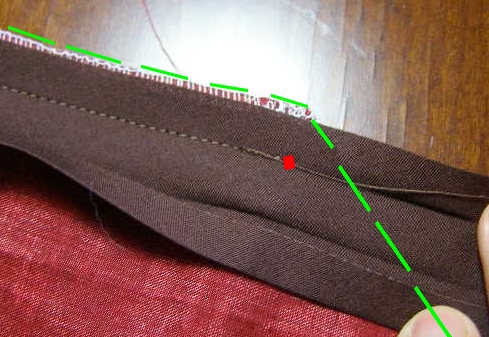
7.  End seam at red dot.

7. End seam at red dot.

The process is much the same for the 45 degree angle.  Sew to 3/8″ from the edge as shown in Photo 7.

88.  Fold bias binding up and then down to form a small pleat.  Pin.  Sew from red dot.

8. Fold bias binding up and then down to form a small pleat. Pin. Sew from red dot.

Fold bias binding up and then down to form a small pleat. Pin.  Start sewing 3/8″ from upper edge.

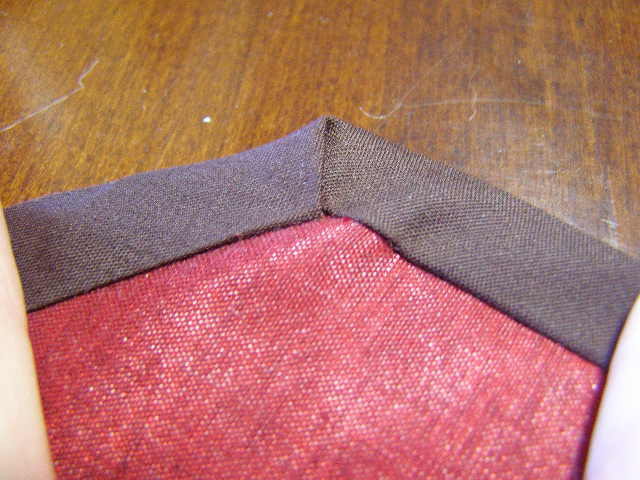
9.  Finished 45 degree angle bound corner!

9. Finished 45 degree angle bound corner!

It might take a bit of sliding the pleat to the back or the front with a pin, but the end result will be very nice.

Fold bias binding to back and stitch down!

Your table runner is complete and will make a wonderful gift!

Completed Destashification Table Runner

Completed Destashification Table Runner - the shimmer of the wide border reflected nicely in this picture. Two of the lighter fabrics also have gold highlights, making the table runner work for the Holidays or Everyday!

Beautiful!

Here is a picture of the table runner in her apartment:

Picture of Table Runner in its intended location

Picture of Table Runner in its intended location

Posted in Destashification Braided Table Runner, Home Decor, Quilting, Sewing, Tutorial | Tagged , | 8 Comments

Destashification Table Runner Tutorial – Part 2

1. One strip down, a few more to go..

1. One strip down, a few more to go..

First strip completed!

Repeat sewing and flipping (and ironing) steps from Part 1 to add each subsequent strip.

2.  Square points should align with foundation fabric crease.

2. Square points should align with foundation fabric crease.

Verify the design is straight by checking after completing each strip that the square point aligns with the crease on the foundation fabric as shown in Photo 2.

2.  "Railroad" Line up the squares/rectangle seams and sew them all at once.

3. "Railroad" Line up the squares/rectangle seams and sew them all at once.

Speed Sewing:  “Railroad” the sewing of the squares to the rectangles as shown in Photo 3. Line up the square/rectangle sets and sew them all at once (Saves time – and thread!)

3.  After first strip, the squares are sewn to the next darker color rectangles.

4. After first strip, the squares are sewn to the next darker color rectangles.

After the first strip, each square is sewn to the next darker color rectangle.

In no time at all, all the strips will be sewn to the foundation fabric…

FOUNDATION FABRIC DISCUSSION:

Why use a foundation fabric?  When sewing fabric on point (at a angle), the fabric is “on the bias”.  Fabric on the bias stretches.  Bias fabrics the length of the table runner tends to stretch oddly and deform! The foundation fabric is “on the straight grain” and will help keep the design straight and true!

Step 5:  Preparing Design for Borders

4.  Lay design portion out and admire your work!

5. Lay design portion out and admire your work!

Lay the design portion flat on a large table or the floor.

Admire your work!

Love the colors and how they seem to blend across the length of the runner!

Using a less than 1/4″ seam allowance, sew across the opened edge of the last strip to secure it to the foundation fabric.

Please note that my foundation fabric is narrower than the suggested 24″ width.  My mistake.  I got carried away with the ripping!

Warning:  Fractions ahead!  Skip down to Math Free Version if you like.  It is really only a 1/4″ or so difference.

Lay a ruler across design as shown in Photos 4 and 6.  Place the upper edge through the points of the squares.  The outer point of the center square will be at some measurement (round off).  On mine, the measurement is 5 5/8″.

6. Align upper edge to square points. Determine distance (5 5/8") to outer point of center square.

6. Align upper edge to square points. Determine distance (5 5/8") to outer point of center square. Add seam allowance (3/8") and draw line (6"). Line is shown in yellow.

Verify that the point on the other side of the square is the same distance.

Add your pressure foot seam allowance (3/8ths” is what I rounded mine to) to that measurement.

The resulting measurement should be in the neighborhood of 6″.  But will vary SLIGHTLY depending on what your pressure foot seam allowance is.

Math Free Version:  If all these fractions are making your head hurt, just use a distance of 6″ from the center points of the squares.  The 1/8″ and 1/16″ measurements are not all that important – and certainly not worth getting a headache over!

6.  Draw a line across the strips.

6. Draw a line across the strips.

Draw a line at that measurement across all the strips.  I have a great fabric marker that fades within 24 hours of use, but since I could not find it, I used a colored pencil.  The line will not show, so most any fine tipped writing utensil will work – but I would recommend against permanent markers.

This is not a seam line mark, it is where the edge of the border fabric will line up – so it will not show.

Measure the length of this line (round up to the next inch) and write it down on a small sheet of paper and pin that paper to your ironing board.  If ten fabrics are used the measurement should be in the neighborhood of 46″ – 50″.  More fabrics would result in a longer measurement.

Step 6:  The Inner Border

7.  Narrow border 1.5" strips

7. Narrow border 1.5" strips

Using a rotary cutter, cuts 1.5″ strips of one of the lighter fabrics.  Four of the strips should be approx. 8″ – 9″ long.  Two other should be 4″ longer than the length written on that sheet of paper pinned to your ironing board.

As seen in Photo 7, Stash fabrics may not be quote long enough for the longer strips.

8.  Piecing border fabric together

8. Piecing border fabric together

No problem:  Piecing the border is simple.

Lay two pieces together at a right angle (a corner of an index card will help ensure the right angle) and sew from corner to corner.

Trim seam allowance and iron open.

If the angle thing is troubling, just sew the pieces together straight across.  I could never discern why piecing required an angled seam – one of those questions that was always answered with “Because it does!”.

7. Sew short border pieces to dark strips as if they were another strip

7. Sew short border pieces to dark strips as if they were another strip

Sew the shorter border pieces to the edges of the last dark strips – as if the border pieces were just another set of strips – just without the squares!

Flip and iron (but you already knew that).

8. Using pressure foot to define seam allowance, align border edge with drawn line and sew through all layers.

8. Using pressure foot to define seam allowance, align border edge with drawn line and sew through all layers.

Align long border piece edge to line drawn on strips and sew through all layers using pressure foot edge to define seam allowance (See Photo 9).

Flip and iron.

There are options at this point.

If the strips “shadow” through the border fabric – and that is not satisfactory – follow these next steps.

If the border fabric is dense enough to prevent shadowing  skip down to Section 7.

Optional: Trim away excess strip fabric.

Optional: Trim away excess strip fabric.

To prevent shadowing, the excess strip fabric will be trimmed away.  Flip right side of border fabric back against the design (the same way it was when you sewed the seam – before you flipped and ironed it). Use the edge of the border fabric as a guide, rotary cut through all layers.

This will trim the foundation fabric as well, so another foundation fabric will have to be added.

No problem.  Sheets are plenty wide.  Rip another 26″ – 30″ wide by 80″ piece of old sheet/tablecloth/fabric.

Crease center lines as done with first foundation fabric.

9. Edges trimmed, design pinned and ready to be sewn to second foundation fabric.

9. Edges trimmed, design pinned and ready to be sewn to second foundation fabric.

Lay foundation fabric flat and place design piece on top – right side up.  Carefully align center square points with creases.  Pin center square.  Smooth outward from center, pinning every 4″ – 6″.  Continue smoothing and pinning until the entire design is pinned to the second foundation fabric.

10.  Sew just outside the border seam- starting from center square point and sewing outward.

10. Sew just outside the border seam- starting from center square point and sewing outward.

Starting from the center square points, sew just outside the border seam through all layers.

Step 7:  Outer Border

Using Rotary Cutter, cut 5″ strips of the fabric chosen for the outer border.  Four of these should be approx. 9″ – 10″ long.  Two others should be 10″ longer than the number written on the little piece of paper pinned to your ironing board.

The longer strips can be pieced the same way the inner borders were.

Also cut two 5″ squares from the darkest fabric.

11. Sew Wide Border Rectangles and Squares as if they were just another strip.

11. Sew Wide Border Rectangles and Squares as if they were just another strip.

Sew the strips and squares as if they were another set of squares and rectangles in the design portion.  Flip and iron.

Align the long edges of the inner and outer borders and sew through all layers.

12.  Outer borders sewn and table runner piecing complete!

12. Outer borders sewn and table runner piecing complete!

Flip and iron.

Lay the table runner flat.

Admire your work.

Love the colors!

The piecing is complete!

Final Steps here…

Posted in Destashification Braided Table Runner, Home Decor, Sewing, Tutorial | Tagged , | 3 Comments

Destashification Table Runner – The Tutorial

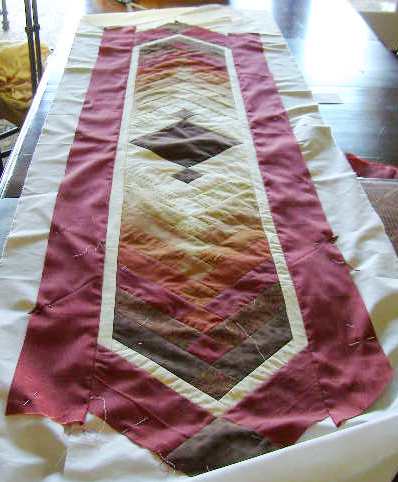
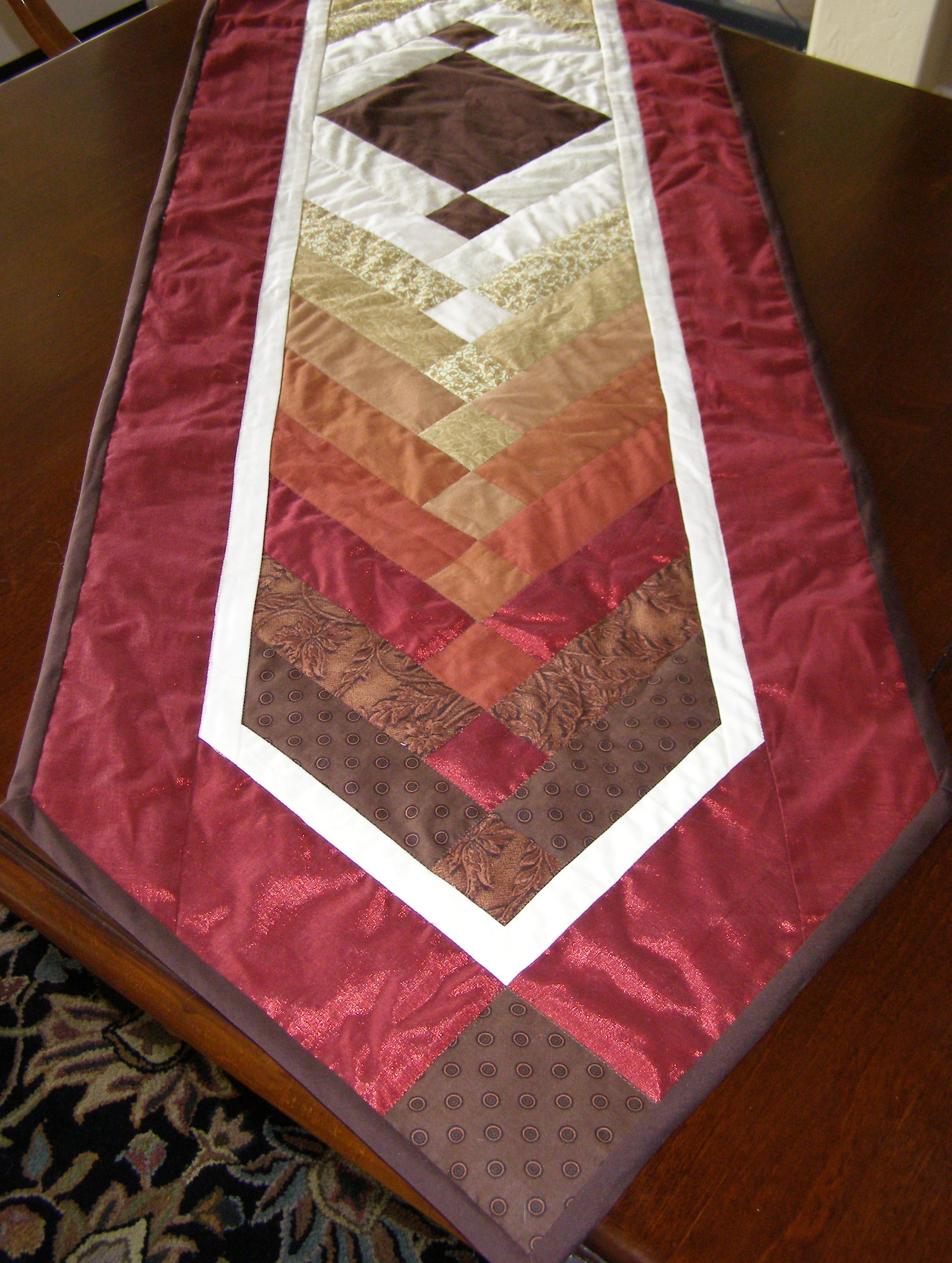
Destashification Table Runner

Destashification Table Runner – Completed

It’s October.

Time for candy corn (best candy ever!) and now that  the costumes are done – time to think about sewing gifts for the holidays.

With rotary cutting, straight seaming, foundation piecing, and endless color possibilities, the Destashification Table Runner can be sized to fit any table!  A great way to turn Stash fabrics into a beautiful gift in an afternoon!

Update 1/6/12:  Less editorialized set of instructions have been added here.

Step 1.  Fabric Selection:  (this is the best part!)  Go through your stash and find 10 – 20 fabrics in your chosen colorway.  Line them up from lightest to darkest.

Fabric Choice #1

Fabric Line Up #1 – The current favorite colors: Rusty Reds, Yellows and Rich Browns!

Like this.

Fabric Line Up #2

Fabric Line Up #2

There will be one or two fabrics that are just “not right”.  Take those out and reform the Line Up.

Like this.

The Line Up still may not be just right.

Collect additional fabrics and try again.

Fabric Choice #3

Fabric Choice #3

Like this.

Fabric Choice #4

Fabric Choice #4

Or this.

...and we have a winner!

…we have a winner! Ten fabrics that just seem to work!

Until – the flow of colors and patterns of the fabrics just fall into place!

Too many beautiful fabrics and unable to select just 10?  No problem:  10 fabric strips = approx. 70″ long runner.  If you find it impossible to limit yourself to 10 fabrics, or need a longer runner, each additional strip will add approx. 4.5″ to the length.

Also needed:

  • Enough of one of the light colored fabrics selected to create a pieced strip 1.5″ wide by approx. 140″ long for the light colored border.
  • Enough of one of the dark colored fabrics to cut a 7.5″ square  and two 5″ squares.
  • Enough of one of the mid-colored fabrics to cut two strips (pieced) 5″ wide by 60″ long and four strips 5″ wide by 10″ long for the wide border.
  • Fabric for the back measuring approx. 80″ long by 24″ wide.  This can be pieced.
  • An old sheet or old tablecloth (tears and stains will not show) or another piece of fabric the same size as the back that will be used for the foundation fabric (solid light color recommended)
Two rectangles and a square

Two rectangles and a square

Step 2:  Cutting the Design Pieces (also fun!)

The design of the table runner is nothing more than a series of rectangular and square pieces.

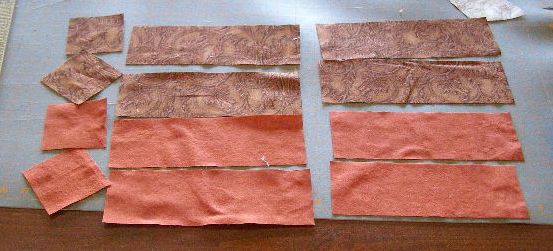
From each fabric of the 10 selected fabrics cut two 2.5″ squares and four 2.5″ * 8″ – 9″ rectangles.

Rotary cutting will make this project faster, more precise, and easier – but only if the blade is sharp!  New Blade! Dull blades leave little uncut portions and frustration and should therefore be relegated to the recycling bin!

Cutting pieces - layer fabrics - aligning fold

Cutting pieces – layer fabrics – aligning fold

Speaking of frustration, the little creases in fabric can cause problems.  To avoid them, iron the fabric prior to cutting. No, really.  Just iron it.  See Discussion on Ironing below.

With fabrics that are  44″  – 45″ wide, one 2.5″ wide strip can easily be cut into the 4 rectangles and 2 squares (with some to spare).

Cut 2.5" strip

Cut 2.5″ strips

Speed Sewing:  It is possible to layer the fabrics and rotary cut more than one fabric at a time!

Squares and Rectangles

Squares and Rectangles

Stash fabrics are typically in irregular pieces.  Each square and rectangle may have to be cut individually.

Squares and Rectangles

Squares and Rectangles

Regardless of original fabric size, you will need two 2.5″ squares and four 2.5″ by 8″ – 9″ rectangles of each of your selected fabrics.

Cut a 7.5″ square of one of the darker fabrics for the center square.

Step 3:  Preparing the Foundation Piece:

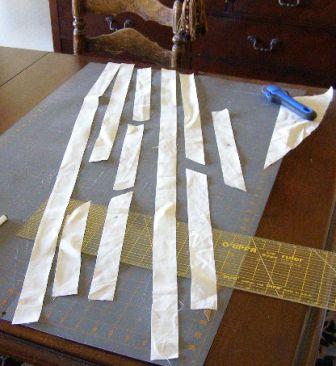
Rip (doesn’t ripping just enpower?) the sheet/table cloth/fabric to be used for the foundation to a large rectangle approximately 24″ by 80″.  Solid, light colored old sheets work great for this purpose.  Ripping “squares” the fabric along the grain line.

Fold the foundation lengthwise and iron the crease.  Then fold it in half width-wise and iron that crease.  These crease lines will serve as guides to keep the design straight.

Lay the foundation fabric flat on a surface large enough to lay it flat – a large table or the floor.

Center square on foundation fabric with first set of strips laid out.

1.  Center square on foundation fabric with first set of strips laid out.

Step 4:  Sewing the Design:

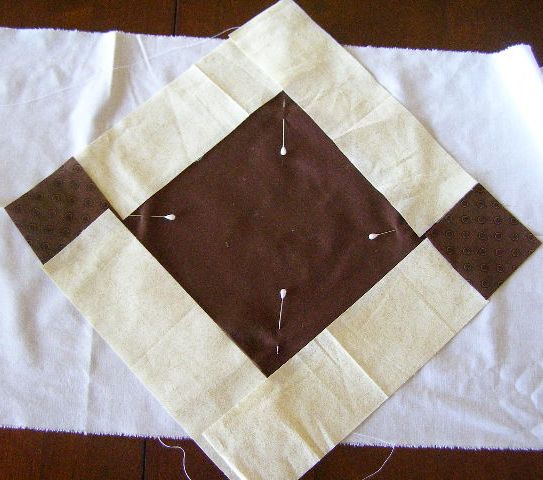
Place the center square on the foundation fabric so that each corner of the square lines up on one of the crease lines.  Pin.

Lay out lightest color rectangles and darkest color squares as shown in Photo 1.  Note that only the points of the dark squares will touch..

SEAM ALLOWANCE DISCUSSION:

Using Pressure Foot as Seam Allowance Guide

2.  Using Pressure Foot as Seam Allowance Guide

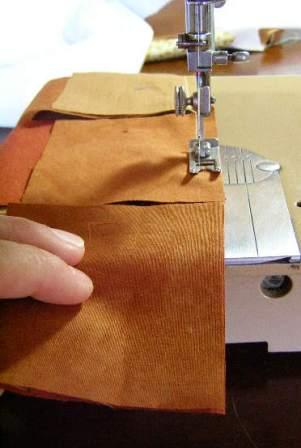
Because of the foundation fabric, it is not possible to use a regular seam allowance guide.  The guide would not be visible from under the fabric.  However, like most of us, a pressure foot has the ability to multi-task, so let it do the work for you!

Align the edge of the pressure foot with the edge of the fabric.  If you have an adjustable position needle, slide it as far to the left as possible.

As shown in the picture, on my machine, this produces a seam allowance of 11/32″ (that is 0.34375″ in decimal form or 13.533465 mm for the metric world!) – but as incalculable as that seems –  it works well!

If your pressure foot produces a seam allowance anywhere between 1/4″ to 1/2″  – it is perfect!  The precision in the project comes from keeping the seam allowance consistent – so make it simple!  Let your pressure foot do all the work!

Back to Sewing!

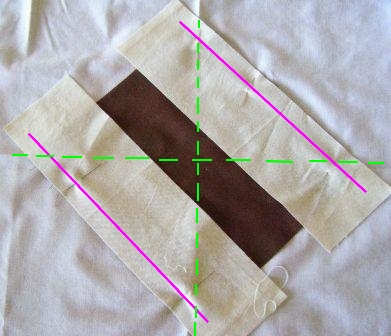
Sew along pink lines.  Green dotted lines are crease lines in foundation fabric.

3.  Sew along pink lines. Green dotted lines are crease lines in foundation fabric.

1.  Wind 2 bobbins.

2.  Go back and do Step #1.

OK, Now back to Sewing:

Place one set of the light colored strips face down on opposite sides of the center square. Using your pressure foot as a seam allowance guide, sew through the strips, the square and the foundation fabric.

Flip light rectangles right side up and iron.

IRONING DISCUSSION:  Foundation Piecing requires ironing every piece open after seaming.  If you would like to incorporate aerobic exercise into the making of your table runner, set up your ironing board across the room/house/street from your sewing machine.  You will get quite a workout! (Speaking of multi-tasking!)

Back to Sewing:

6.  Sew along pink line using pressure foot as seam allowance guide.

4. Sew along pink line using pressure foot as seam allowance guide.

Sew the dark squares to the two remaining light rectangles using the same seam allowance as shown in Photo 4.  Iron seam open.

Place the rect/square set face down on one of the remaining edges of the dark center square.

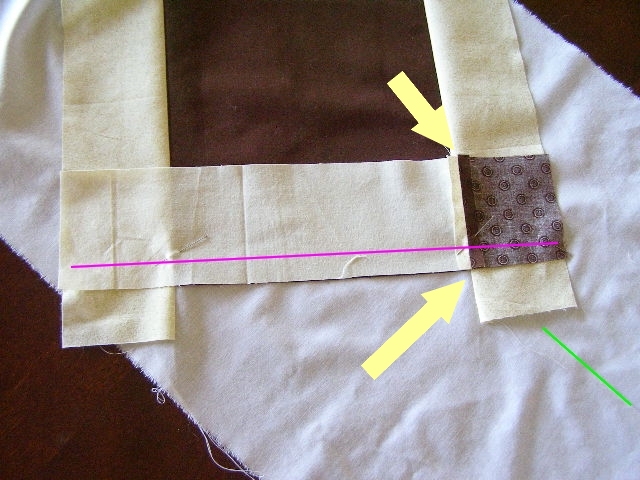
5. Align seams at yellow arrows. Sew along pink line.

5. Align seams at yellow arrows. Sew along pink line.

To keep design straight and square, match seams as shown in Photo 5.  Pin. Sew along pink lines using pressure foot as seam allowance guide.

Repeat for remaining side of center square.

aa Daa!  First Row Done!  Points of Squares should align with foundation creases!

Taa Daa! First Row Done! Points of Squares should align with foundation creases!

Flip strips to right side and iron.

Note that the points of the small dark squares fall very close to the crease lines on the foundation fabric (they are supposed to!)

Congratulations!  The first row is complete!

These simple steps are repeated to create the design.

Part Two starts here….

Posted in Destashification Braided Table Runner, Home Decor, Quilting, Sewing, Tutorial, Uncategorized | Tagged , , , | 8 Comments

The Temporary Teddy Bear Destash

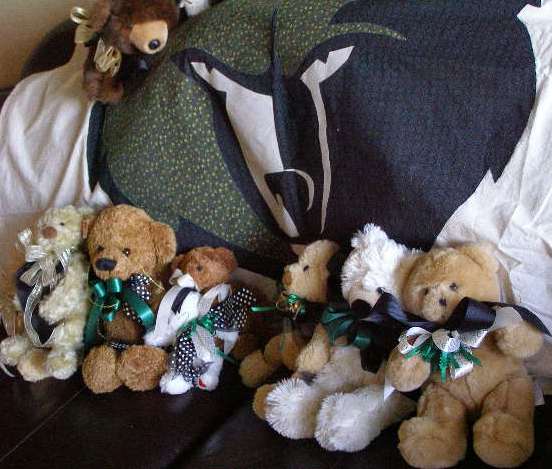
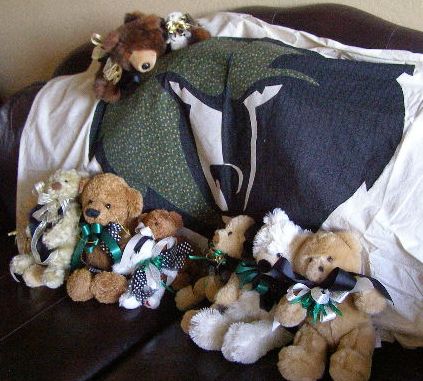
Teddy Bears for Varsity Team

Teddy Bears for Varsity Team

My Stash is comprised of fabric, yarn, ribbons, buttons, patterns – all things Needle-Artist related.  However, my daughter’s Stash is more universal.  Her largest is probably her stuffed animal collection.

Ribbons from my Stash, Teddy Bears from my daughter's.

Ribbons from my Stash, Teddy Bears from my daughter's.

Her Teddy Bear collection rivals my yarn Stash in size – and variety!  Luckily, she attends a high school with a bear for a mascot – and when her Varsity Team has a special occasion – her teddy bears get all dressed up to attend!

The school colors are black, green and gold.  My Stash provided numerous ribbons in appropriate colors to dress up the bears!

But the Bears only get to attend the special occasions for a short while – it is only a temporary Teddy Bear Destash!  When the special nights are over, the bears all come back home to her room and wait for next year’s season!

Teddy Bear for Senior Girls

Teddy Bear for Senior Girls

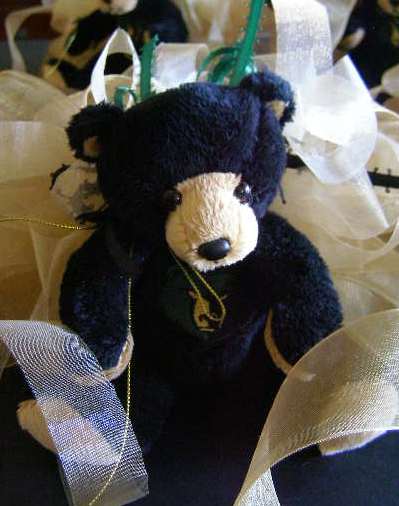
For Senior Night, I sewed the school mascot on Beanie Baby Bears and dressed them up in ribbons – both new and Stash!

Teddy Bear Bows

Teddy Bear Bows


So much ribbon!  So much fun!

Go Bears!

Bears and more Bears!

Bears and more Bears!


Posted in Home Decor, Repurpose, Sewing, Sewing for a Teenager | Leave a comment

More on the 3-Generation New York Beauty Quilt

3 Generation NY Beauty Quilt

3 Generation NY Beauty Quilt

I was blessed to receive fabric from my Grandmother’s Stash.  Many were very small pieces – no larger or wider than an an inch!  These precious pieces were safely stored until I found the perfect project.  Last spring I found the New York Beauty Quilt and its foundation pieced version by Karen K Stone.

Karen K. Stone

Karen K. Stone

The triangles in the arches range from as small as 1/2″ to larger than 3″.  In addition to being an beautiful pattern for incorporating the tiny pieces from my Grandmother, each foundation pieced 12″  square varied from those around it so this pattern will never create the feared “repeat squares boredom”!

3 Generation NY Beauty Quilt

3 Generation NY Beauty Quilt

The long arm quilter worked her magic on the quilt and it has been bound and mounted in the wall space it was designed for (note the samplers reflected in the mirror) .

I took some pictures to send to my mother highlighting some of the fabrics Grandma used to make her dresses.


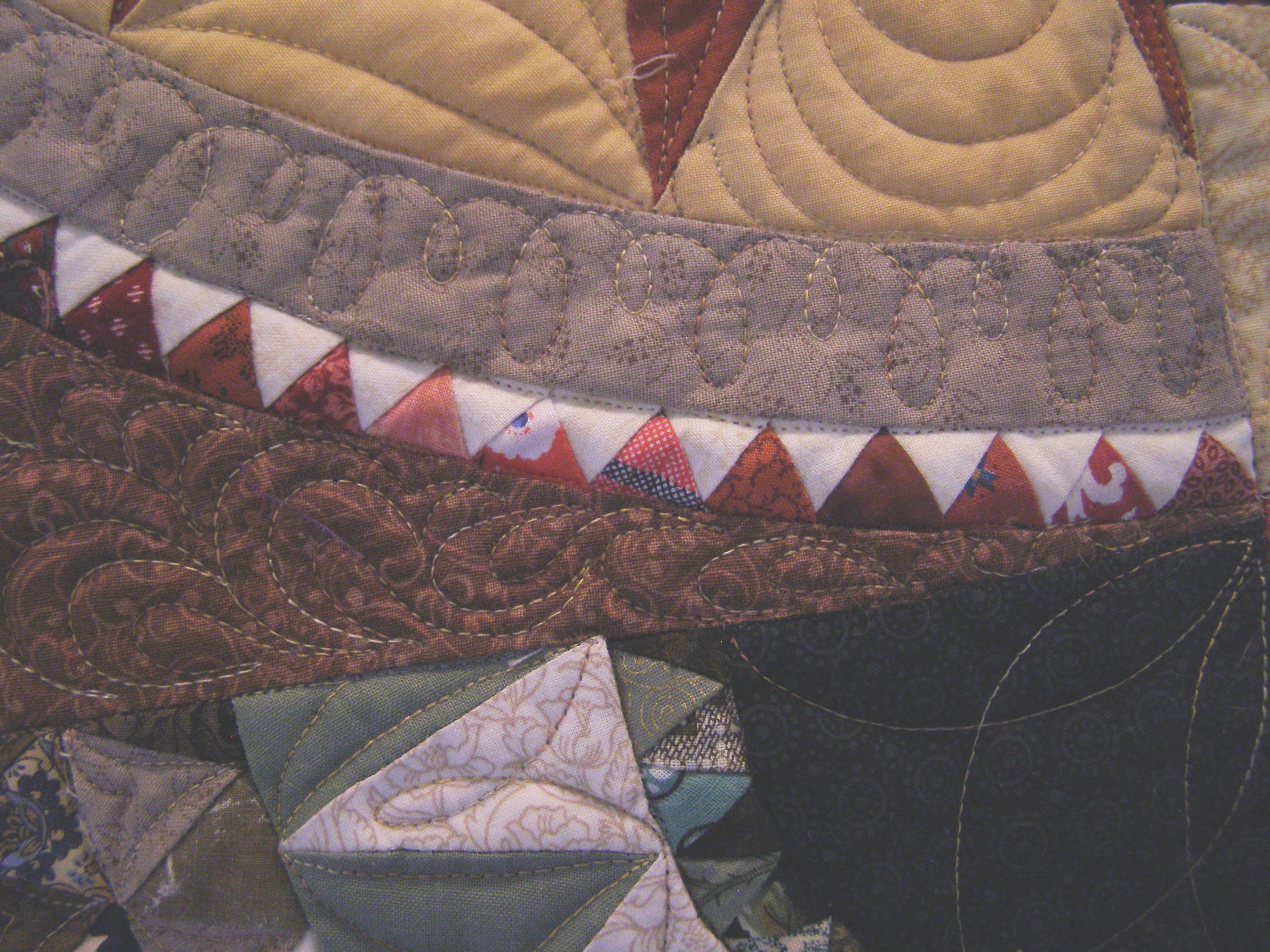
Red triangles are 1/2" inch and include some of Grandma's fabrics

Red triangles are 1/2" inch and include some of Grandma's fabrics

The second from left red triangle is a single remaining scrap from my first major attempt at quilting in the 1980s.

Some of the yellow fabrics in the upper "sun" are from my Grandmother's Stash

The center yellow triangle in the upper "sun" are from my Grandmother's Stash


The center yellow triangle in the square with ivory rays is from my Grandmother’s Stash as are many of the small (approx 1″) blue triangles in lower square (detailed in photo below)


Detail of Blue Triangles - some are fabrics from my Grandmother

Detail of Blue Triangles - some are fabrics from my Grandmother


The second and sixth blue triangles (from the right) are made from the same tiny piece of fabric.  It has little tiny pigs and ducks on it.

Many of the light fabrics in outer arch are from my Grandmother's Stash

Many of the light fabrics in outer arch are from my Grandmother's Stash


I love the quilting swirls the long arm quilter used in the lighter section of this block.

Detail of light colored fabric in outer arch

Detail of light colored fabric in outer arch

This detail view shows some of the fabric prints.  Most of the lighter colored fabrics are from my grandmother.

It still amazes me how fabrics from very different decades work so well side-by-side in this pattern. Some of the fabrics are Jinny Beyer fabrics that I purchased as a set of 5″ squares in the 1980s. Others, like the giraffe spot print, are more modern.

The hallway where the quilt is hung receives no direct sunlight – which in Arizona can be very damaging.  I hope I am able to pass this quilt and its storied fabrics to future generations of needleartists!

More pictures (pre-binding and hanging) in original post here.


Posted in Home Decor, New York Beauty, Quilting, Sewing, Stash Couture | 4 Comments

Human-sized Top from a Size 0 Dress

Anthropologie Blurred Boundaries Dress by Tabitha

Anthropologie Blurred Boundaries Dress by Tabitha

Isn’t this just a beautiful dress?  Love the colors, love the silk gauze fabric, love the cut of the dress.

Don’t love the $170+ price tag and from product reviews, the miniscule waist would create fitting (if not breathing) difficulties.

Tabitha Size 0

Tabitha Tag, Size 0

But, apparently someone was smiling down on me…  I found the dress – in a size 0 (Really?  A size 0? Is that a size or in the mathematical/logical sense – a complete lack of size???) for $10 because someone had broken the zipper.

New Look 6466

New Look 6466

The dress contained lots of fabric because of the waist pleats – so I decided to make New Look 6466 – which had a similar bodice.

I used the existing hem, parts of the existing bodice fronts and the existing ties.  Cut the skirt, the bodice back and new straps, and pieced the bodice fronts.

After several fitting and re-fitting efforts (the pattern reviews are correct – the pattern runs large and big around), the top was complete.

Tabitha Top

Tabitha Top - self portrait!

After seeing these photos, I guess the top is not complete.  Even with a camisole underneath, the skirt of the top is too sheer.

I shall have to see if The Stash holds any voile or light weave to line the skirt.


Posted in Repurpose, Sewing | Tagged | 4 Comments

Patchy Boho Sling Bag Tutorial

Patchy Boho Sling Bag

Patchy Boho Sling Bag

The Patchy Boho Sling Bag is what prompted this series of tutorials.  After completion of the foundation piecing, the bag is constructed in the same manner as the Boho Sling Bag.

The simple construction makes this a great beginner sewing project!

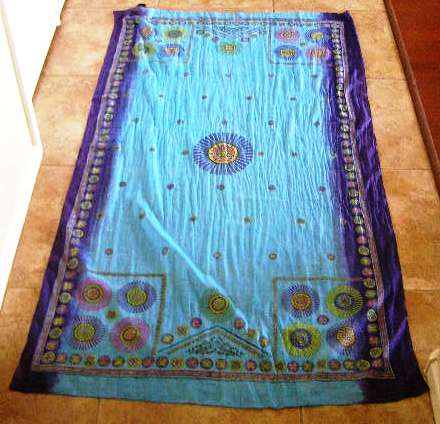
Scarf used as fabric to make bag

Scarf used as fabric to make bag

The bohemian look of the bag would not have been achieved if I had used fabric from The Stash for the bag, so I used a scarf for the main fabric.  Another option would have been to use those block print dorm room bedspreads from “back in the day”.

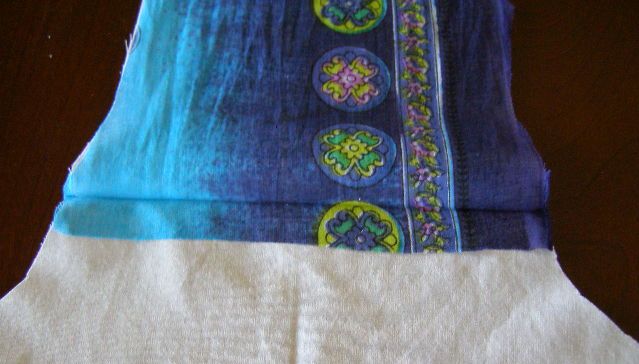
To give the fragile scarf fabric some additional strength, a foundation piecing method was used to create the patchwork.  Foundation piecing is possibly the simplest and most accurate form of piecing.

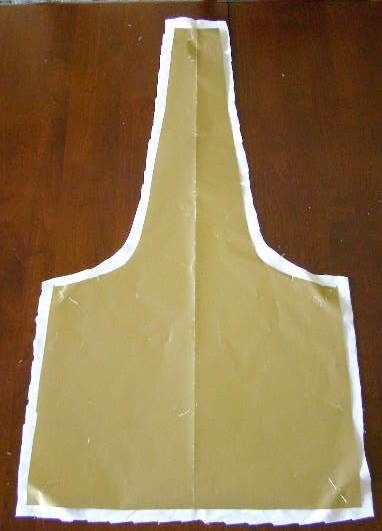
Using the pattern and the instructions for the Boho Sling Bag, cut out two bag pieces from a plain light colored fabric – adding about 1″ all the way around the pattern piece.

1.  Cut out light colored fabric adding 1" all around pattern

1. Cut out light colored fabric adding 1" all around pattern

In place of fabric, pillow cases or sheets may also be used.  I used some no longer needed King-sized pillow cases (as we no longer have King sized pillows!)

Trace around the pattern piece with a pencil or disappearing marker directly onto the light colored fabric.

Make small snips or slits in the fabric to mark the  center top and bottom of the bag. The centers are easy to find – just fold the pattern piece in half and the crease identifies the centerpoints.

Save pattern piece for later.

2. Draw a 4" grid on the fabric

2. Draw a 4" grid on the fabric

Fold the fabric pieces at the snips and press to form a obvious centerline.  Using a yardstick or quilting ruler, draw a line along that centerline.

Draw additional vertical lines 4″ from the centerline and horizontal lines 4″, 8″, 12″ and 16″ from the base line.

This will result in a 4″ grid drawn on the body portion of the two light colored fabric pieces.  These lines will be sewing lines.

Cut 5″ squares of fabrics selected for patchwork (Yes, 4″ grid, 5″ squares.  It is not a typo.)

As there are 16 squares (2 of which are partial squares) on each of the two fabric pieces, a total of 32 squares will be required.

3.  A five inch square template makes accurate cutting easier

3. A five inch square template makes accurate cutting easier

Cutting the squares accurately is important.  A 5″ template will help – but it is not necessary to use one of these commercially available plastic ones – A 5″ square cut from a cereal box cardboard works just as well.

A rotary cutting device is also nice, but not required.  By tracing around the 5″ square template with a fine-tip pen, a very accurate square will result.

3. A five inch square template makes accurate cutting easier

3. A five inch square template makes accurate cutting easier

4. Lay out squares and fabric for handle - and then take photo!

4. Lay out squares and fabric for handle - and then take photo!

Arrange the squares on ONE fabric piece in a pleasing manner – the other fabric piece comes later.

Cut another piece of fabric to cover the portion of the handle that is not covered by squares.  It should extend at least 1″ beyond the 16″ grid line.

Then – take a picture of the layout with your phone or other digital camera or use small pieces of Painters Tape and write the number of each square shown in Photo 6.

Remove the squares and the handle piece from the light colored fabric – which we will now call the “foundation”.

Turn the foundation fabric grid side down on the table and place the handle fabric on top of it – right side up.  Verify that the handle fabric extends 1″ beyond the 16″ line.  Pin.

6.  Seam at 15.75" securing handle piece

5. Seam at 15.75" securing handle piece

Turn over so the gridlines are visible.

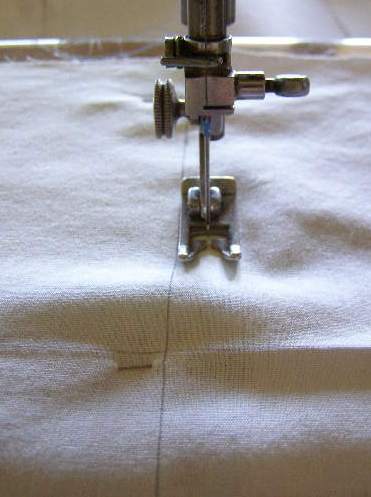
6.  Stitching 1/4" from grid line.

6. Stitching 1/4" from grid line.

Secure the handle fabric to the foundation fabric by stitching just below the 16″ line (at about 15.75″).  Trim the seam to 1/4″.  Also stitch just inside the bag pattern line drawn all around the handle.

7.  Squares numbered in the order in which they are sewn

7. Squares numbered in the order in which they are sewn

Now it’s time for the squares.

Take squares 1 and 2 and place them right sides together.  Sew together using a 1/2″ seam allowance.  Press seam open.

It may be helpful to press creases at each of the vertical grid lines.

8.  Ready to sew squares 1/2 to foundation.

8. Ready to sew squares 1/2 to foundation.

Place the sewn squares 1/2 upside down on the handle fabric.  The stitching line is shown in Photo 7 by the edge of the ruler.  However, the stitching will be done from the grid side of the foundation fabric.  Pin squares in place.  Sew along the 16″ grid line.

Turn to the squares side.  Remove pins. Flip the squares down and press.  They should overlap the grid lines by 1/2″. Pin in place.

8.  Square 4 seam sewn and flipped. Square 3 ready to sew.  Note vertical creases in foundation.

9. Square 4 seam sewn and flipped. Square 3 ready to sew. Note vertical creases in foundation.

Place square 3 and on top of square 1 – RIGHT SIDES together.  Place square 4 on top of square 2 – RIGHT SIDES together.  Align the lower and outer edges. Pin.

Turn to grid side.  Sew vertical seam between square 2 and square 4.  Sew vertical seam between square 1 and square 3.

Turn to squares side.  Remove pins.  Flip squares 3 and 4 and iron.  Pin.

Turn to grid side and sew 1/4″ below the 12″ grid line.

9.  Squares 1 - 4 sewn, flipped, and pressed

10. Squares 1 - 4 sewn, flipped, and pressed

Photo 10 shows Squares 1 – 4 pinned and ready for the stitching that will be 1/4″ below the 12″ grid line – from the squares side.

10. Squares 1 - 4 after 11.75" stitching completed from grid side

11. Squares 1 - 4 after 11.75" stitching completed from grid side

Photo 11 shows the same squares – after the stitching 1/4″ below the 12″ grid line has been completed – from the grid side.  Looking closely the grid lines are visible.

Foundation piecing is also called the “stitch and flip” method.

12.  Squares 5 - 8 sew into a row, ready to flip and sew.

12. Squares 5 - 8 sew into a row, ready to flip and sew.

*Sew squares 5 – 8 into a row, using 1/2″ seam allowances.  Press seams open.

Photo12 shows squares 1 – 4 secured to foundation by 11.75″ seam and squares 5 – 8 sewn into a row.

Place the row of squares 5 – 8 on top of squares 1 – 4 RIGHT SIDES together.  Align seams and edges.  Pin.

Turn to grid side and sew along 12″ grid line.  Turn to squares side. Remove pins, flip fabric and press with iron. Pin.*

13.  Squares 9 - 12 sewn in a row.

13. Squares 9 - 12 sewn in a row, ready to flip and sew.

Repeat instructions between *’s with squares 9 – 12 and finally with squares 13 – 16.

14.  One completed piece.

14. One completed piece.

Photo 14 shows a completed piece – but to sew a bag, two piece are required!

Typically when doing patchwork, placing two similar squares next to each other is avoided.  To avoid that “piecing faus pax”, laying out the second bag piece was delayed until this point.

15. Right side is complete.  Squares on left side are being arranged.

15. Right side is complete. Squares on left side are being arranged.

Fold the completed piece along the centerline.  Fold the remaining light colored bag piece along its centerline.  Arrange squares until satisfied.  Pin to foundation fabric.

Flip both bag sections and align remaining squares.

Complete second bag section in the same manner as first bag section.

Sew around bag sections approximately 1/4″ from edge of squares.

Trim excess foundation fabric.

Complete bag following Boho Sling Bag instructions.

Posted in Accessories, Purses, Quilting, Sewing, Sewing for a Teenager, Tutorial | Tagged | 6 Comments

Tutorial for Boho Sling Bag, Part Two

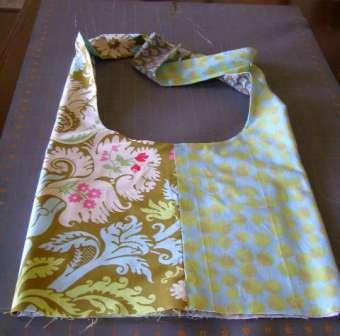
1.  Almost a Boho Sling Bag

1. Almost a Boho Sling Bag

Part One Here

So now the bag looks almost like a bag… just a few more seams…

The base or bottom of the purse is the next section. (Full size pattern can be downloaded here)

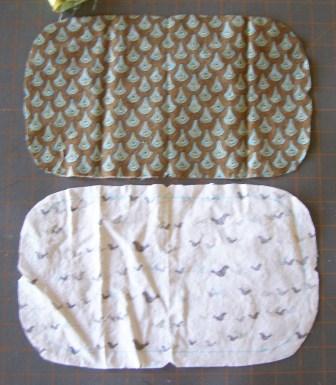
2.  Two bases

2. Two bases

Cut out two fabric bases, one of the lining and the other of the outer fabric as shown in Photo2. (It is fine if they are both the same fabrics!)

To give the purse some structure – so it doesn’t just lie flat – the lining  portion of the purse base will have a three layers.

Cut another base from an old (but clean) washcloth, an old towel, a small piece of batting or felt and another one from another piece of scrap fabric. This fabric will not show, so it does not have to coordinate at all.  It does help if it is a light color – as a stitching line will be drawn on it.

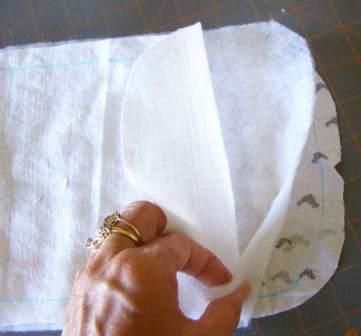
4.  Fabric Sandwich

3. Fabric Sandwich - line drawn around trimmed pattern is visible on upper on lower edge of upper fabric.

Place the lining fabric on a table with the right side down.  Place the filler on top of it and then the scrap fabric to make a  “sandwich” as shown in Photo 3.  I have used a scrap of white fabric and a piece of some left over batting for my sandwich.

Take the paper Base Pattern (NOT the fabrics!!) and cut off the seam allowances to create a template.  Place the template on the top of the sandwich  – on the scrap fabric and draw around it with a pencil or pen (the line will never show).

Pin the layers together.  To secure the “sandwich”, sew the layers together halfway between the line and the edge of the fabric.

4.  Align marks on base to marks and seams on bag.

4. Align marks on base to marks and seams on bag.

The lining base “sandwich” will be sewn to the bag lining – right sides together.

Photo 4 illustrates how to align the lining base “sandwich” to the purse lining.  Important:  The center of the wide sides of the base align with the  side seams.  Align and pin.

The centers of the narrow end of the base align with the centers of the purse pieces.   Align and pin.   It may help to refer to the pattern pieces which have marks indicating what lines up with what.

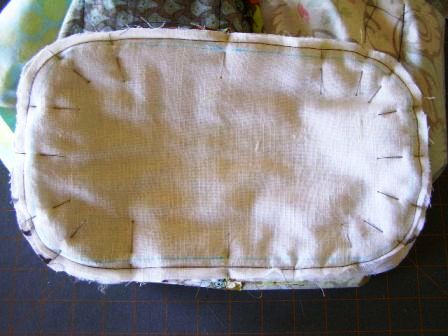
5.  Base pinned and ready to be sewn..or not

5. Base pinned and ready to be sewn..or not

Then pin all the way around.  From the base side, Photo 5 looks ready to be sewn.

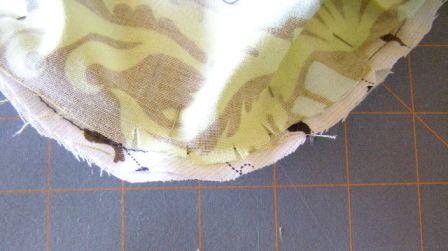
6.  Curves will require clipping (and later some trimming)

6. Curves will require clipping (and later some trimming)

However, from the top side, the fabric does not align with edges of the base.  This can be seen in Photo 6.

That is because curves must be clipped (and later trimmed). Clipping is a series of small (from the edge to no more than 1/4″ deep) cuts made perpendicular to where the seam will be sewn.  These help fit curved pieces together.

7.  Clipped curves align much better

7. Clipped curves align much better

After clipping, the fabric edges align much better as shown in Photo 7.

8.  Sew along the line drawn on the scrap fabric

8. Sew along the line drawn on the scrap fabric

9.  Leave one straight section unsewn.

9. Leave one straight section unsewn.

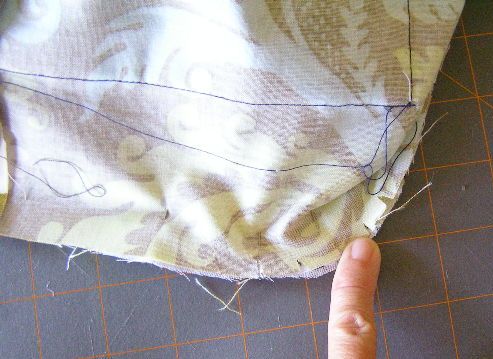
Repin and sew lining base to lining along the line drawn on the scrap fabric – leaving about 4″ along one straight section unsewn.  See Photos 8  and 9.  If you do not leave the short section unsewn as shown in Photo 9, you will not be able to turn your purse right-side-out later.

11.  Sew second reinforcing seam

10. Sew second reinforcing seam

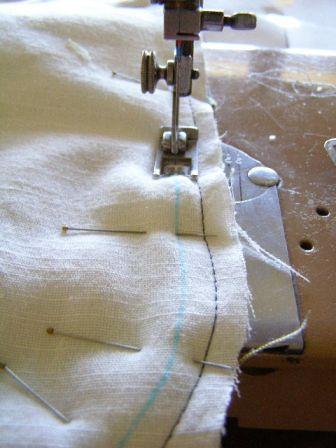
As this seam will support all the weight of the purse (and everything in it!), it is best to reinforce the seam.  Sew a second seam just outside the first seam as shown in Photo 10 – but be sure to leave the same opening unsewn.

11. Trim the seam

11. Trim the seam

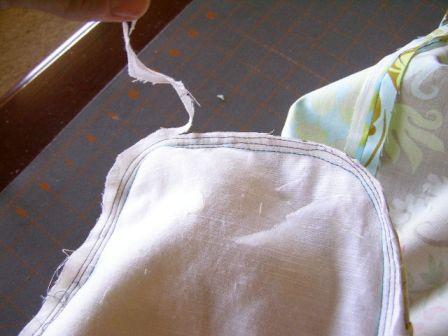
Then trim the sewn sections of the seam. Trimming is to cut away about 1/4″ from the seam that you just sewed as shown in Photo 11.  Curved seams will fit together – clipping and trimming help!

Now that you have mastered sewing a curved base to the purse pieces, use the same steps (except no sandwich), to sew the outer base to the outer bag fabric.  Go ahead and use the base template to draw the stitching line on the wrong side of the purse base fabric – but use a pencil – a Sharpie or gel or ink pen may bleed through and be visible.  This time, there is no need to leave an opening – so sew the seam all the way around!

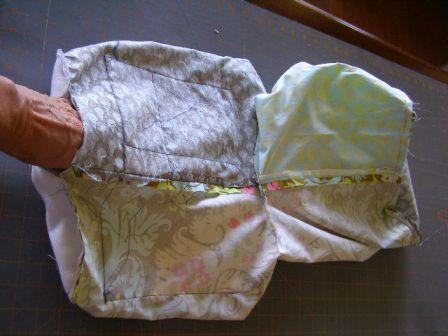
12.  Reach hand through opening in lining base seam and pull bag right side out.

12. Reach hand through opening in lining base seam and pull bag right side out.

When both bases are attached. The project will not resemble a purse.  It will look more like a deflated balloon.

Reach hand through unsewn opening in the lining base seam.  Grasp the outer bag base and turn the bag right side out as shown in Photo 12.

To secure the lining to the bottom of the bag, the lining base seam edge is sewn to the edges of the bag base seam.

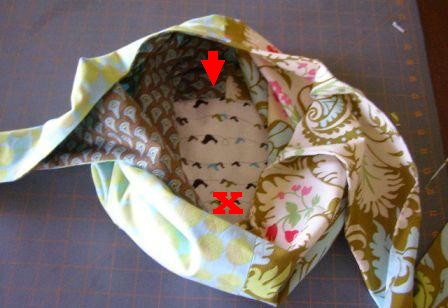
13.  Reach through opening and grasp both base seams on the far side of the bag.

13. Reach through opening and grasp both base seams on the far side of the bag.

Place the bag on its base on a table.  Reach through the opening in the base and grasp the two base seams (the outer and the lining) on the opposite side.

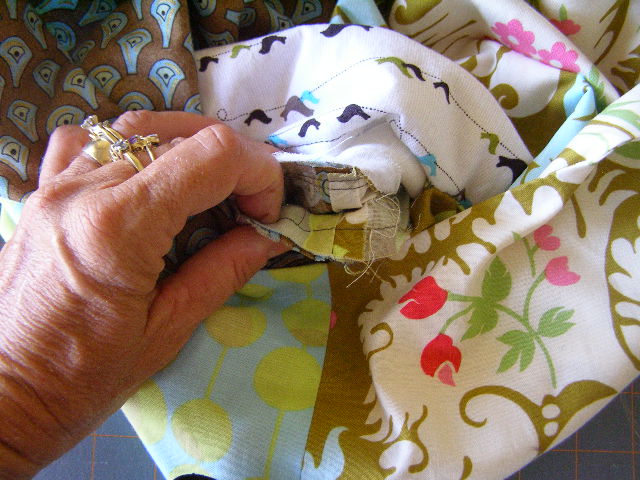
14.  Pull two base seams through base opening and align two sides seams.

14. Pull two base seams through base opening and align two sides seams.

Pull the two seams through the opening as shown in Photo 14.  Only 3″ – 4″ of the seam need be pulled through the opening.  The 3″ – 4″ section should include the purse side seams.  Align the two side seams and pin.

15.  Stitching the "tack"

15. Stitching the "tack"

Sew back and forth in the seam allowance for about 1″. This is just to keep the lining attached to the outer bag.  It is a short seam called a “tack”.  It will not show.

16.  Aligning base seams on opening side for tacking.

16. Aligning base seams on opening side for tacking.

Repeat for the base seams on the opening side.

Handstitch the opening closed… That is the only handstitching in the entire project!

Now on to finishing the handles.

17.  One of the Great Mysteries of Sewing

17. One of the Great Mysteries of Sewing

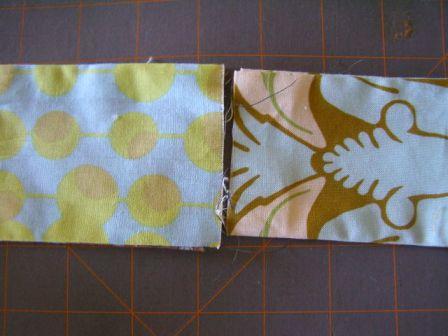
Lay handles flat – making sure not to twist them.  It is one of the Great Mysteries of Sewing that two handles cut from the same pattern, sewn using the same seam allowance – will not be the same size!

But, in this case, that is good!

As visible in Photo 17, the blue green circle handle is wider than the large print handle.

18.  Fold ends of wider handle to the inside and press.

18. Fold ends of wider handle to the inside and press.

Fold the ends of the wider handle to the inside, approximately 1/2″ and press with the iron.

19.  Topstich the handle seam.

19. Topstich the handle seam.

Insert the narrower handle into the opening of the wider handle approximately 1″.  Make sure the handles are not twisted and are straight.  Pin.

20.  Topstitched Handle Seam

20. Topstitched Handle Seam

Topstitch close to the edge of the wider handle and then continue topsitching as shown in Photo 20.  The “rectangle” shape of the stitching gives a nice finished look – and reinforces the seam – because bags can get heavy!

Speaking of a finished look…. Your Bag is now Finished!

So, now you can make another one for a friend!

You did it!

You did it!

Or even better – show your friend how to make one!

Posted in Accessories, Beginner Sewing Projects, Sewing, Tutorial | Tagged | 61 Comments