MMQ – A few more blocks

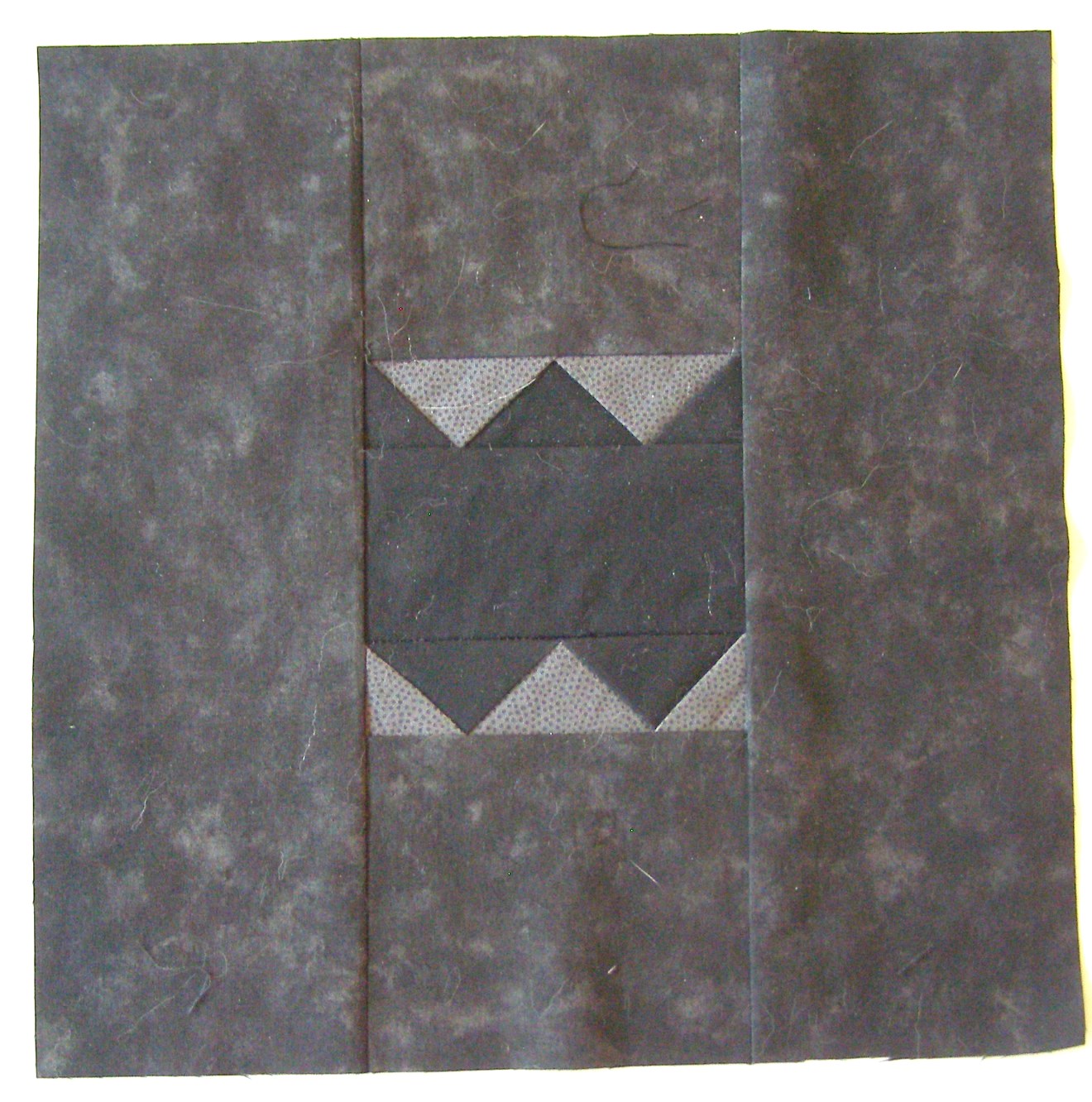
Sixteen blocks are needed for the MMQ top.  These 4 blocks include a simple 4″ square, a modified sailboat block, a shaded 4-patch block and a “W” alphabet block.

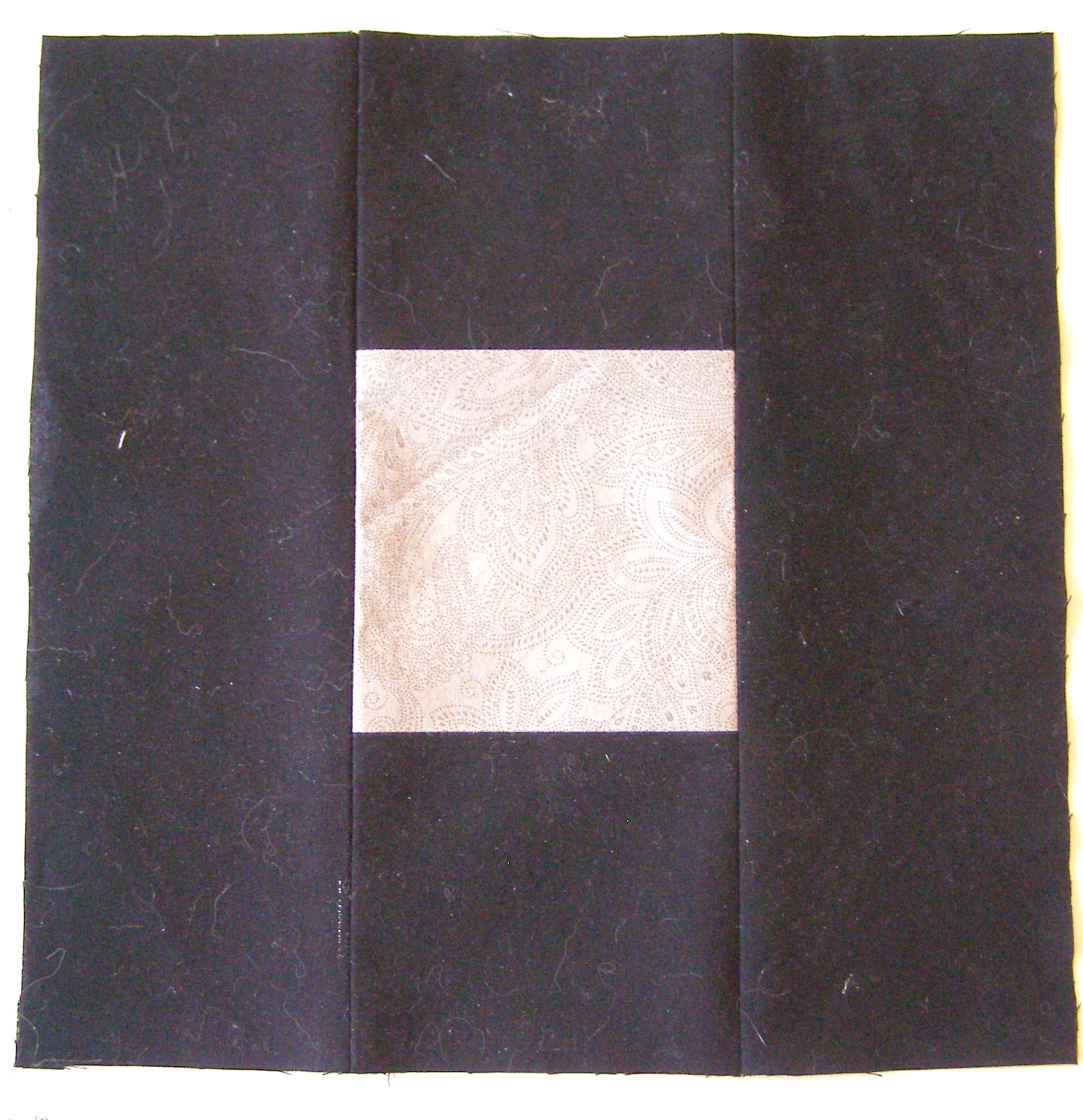
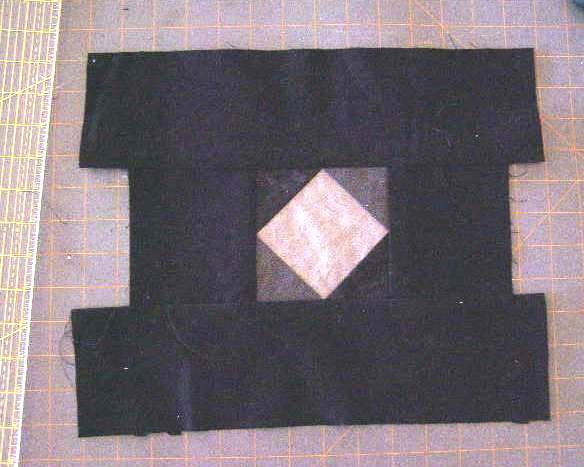
Block with 4" square Center Block "Color" 1

Block with 4″ square Center Block “Color” 1

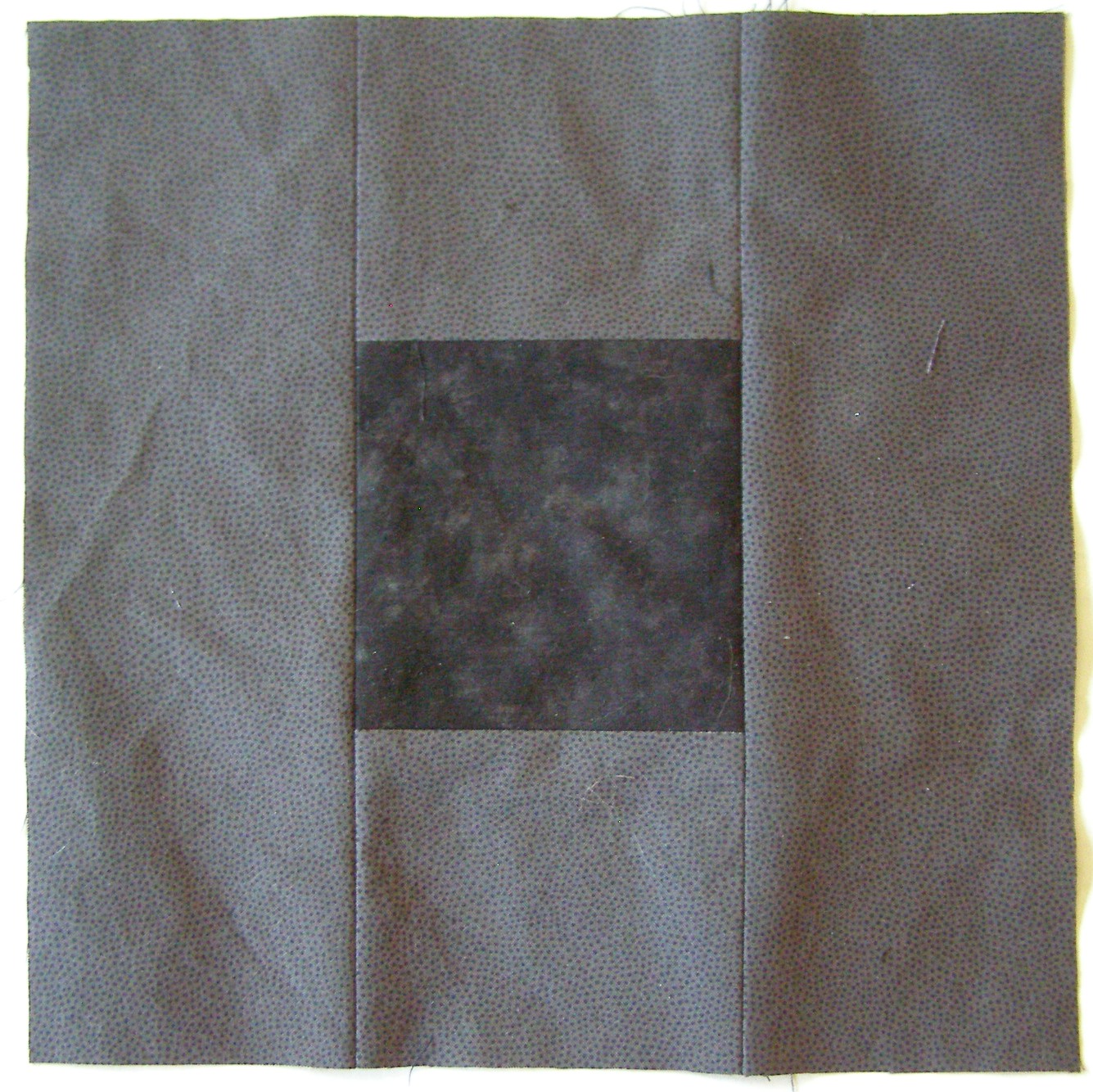
The 4″ square is perhaps the simplest block.  The fabric is machine basted to the graph paper 1/4″ outside the 4″ square lines – and the borders are attached using the same process used for the other blocks.

Block with 4" square Center Block "Color" 2

Block with 4″ square Center Block “Color” 2

Pinning the center square fabric to the graph paper in at least 4 locations will help as the fabric may slide during machine basting.

Interpretation of a Sailboat Block

When complete, this quilt will be gifted to my son.  When he was small, I made him a sailboat quilt (blue gingham and calico), and I wanted to incorporate a sailboat block into this quilt.

Sailboat Block from Quilting About.com

Sailboat Block from Quilting About.com

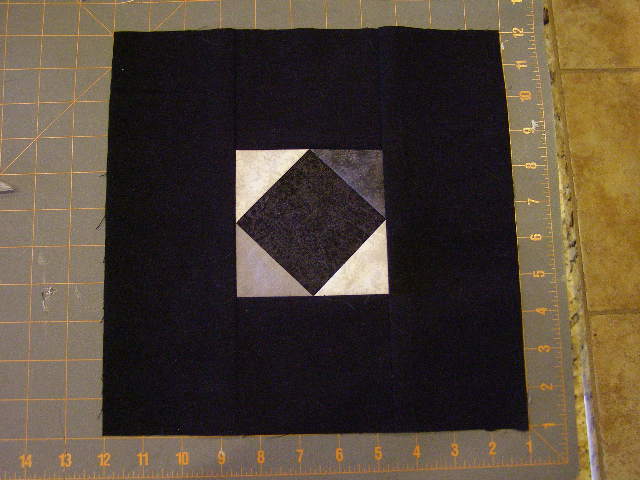
This sailboat block is from Quilting About.com.  A beautiful block, its complex design is not in keeping with the “simplistic look” of the MMQ, so a “modern art” variation was developed.

Interpretation of a Sailboat Block

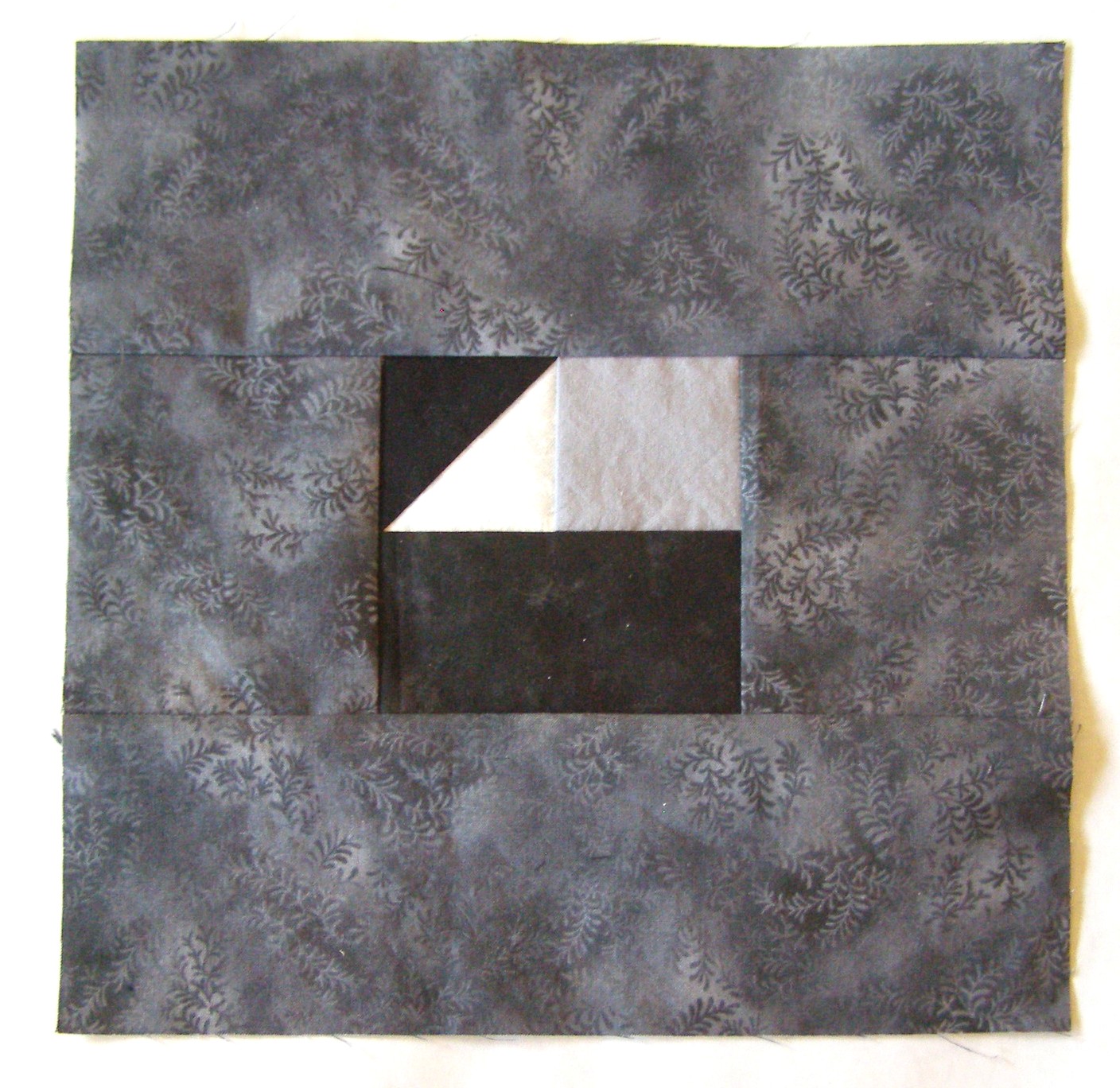
“Modern Art” Interpretation of a Sailboat Block

The variation has all the design elements – a rectangle, a square and triangles – but like most modern art leaves much to “interpretation.”

Paper Piecing Diagram for Boat Block

Paper Piecing Diagram for Boat Block

The Paper Piecing Diagram shows the order of seaming for this design block starts with the triangles, then the square, and finally the rectangle.

Once the design block is complete, borders are added following the process outlined in MMQ Block 1 and Borders.

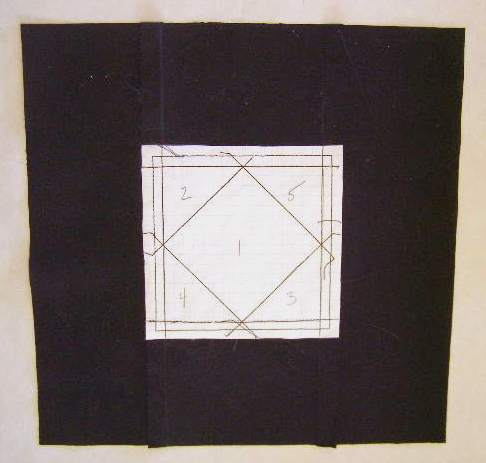
MMQ Shaded Four Square Block

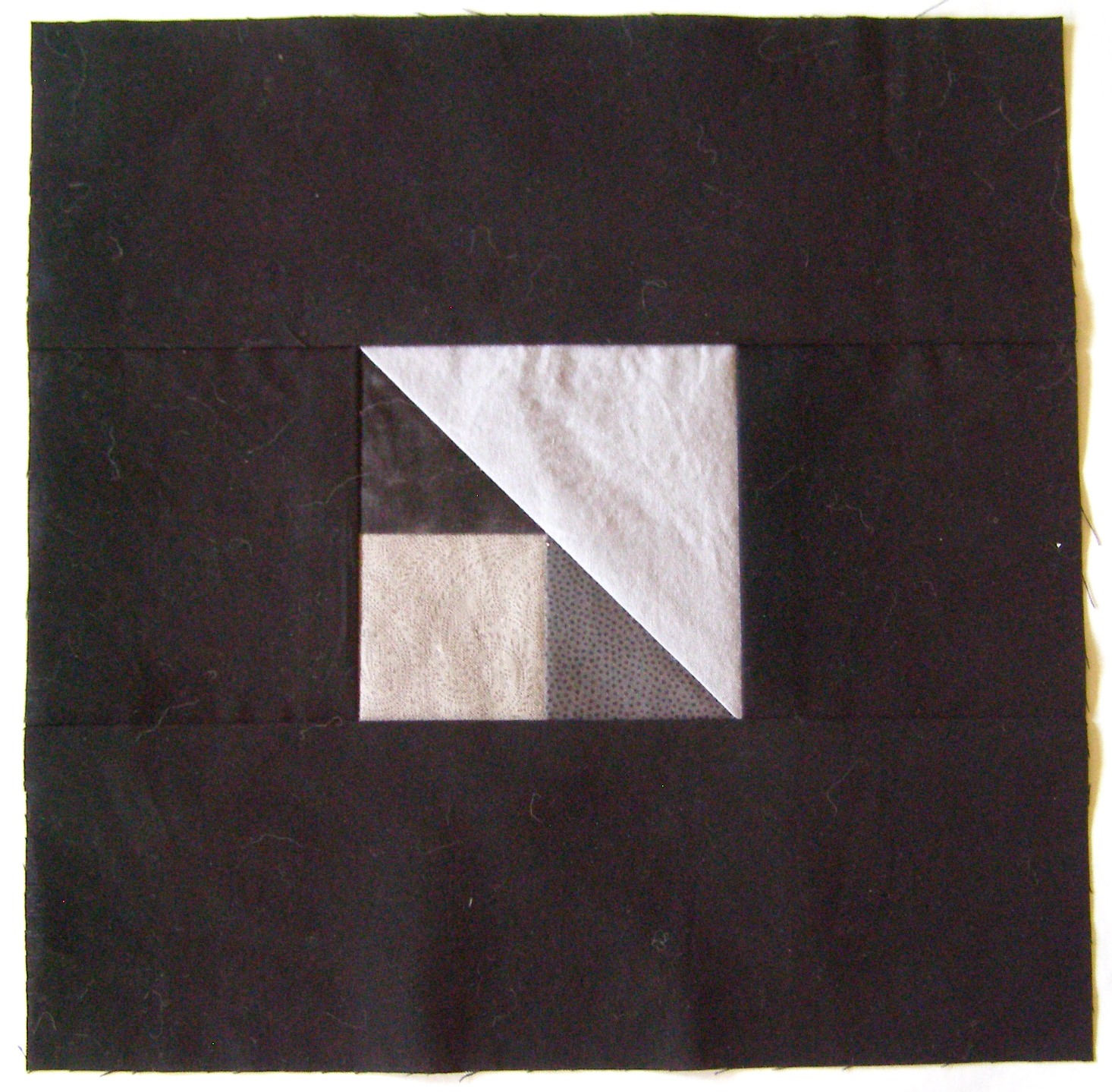
MMQ Shaded Four Square Block

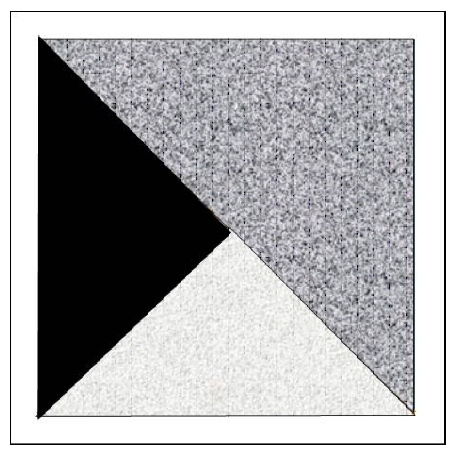
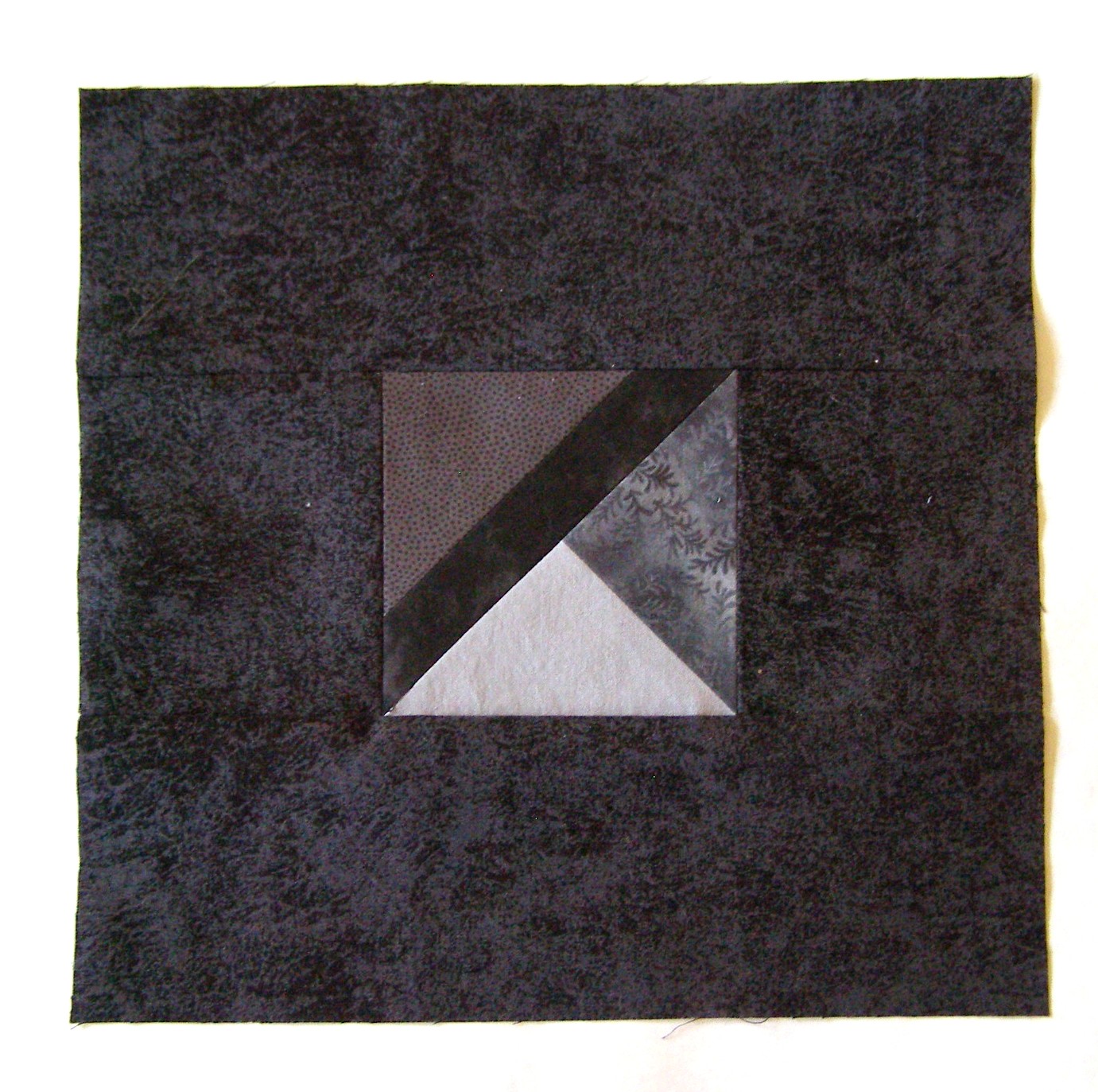
The Shaded Four Square Block is another variation of the Half Square Triangle used for Block 2.

This blogger demonstrates how the same rather simple Shaded Four Square Block can be combined to create very different looking quilts.

Paper Piecing Diagram for Shaded 4 Patch

Paper Piecing Diagram for Shaded 4 Patch

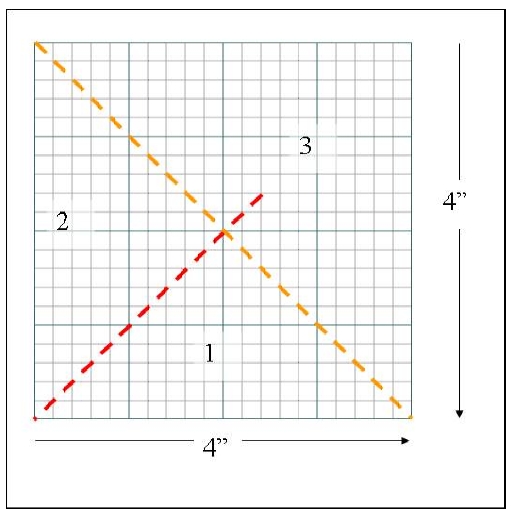
The block is fairly simple to piece using Paper Piecing.  It only has 3 seams!

Careful piecing and pressing is required to ensure the yellow seam crosses the very corner of the Piece 1 square.  Paper Piecing makes that precision easy!

Add borders, square up and another block is complete!

MMQ "W" Block

MMQ “W” Block

Alphabet Block:

Personalizing a handmade quilt makes it extra special.  A “W” Block was created for that purpose (my son’s first name starts with a “W”).

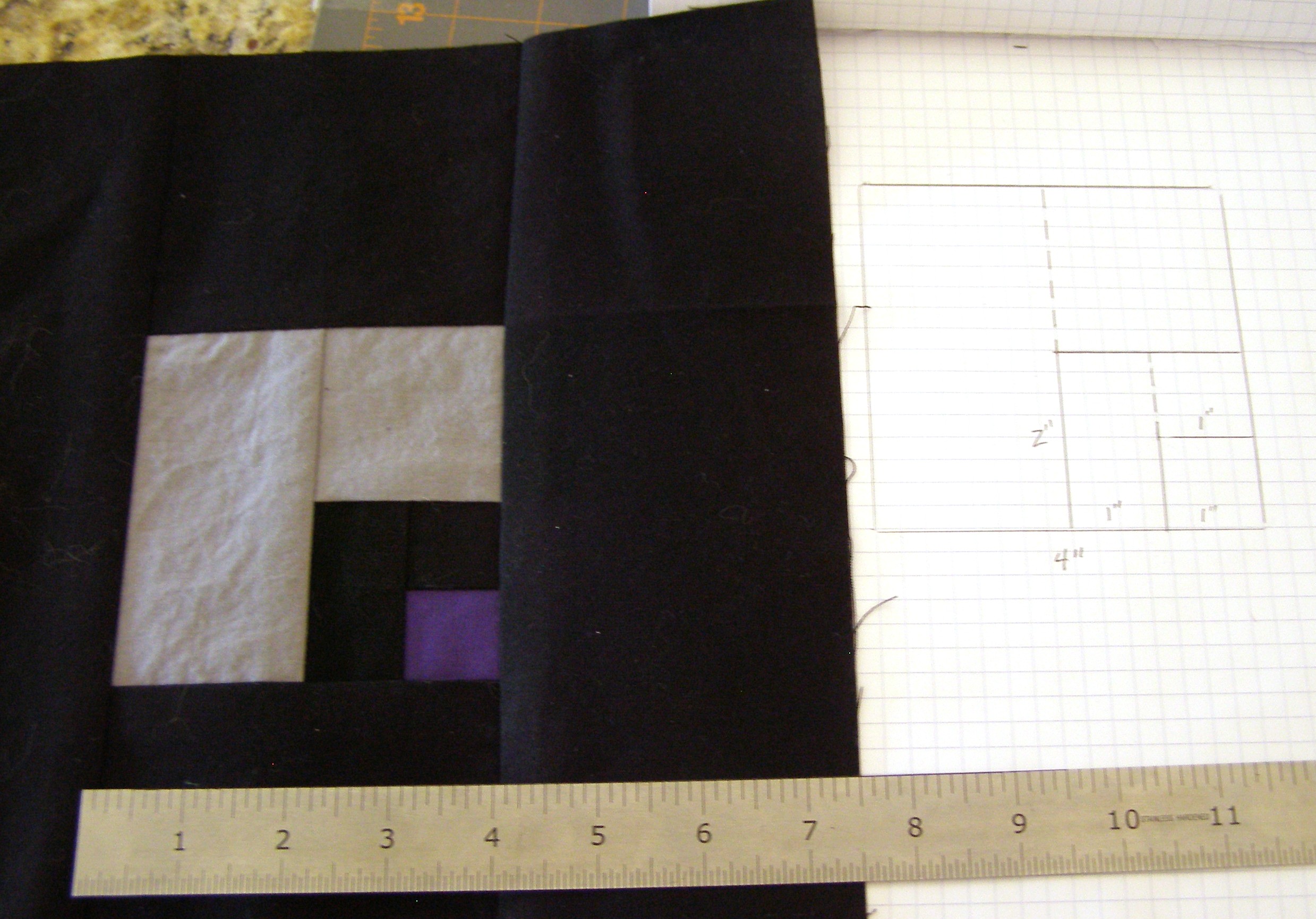
The 4″ center “W” design block was the most complex of all the MMQ blocks.   It required assembling three separate Paper Pieced sections – the upper and lower 1″ triangle sections and the center rectangle.

While this “W” Block might work for all the Willamena’s, Washington’s, and Wyatt’s out there, thankfully, Quilters’ Cache has a complete set of simple 4″ Paper Pieced alphabet blocks.

Just one more Block to Go!

Posted in Beginner Sewing Projects, Home Decor, Modern, Quilting, Sewing, Sewing for a Teenager, Stash Couture, Tutorial | Tagged , , , | Leave a comment

Huck Towel Graph

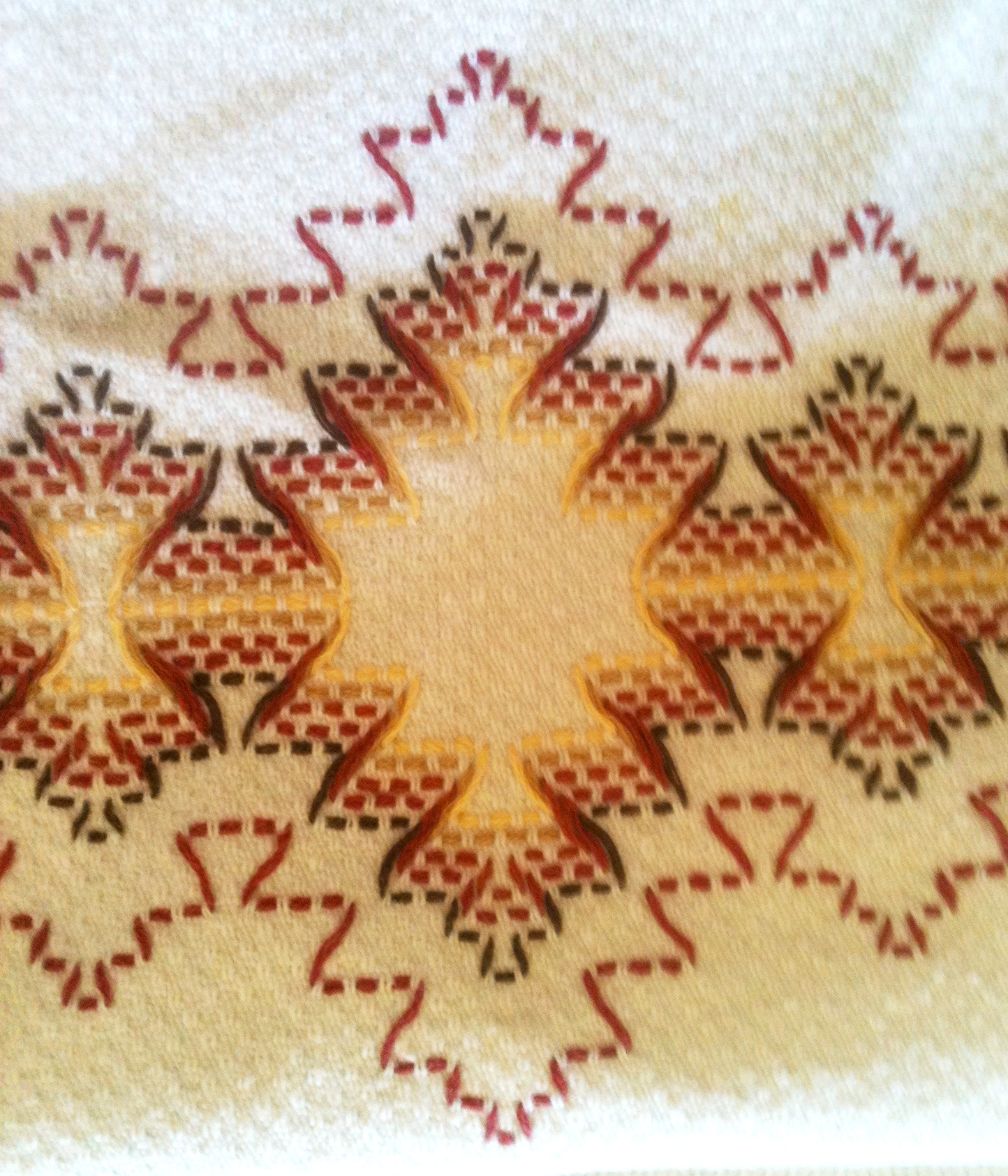
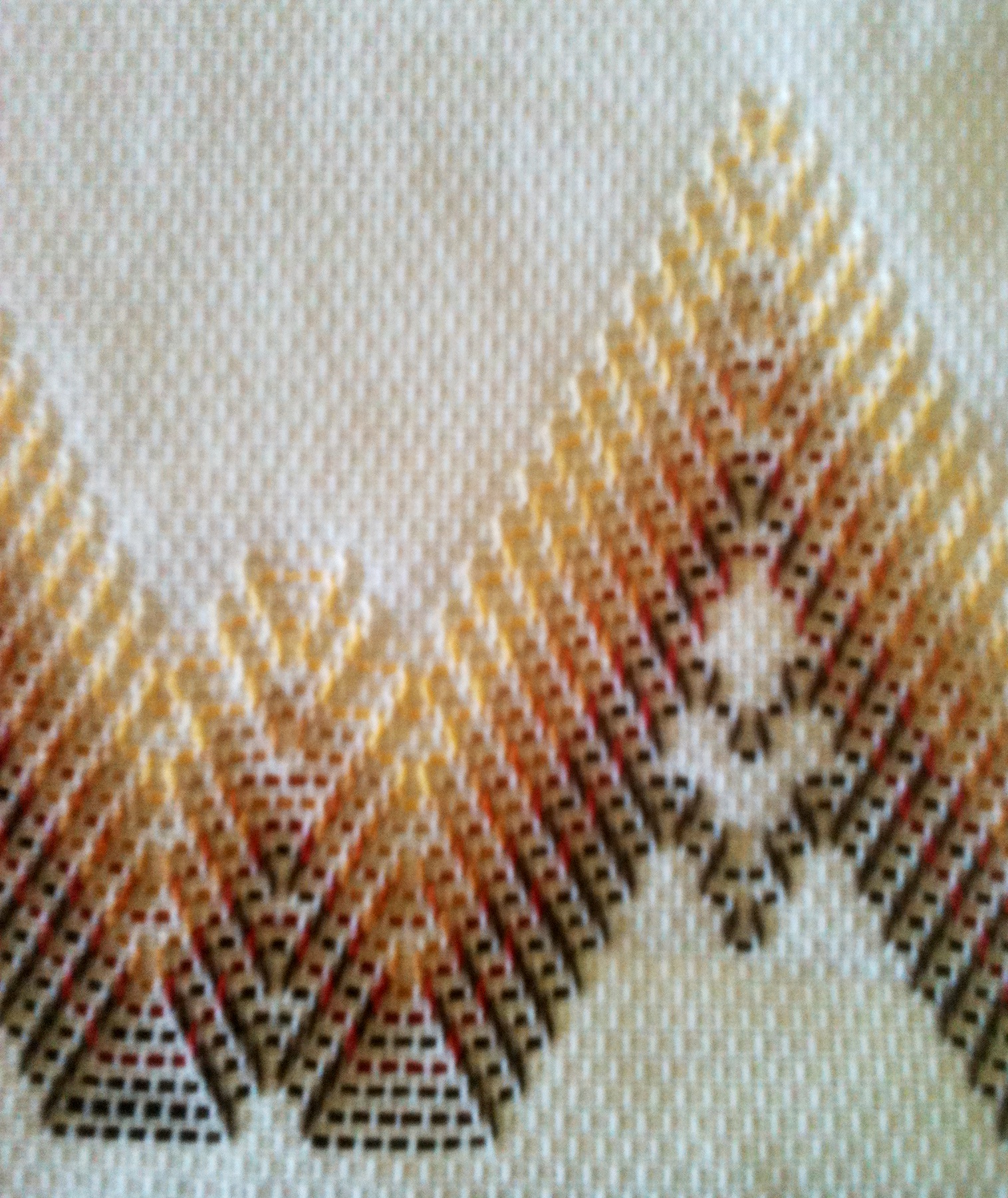
Huck Towel Embroidered Design

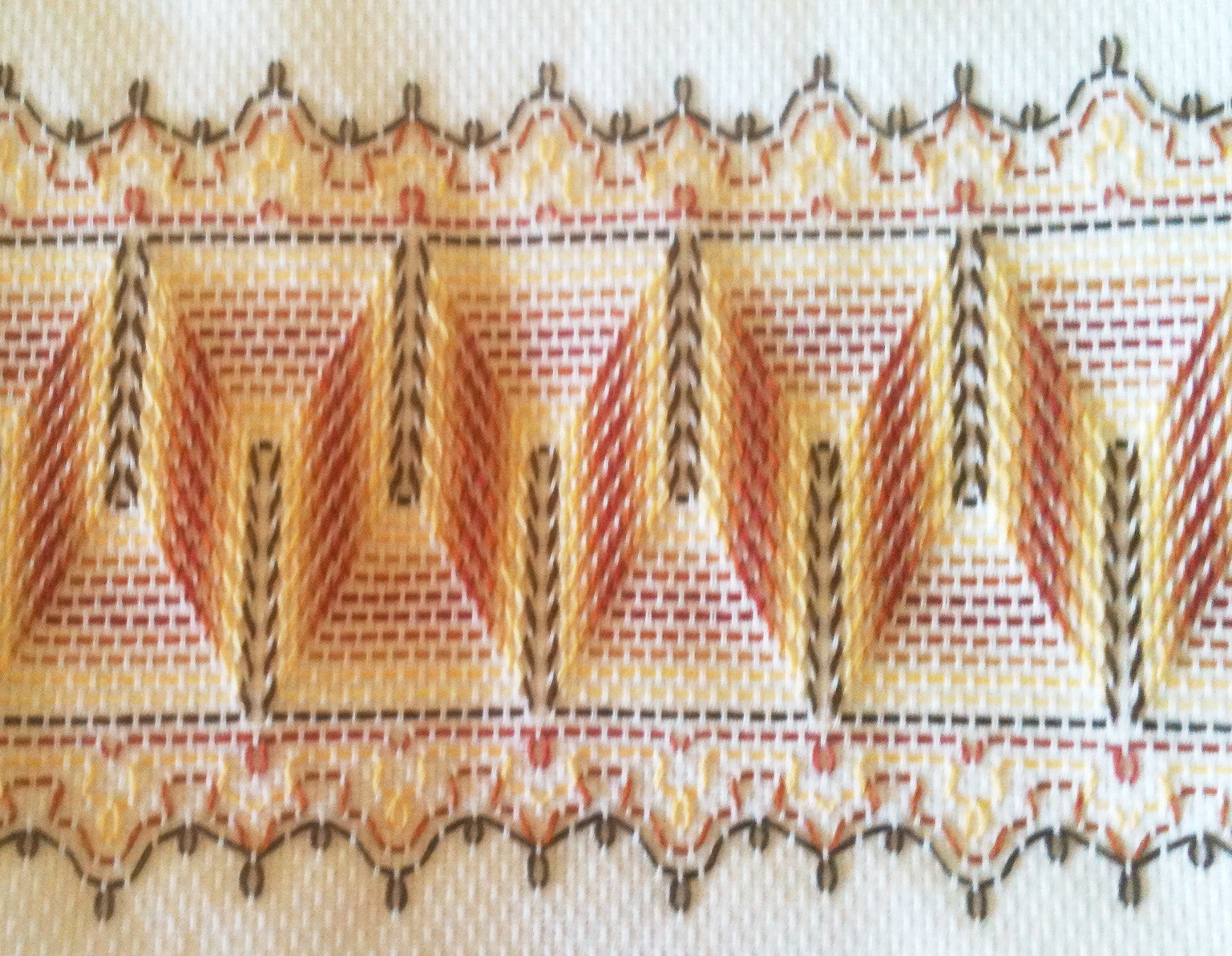
Huck Towel Embroidered Design Waves with “Lace” Edge

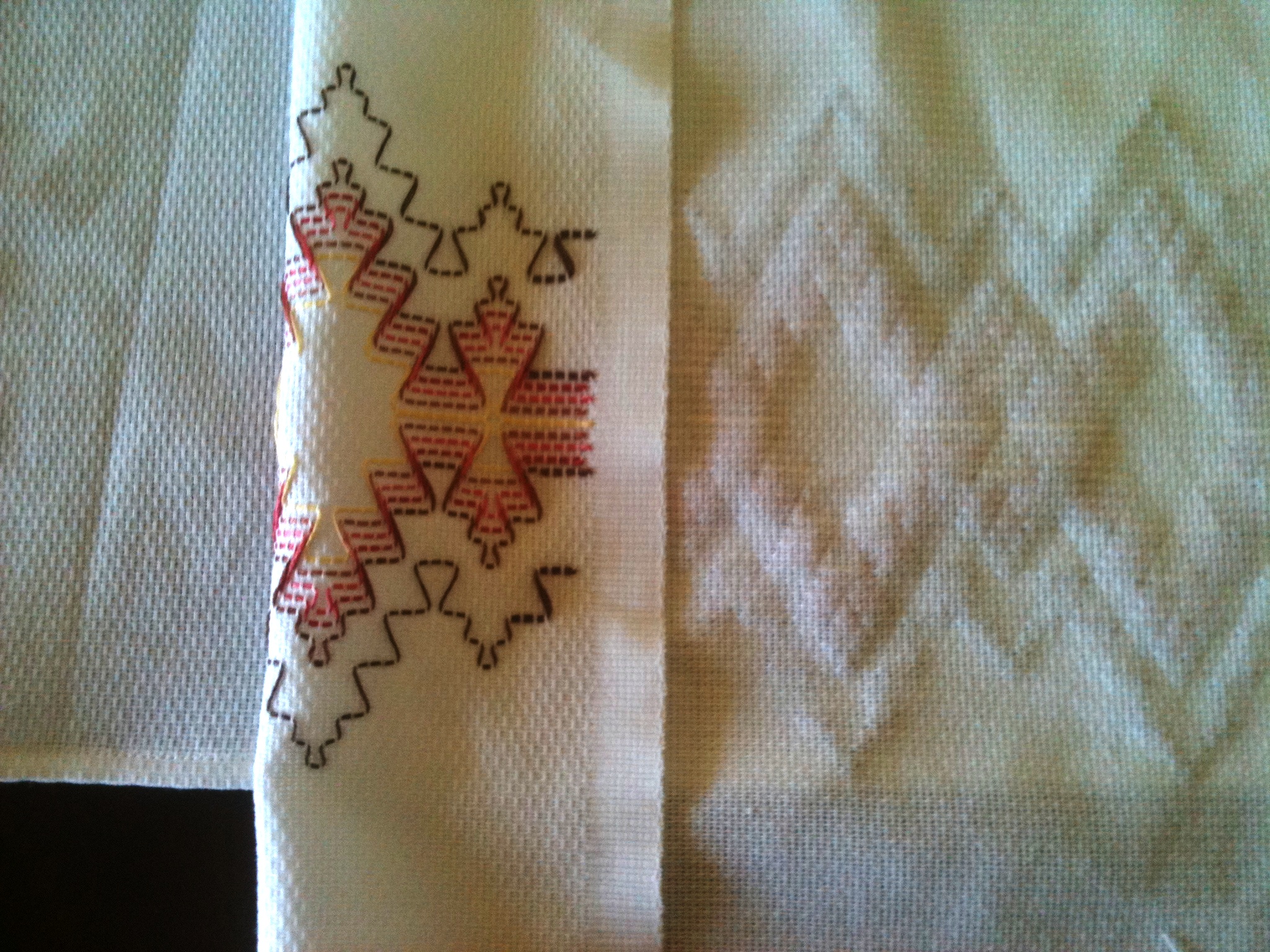
Most Huck Towel designs can be replicated from a picture. However, the wave section  of the Stash Couture Huck Towel design Waves with “Lace” Edge, creates a colorblending optical illusion that makes it difficult to see individual threads.

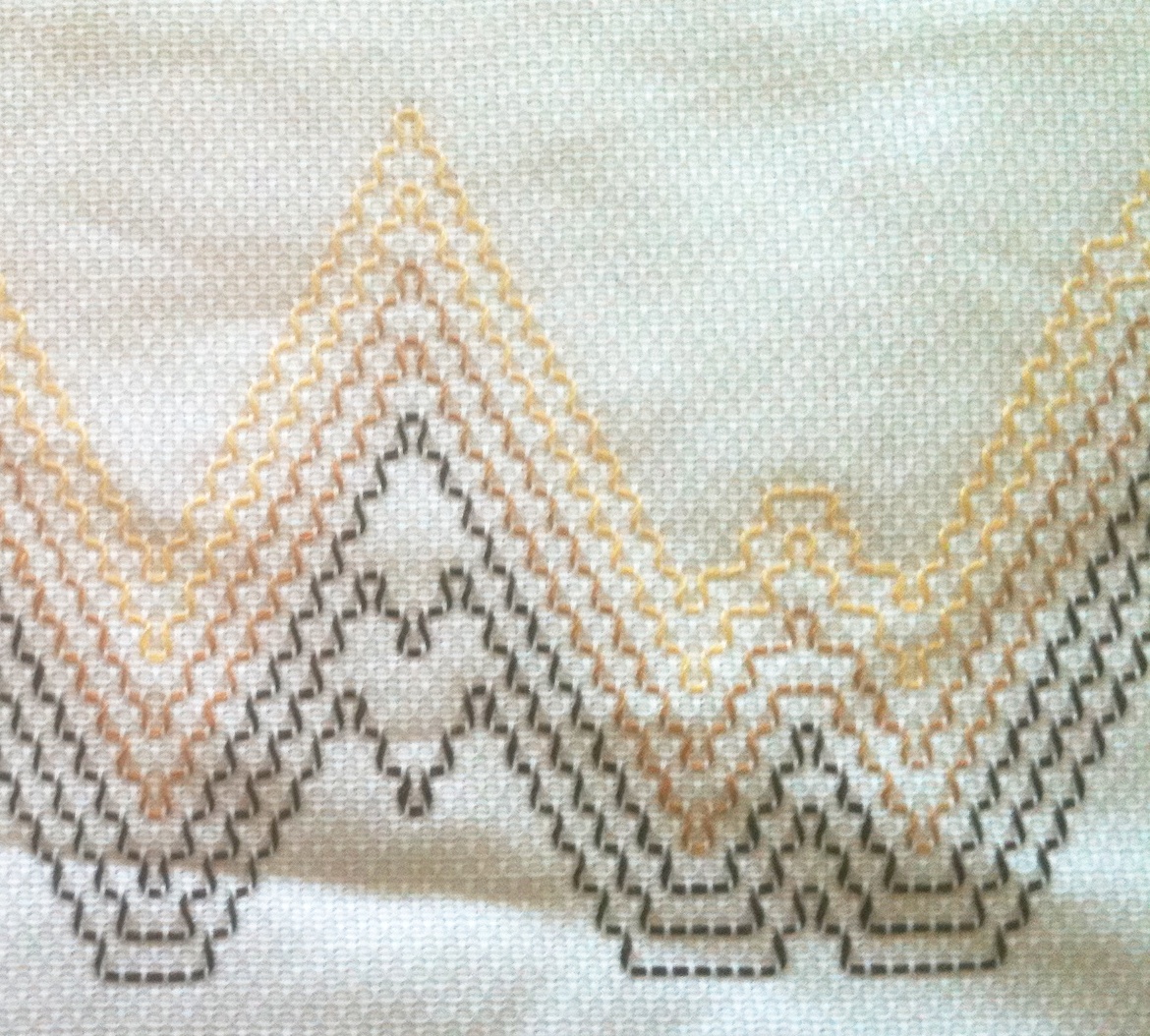
The following graph of the design was created to be used as a pattern.  Scroll down for more detail on how to read a Huck Design graph.

Graph for Waves and "Lace" Edge

Graph for Waves and “Lace” Edge

The colors on the graph were chosen to emphasize individual threads – color choices for finished towels are up to the needleartist’s discretion.  The colorblending illusion is achieved by selecting colors that grade from light to dark or from one color to another.

Examples:

  1. Light Yellow
  2. Yellow
  3. Orange
  4. Rust
  5. Brown
  6. Brown
  7. Rust
  8. Orange
  9. Yellow
  10. Light Yellow
  1. Light Green
  2. Green
  3. Teal
  4. Blue
  5. Navy – then reverse color order

To begin, follow the same process as outlined in Huck How-to.

  • Hem the towel.
  • Locate its lengthwise centerline approximately 6″ from the bottom hem.
  • Thread darning or cross-stitch (blunt end) needle with a very long piece of embroidery floss (3 strands).
  • Begin embroidery with the center stitch of the uppermost thread in the wave pattern.  (The center stitch is the horizontal stitch under the “C” in the “Center of Pattern” label on the graph.)
  • Pull the thread halfway through at the center stitch.  Work design to one edge of towel using half of the thread.  Return to other half of thread and work design to other edge of towel.
  • Huck Embroidery has No Knots – weave thread ends in as indicated in Huck How-To.
  • Complete wave design using selected colors.
  • Complete lower “Lace” design.
  • Complete another section of “Lace” design along upper edge of Wave Section.
  • Admire your beautiful towel.
  • Use your beautiful towel.

How to Read Huck Graph:

Huck Towel Weave with Rows of Floats Highlighted

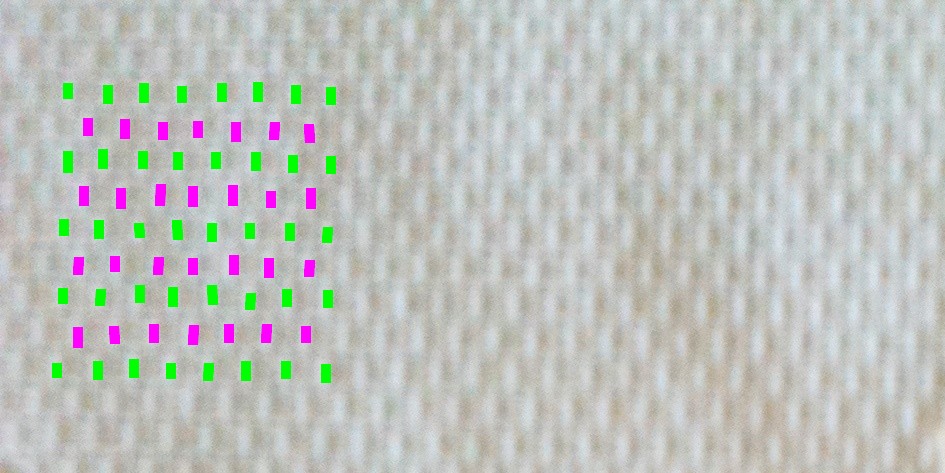
Huck Towel Weave with Rows of Floats Highlighted

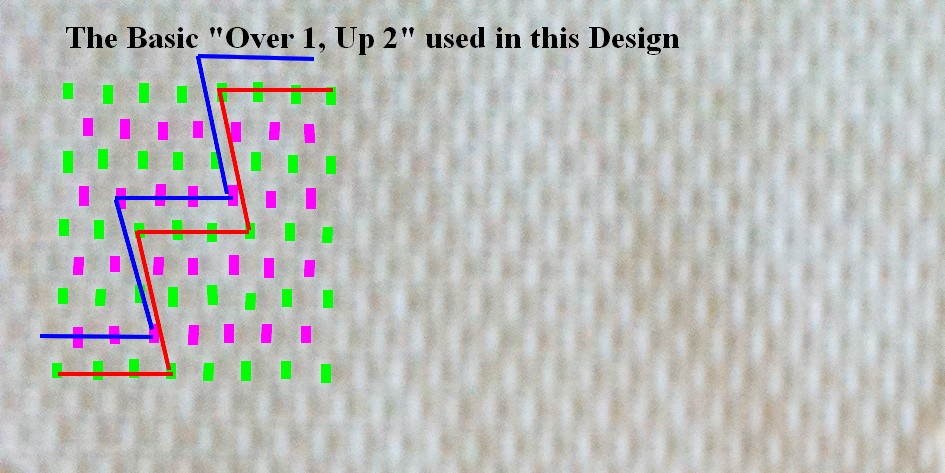
The weave of Huck Toweling creates “float” threads that form a pattern.  As illustrated in the photo, every other row of floats line up in columns.

IsoDot Graph Paper

IsoDot (Diamond Dot) Graph Paper

There is a graph paper that has this same “every other row lines up” design.  It is called “isodot.”

Comment:  Obviously this graph paper was not named by a needleartist.  Needleartists rarely use the phrase “iso” – let’s go with “diamond dot.”

Each dot on the graph paper represents a float on the Huck Toweling.

Simply put, Huck Embroidery is just “connecting the dots!”

The only detail is what direction to pass the thread through the floats. The center of the wave design above seems to form “V’s” as the direction of threads changes.  The colorblending illusion of the wave pattern is achieved by stitching rows of different colored threads in the same direction.

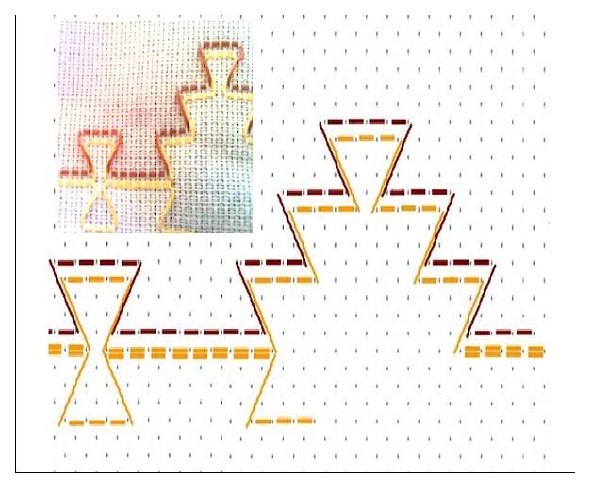
To show the direction of the threads on a graph, the dots are not connected with vertical lines – the lines are slightly angled.

Huck Embroidery and Graph of Design

Huck Embroidery and Graph of Design

The above photo includes a simple stitched Huck Embroidery Design and its graph.

Try the sample to gain familiarity with the process. then move onto more complex patterns..

Warning:  Huck Embroidery is Addictive! 

Posted in Beginner Sewing Projects, Embellishment, Home Decor, Huck Towel, Sewing, Stash Couture, Tutorial | Tagged , , | 11 Comments

MMQ: Log Cabin Block Variations

Completed Log Cabin Block

Completed MMQ Log Cabin Variation 1

The Log Cabin Quilt Block is a very common block in traditional quilting.

https://i0.wp.com/static.ddmcdn.com/gif/cabin-warmth-quilt-pattern-3.jpg

Traditional Log Cabin Quilt Pattern from TLC Home Website

Traditional Log Cabin Quilts are typically sewn with a red center square and alternating sides of light and dark as in this example from the TLC Home Website.

The MMQ Log Cabin Variation 1 Block is actually a 1/4 of a Log Cabin Quilt Block.

Paper Piecing Diagram for Log Cabin Variation 1

Paper Piecing Diagram for Log Cabin Variation 1

The Paper Piecing Diagram illustrates that the design starts with the lower left 1″ square and then 1″ strips are layered on the top and one side to form the “logs”.

The colors of the rainbow are used to identify the order for sewing the seams (Red, Orange, Yellow, Green, Blue, Indigo, Violet).  – I have to add this – the greys of the quilt are causing color deprivation!

Leftover pieces from trimming the borders of the earlier blocks can be used for these blocks as the pieces are quite small.

Verifying location of Piece 1 by holding up to window.

Verifying location of Piece 1 by holding up to window.

The location of Piece 1 is window checked to verify that it is correctly located.  The finished Piece 1 will only be a 1″ square – but it starts much larger.

Red Seam extending 1/2" (two graph paper lines) beyond border and Orange Seams

Red Seam extending 1/2″ (two graph paper lines) beyond border and Orange Seams

The Red Seam is quite short (1″).  It will help maintain a precise square if the seam is extended approximately 1/2″ beyond the Orange and border seams.  

Flip and press Piece 2 open.  Trim the seam allowance under Piece 2 prior to sewing Orange Seam to attach Piece 3.

Log Cabin Block, basted, trimmed and ready for border.

Log Cabin Block, basted, trimmed and ready for border.

Because of the small size of the pieces, seam allowances should be trimmed after sewing each seam.

This block has more seams (6 so far) than any of the other blocks thus far, but it is quite simple.

Machine baste 1/4″ (one graph paper square) from border seam and trim 1/2″ (two graph paper squares) from border seam.  Attach borders, square and another block complete!

Love the ease of measurement – and precision  – of using graph paper!

MMQ Log Cabin Variation 2 is sewn in the same manner as Variation 1 – the only exception is that Pieces 4  and 5 are 2″ wide (eliminating the need for Pieces 6 and 7).

I admit my weakness!  I had to use color!

Log Cabin Variation 2 - Purple square and all!

Log Cabin Variation 2 – Purple square and all!

When complete, this quilt will be gifted to my son, who is now 30.  But as any mother can attest, 30, 40, or 50 years old – we remember our children as children.  As a child, he loved purple…so a 1″ square of purple was included.

Paper Piecing Diagram: Log Cabin Var 2

Paper Piecing Diagram: Log Cabin Var 2

Although each of the “logs” can be sewn in different fabric, both MMQ Log Cabin Variations were sewn so that both logs of each layer was constructed of the same fabric.

I have to say, Variation 2 with its tiny purple square is my favorite block thus far!

Posted in Beginner Sewing Projects, Home Decor, Modern, Quilting, Sewing, Sewing for a Teenager, Stash Couture, Tutorial | Tagged , , | Leave a comment

MMQ Blocks 5, 6 and 7: Pinwheel and Variations

Pinwheel Block Sketch

Pinwheel Block Sketch

Pinwheel is another traditional quilting pattern.

https://i0.wp.com/static.ddmcdn.com/gif/double-pinwheel-quilt-block-3.jpg

Sketch of 4 Pinwheel Blocks from TLC Home Website

When multiple blocks are joined – especially if completed in brightly colored and patterned fabric – the quilt top appears to be in motion! (see more at TLC Home Website)

Block 2 was a Half Square Triangle.  A Pinwheel Block can be thought of as a “Double Half Square Triangle”.

Paper Piecing Diagram for Pinwheel Block

Paper Piecing Diagram for Pinwheel Block

The Paper Piecing Diagram shows that the lower left triangles are sewn first, then the upper right larger triangle finishes the block.

Two seams!

Baste and trim excess fabric and add borders following instructions for MMQ Block 1 and Borders – and another block is complete!

Pinwheel variations are also fairly common in traditional quilt patterns.

The Pinwheel Variations used for the next two blocks are similar, just a minor difference in the location and width of a narrow strip.

Pinwheel Variation 1

Pinwheel Variation 1

Neither variation alters the first two pieces of the block – they remain a Half Square Triangle.  However, the larger upper triangle has a stripe which is sewn first, then flipped, and pressed.  Then the upper triangle piece is sewn on.

Paper Piecing Diagram Pinwheel Variation 1

Paper Piecing Diagram Pinwheel Variation 1

Variation 1 is a very simple variation – especially when using Paper Piecing.

Piece 3 is a 3/4″ wide stripe.  Once sewn along the orange line, flipped and pressed, the final triangle Piece 4 is added.

Just one additional seam!

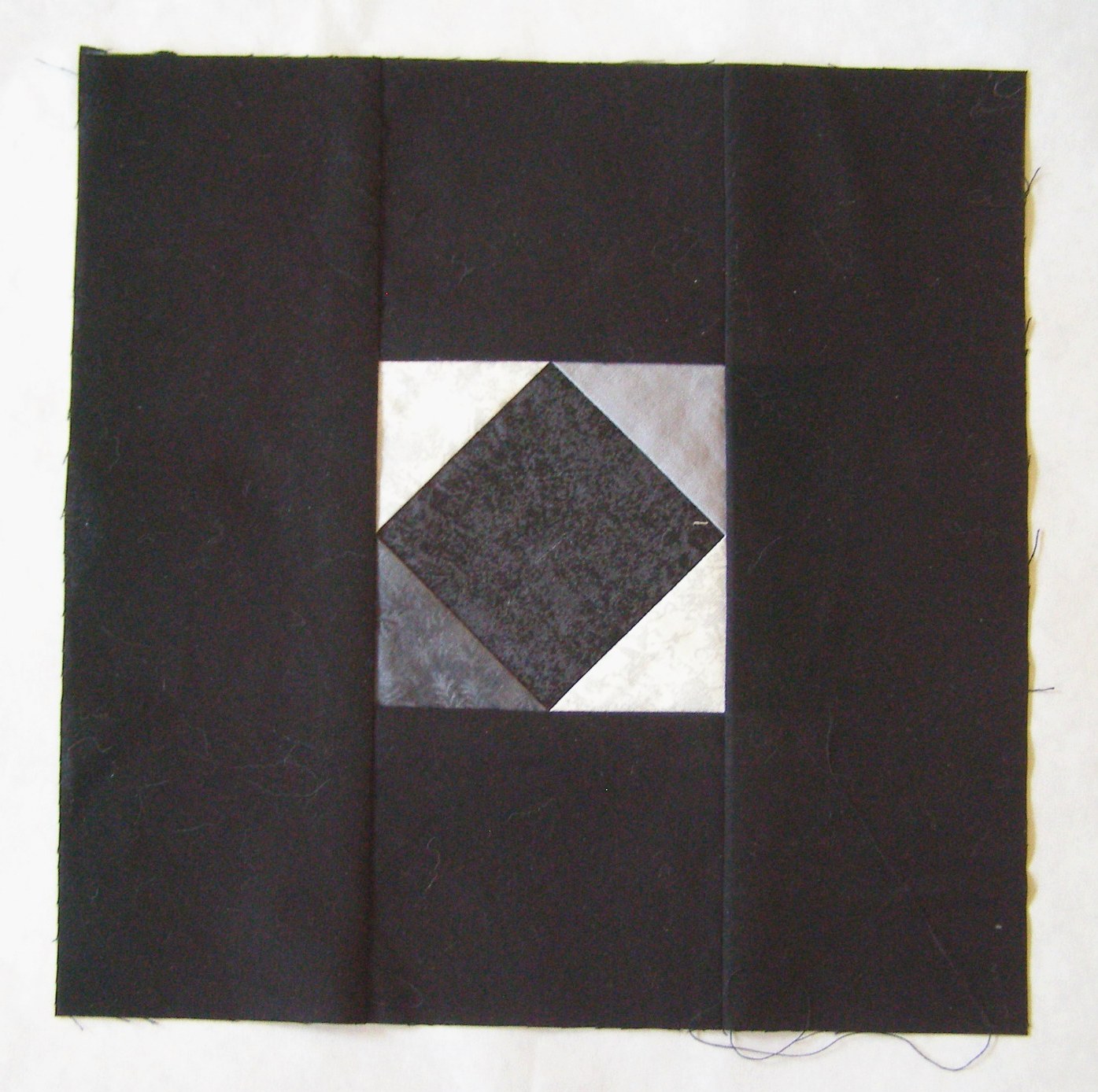
Pinwheel Variation 2

Pinwheel Variation 2

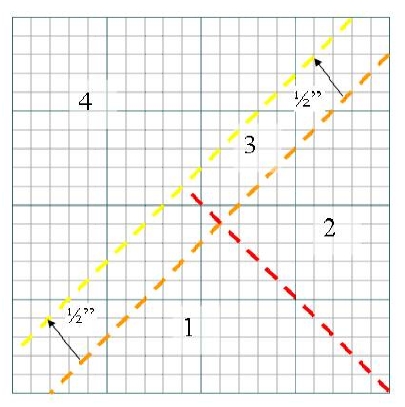
Pinwheel Variation 2 also has an added strip – but this strip is quite narrow (approximately 1/2″) and is centered over the centerline of the square.

Being such a narrow strip, precision is very important! Even the smallest deviation from precise sewing will be obvious!

Good thing there is Paper Piecing for Precision!

The benefits of drawing the Paper Piecing diagrams on graph paper will also become apparent when drawing the sewing lines for the center stripe.  Place the lines two squares up (for the upper line) and two squares down (for the lower line) from the centerline.  This will result in a strip with a consistent width of approximately 1/2″.  Counting two squares is so much easier than trying to determine the correct measurement (it involves calculating a square root)!  

Paper Piecing Diagram:  Pinwheel Variation 2

Paper Piecing Diagram: Pinwheel Variation 2

Love the ease of graph paper!

Because of the different placement of lights and darks, these two very similar blocks look quite different.

Even with as few as 4 seams, the blocks are beginning to look quite complex!

Make one extra block from one of the patterns and 8 of 16 blocks are complete!

Half way done already!

Block 1: Square in a Square

Block 1: Square in a Square

Another Block 1: Square in a Square

Another Block 1: Square in a Square

Block 3: Split Rail Fence

Block 3: Split Rail Fence

Block 4: Bordered Block

Block 4: Bordered Block

Pinwheel Block Sketch

Pinwheel Block Sketch

Pinwheel Variation 1

Pinwheel Variation 1

Pinwheel Variation 2

Pinwheel Variation 2

Posted in Beginner Sewing Projects, Home Decor, Modern, Quilting, Sewing, Sewing for a Teenager, Stash Couture, Tutorial | Tagged , , | Leave a comment

MMQ Blocks 2, 3 and 4

The MMQ Blocks for today are very simple – instant gratification!

Block 2:  Half Square Triangle

Block 2: Half Square Triangle

Block 2 is a Half Square Triangle – a single seam creates the center 4″ design block!

Half Square Triangles are used in a multitude of traditional quilt blocks, from Broken Dishes to Ohio Star to Bear Claw!

Simple to sketch on graph paper and simple to sew.

Paper Piecing Diagram for Half Square Triangle

Paper Piecing Diagram for Half Square Triangle

Following the same process used for Block 1, draw the diagram on graph paper.  Place Piece 1 right side up on the back side of the graph paper – hold it up to a window to verify it is correctly located.

Then place Piece 2 right side down on top of Piece 1 (does this remind you of Thing 1 and Thing 2 from Dr. Suess?) and sew along the red line.

Flip Piece 2 open and press.

Baste 1/4″  and trim excess fabric 1/2″ from the squares finished 4″ lines.

Add borders, trim following “Squaring the Squares” process for Block 1 and Block 2 is complete….only 5 seams!!!

Block 3:  Vertical Stripe

Block 3: Split Rail Fence

Block 3 is a variation of a traditional quilt block called “Split Rail Fence”.  Split Rail Fence typically has all vertical stripes the same width – but varying the widths adds some dimension to the block.

Paper Piecing Diagram for Split Rail Fence

Paper Piecing Diagram for Split Rail Fence

Following the same process used for Blocks 1 and 2, draw the Paper Piecing Diagram onto graph paper and sew pieces together in order.  Flip and press each piece before proceeding to the next piece.

Comment:  It is not uncommon to sew a piece upside down or facing the wrong direction when first trying paper piecing.  Fortunately, the no seam is ever longer than 6″, so removing the stitching is never all that time consuming!

Baste and trim – add borders – square up and Voila! Block 3 is complete!

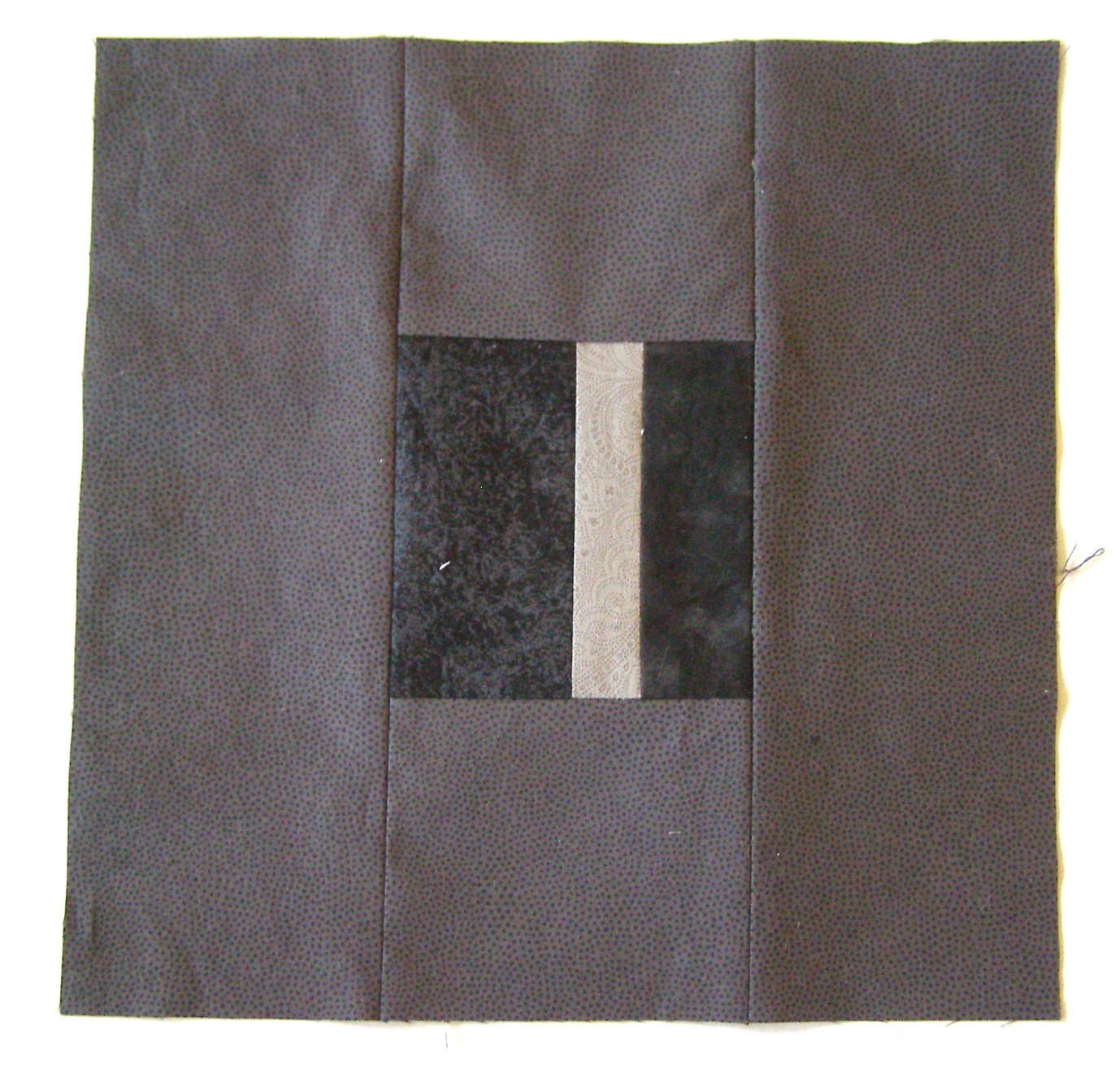
Block 4:  Bordered Block

Block 4: Bordered Block

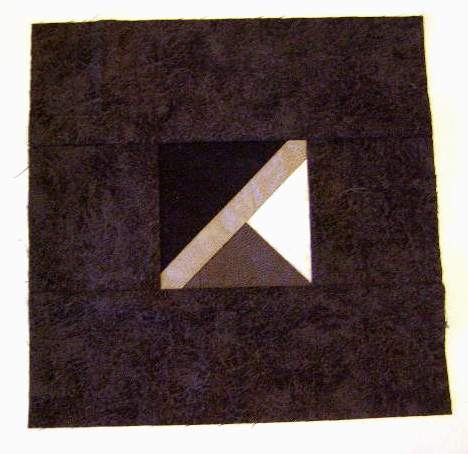
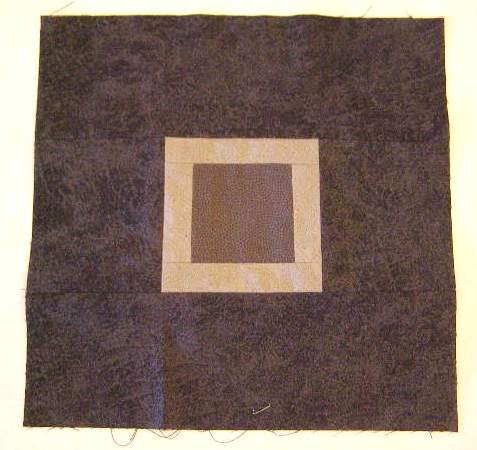
Block 4 is a Bordered Block.  Many traditional quilt blocks are bordered to create a visual separation from adjacent blocks.

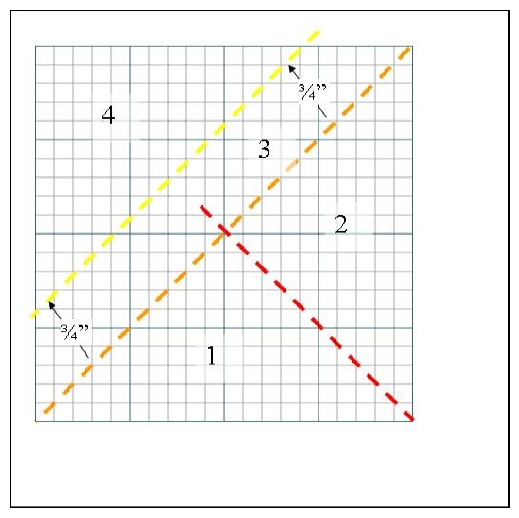
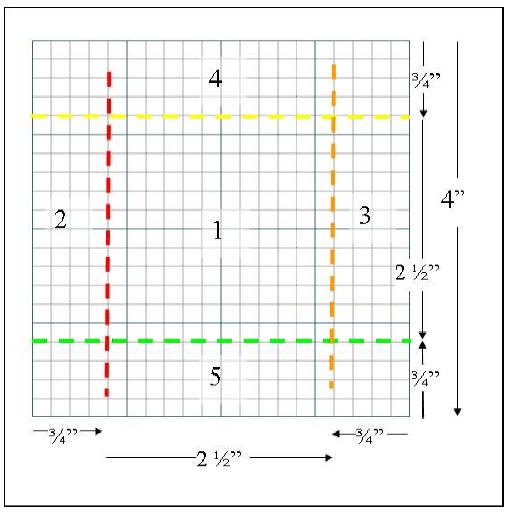
The center design block is, like the others, a finished 4″ square.  This block includes a grey 2 1/2″ square surrounded by a 3/4″ lighter border.

Paper Piecing Diagram for the Bordered Square

Paper Piecing Diagram for the Bordered Square


Here is the Paper Piecing Diagram to transfer to graph paper.

Remember the order of seams sewn follows the rainbow (Red, Orange, Yellow, Green, Blue, Indigo and Violet) – I had to get a color fix – the grey monochromatic is difficult when color has been such a focus!

Sew, trim and add border in the same manner used for the earlier blocks.

Four Blocks Complete!  Or, possibly even more than four!

Block 4: Bordered Block

Block 4: Bordered Block

Block 1:  Square in a Square

Block 1: Square in a Square

Another Block 1:  Square in a Square

Another Block 1: Square in a Square

Block 2: Half Square Triangle

Block 2: Half Square Triangle

Block 3:  Split Rail Fence

Block 3: Split Rail Fence

Posted in Beginner Sewing Projects, Modern, Quilting, Sewing, Sewing for a Teenager, Tutorial | Tagged | 1 Comment

The MMQ – Modern Monochromatic Quilt: Block 1 and Border

Urban. Contemporary. Modern.

One might consider those odd words to use to describe quilting – and age old art form.
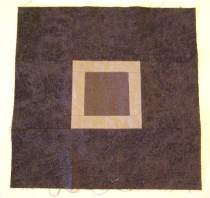
MMQ - Bordered Block

MMQ – Bordered Block

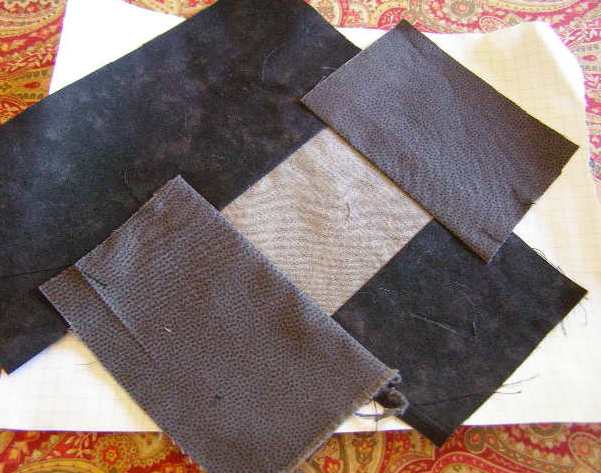
Blacks and Greys – monochromatic colors were used to create simple blocks for a Modern Monochromatic Quilt.

MMQ - Square in a Square:  Block 1

MMQ – Square in a Square: Block 1

When piecing these simple 10″ blocks with these fabrics, precision becomes most important – and the simplest construction method for precision piecing is Paper Piecing.

Paper Piecing provides a stitching line drawn on paper – which when stitched creates perfect seams every time!
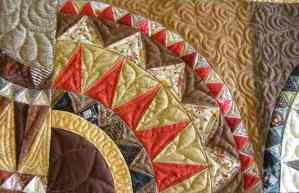
Three Generation Quilt Detail of 1/2" triangles

Three Generation Quilt Detail showing 1/2″ red triangles

The 3-Generation Quilt triangles – some as small as 1/2″ – were all Paper Pieced.

There are many how-to’s for Paper Piecing, this one, by Quilter’s Cache, is very good.

The next few posts will include Paper Piecing Diagrams, block sketches, and finished blocks as the MMQ comes together.

Each finished MMQ block is a 10″ square.  The smaller “design” area within each block is a finished 4″ square.  To create the larger square, the design square is enclosed in a finished 3″ border.

The first 4″ design block is a Square in a Square, based on the Paper Piecing How-To from the Quilter’s Cache Link.

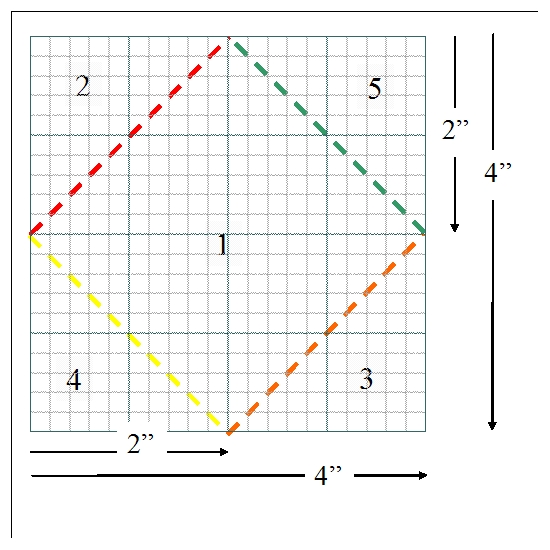
Paper Piecing Diagram for Square in a Square

Paper Piecing Diagram for Square in a Square

Materials:

  • Five or so fabrics in a monochromatic color scheme.
  • Graph Paper (1/4″ squares – best)
  • Sharp pencil
  • Rotary Cutter – with new blade
  • Rotary Cutting Board
  • Rotary Cutting Ruler

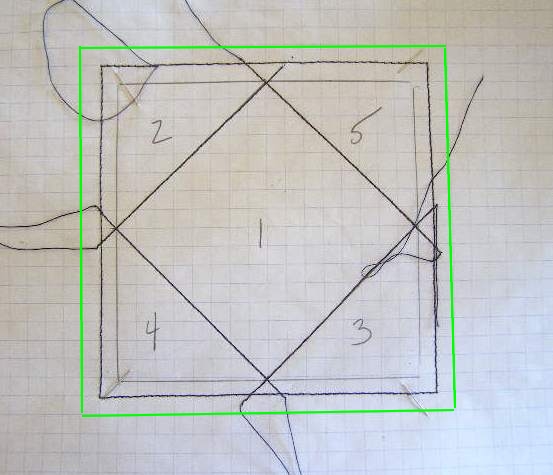
This graph paper shows the piecing order for the Paper Piecing.

Square in a Square drawn on Graph Paper

Square in a Square drawn on Graph Paper

The Paper Piecing Diagram should be drawn on graph paper as shown in the Photo.

The seams shown in the Diagram are sewn in rainbow color sequence (ROYGBIV – or Red, then Orange, then Yellow, Green, Blue, Indigo and Violet!)  All this black and grey just cried out for some color to be used somewhere in the process!).  The pieces are sewn in the numbered sequence

Square in a Square 4" Design Block Sketch

Square in a Square 4″ Design Block Sketch

Here is an electronic sketch of the completed 4″ design block

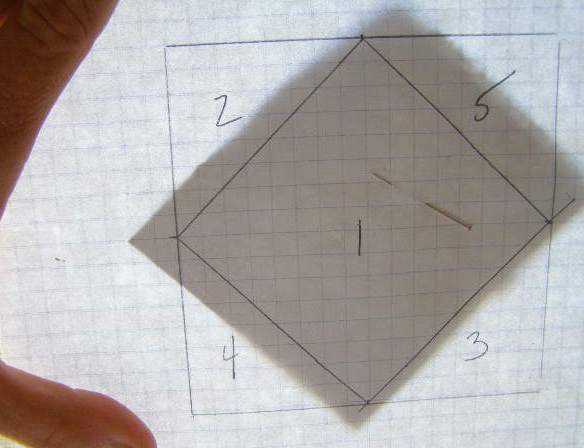
Using graph paper with diagram drawn on it, place Piece 1 on the back side of the graph paper – right side showing.
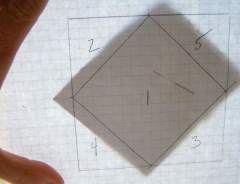
Hold up to window to verify Piece 1 is positioned correctly.

Hold up to window to verify Piece 1 is positioned correctly.

I was using a scrap piece of fabric that was just large enough for Piece 1.  To verify that it was positioned correctly, I held it up to the window.  Once all seam lines were covered, it was pinned into place (and held up to the window again – just to be sure!)
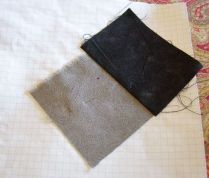
Piece 1 and Piece 2

Piece 1 and Piece 2 – flipped and pressed.

Piece 2 was placed right side down directly onto Piece 1 and the Red Seam (between Piece 1 and 2) was sewn.  Piece 2 was then flipped open and the seam pressed.
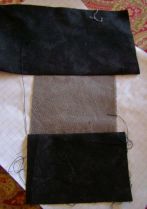
Pieces 1, 2 and 3

Pieces 1, 2 and 3

Then the same process was repeated for Piece 3 and the Orange Seam.  The seam allowances may be trimmed to 1/2″, but trimming the excess fabric will occur later.

A Square in a Square???

A Square in a Square???

When all four seams are sewn, the resulting design square might look something like this on the right side.  Although it might not be quite what you were expecting – it is correct.

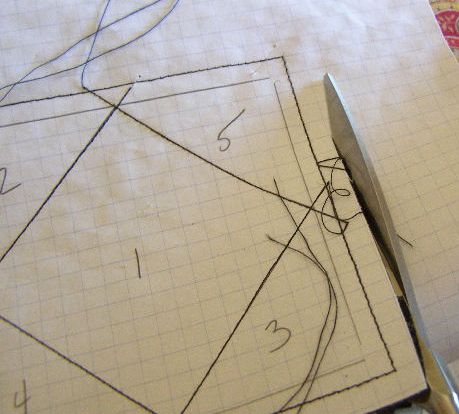
From the paper side, stitch all the way around the 4″ design square, 1/4″ outside the design edge to baste all fabric in place prior to trimming.  Then trim the square to 5″ by cutting 1/2″ from the design edge.
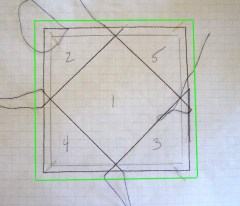
Basting completed.  Green line is cutting line.

Basting completed. Green line is cutting line.

Using 1/4″ graph paper makes these steps very easy –  the basting and the cutting lines were just the next two graph lines.
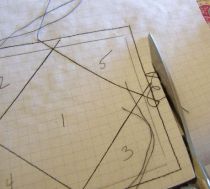
Cutting away excess fabric.
Cutting away excess fabric.

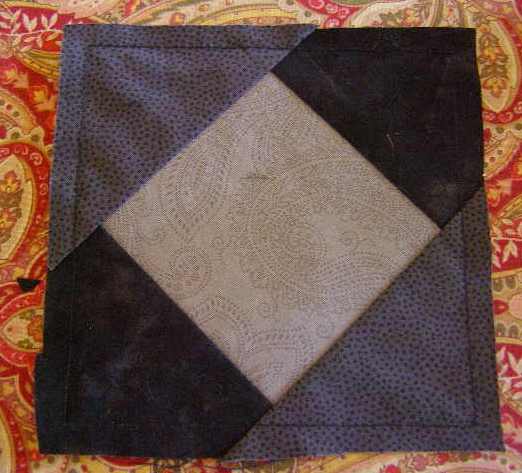
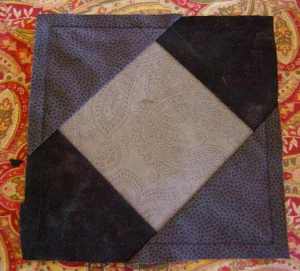
Square in a Square trimmed and ready for Borders.

Square in a Square trimmed and ready for Borders.

Once the excess fabric and graph paper are cut away, it will form a 5″ square.

The design will more closely resemble the Square in a Square – all ready for the borders!

Border:

Using the rotary cutter, ruler and board, cut a 4.25″ strip of another fabric for the border of the square.   For simplicity, this strip can be the entire 42″ – 45″ width of the fabric.

Four border pieces.

Four border pieces.

Cut two pieces from the strip approximately 6″ long and two pieces approximately 14″ long.

Sew the strips to the top and bottom of the design square along the line defining the edge of the 4″ square.  This should create a 1/2″ seam allowance. Press seam allowances toward the border.
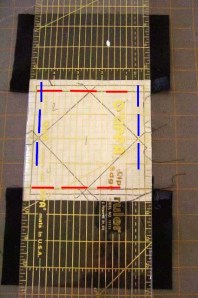
Match seam lines (red) and paper piecing sewing lines (blue) to lines on ruler.

Match seam lines (red) and paper 1/2″ seam lines (blue) to lines on ruler.

Place the square with the two border pieces wrong side (paper side) up on the rotary cutting board.

Match the horizontal seams just sewn to horizontal lines on the ruler (red lines in the photos).  Match the left and right 1/2″ seam lines to the 1/2″ line on the ruler (blue lines in the photo).  Matching in two directions helps with “precision.”

Using rotary cutter, carefully trim excess border fabrics from sides.
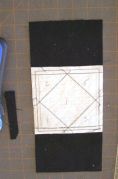
Trimmed and ready for final border pieces.

Trimmed and ready for final border pieces.

Sew the remaining strips to the sides of the design square along the line defining the edge of the 4″ square.  This should create a 1/2″ seam allowance. Press seam allowances toward the border.

To Square the Squares:
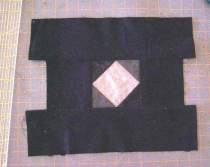
Trimming Required.

Trimming Required.

Obviously, more trimming is required as the final square needs to be “squared.”

Care must be taken at this step to ensure the center 4″ design square remains in the center of the border as the border edges are trimmed.

Trimming more from the top than from the bottom might still result in a square, but the center design square would be off-centered.

Pink Lines - seam lines for center design square.  Green Lines - trim lines.

Pink Lines – seam lines for center design square. Green Lines – trim lines.

To make the process of keeping the squares squared, I placed tape on my rotary cutting board at important measurements.  The center 4″ square should fit between the tapes at 5″ and 9″ on the left and right edges and between the 23″ and 27″ marks on the top and bottom.  Placement is verified with the ruler.

Once the center design square is squared to the taped measurements, move the ruler to the position shown, using the upper tapes as guides, and trim the upper edge.

Move the ruler to the lower edge (the tape at 1.5″ fell off) and trim.
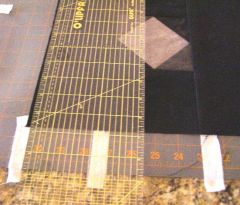
Trimming left edge after aligning edge of ruler with tape.

Trimming left edge after aligning edge of ruler with tape.

Move ruler to left edge and trim (tape is at 30.5″).  Repeat for right edge.

The borders will now be 3.5″ wide – which includes a 1/2″ seam allowance for sewing to the sashing.

Completed Block 1 Front

Completed Block 1 Front

However, sashing is another day…Many squares to complete first!
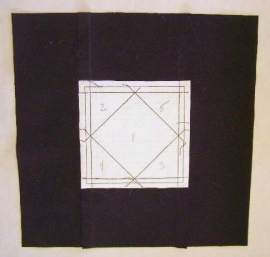
Completed Block 1 Wrong Side - still has paper on it!

Completed Block 1 Wrong Side – still has paper on it!

The back of the design square still has paper on it!  Time to remove it.
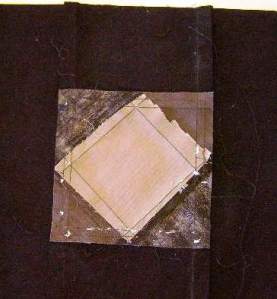
Completed Block 1 Wrong Side - Paper Removed

Completed Block 1 Wrong Side – Paper Removed

Pulling off those last tiny little pieces of paper might require a pair of tweezers!

Block 1 completed!

Only 15 more to go!!!

Posted in Beginner Sewing Projects, Home Decor, Modern, Quilting, Sewing, Sewing for a Teenager, Tutorial | Tagged , , | 4 Comments

Huck How-To

Embroidered Huck Towel - Front

Embroidered Huck Towel

Embroidering huck toweling (also called Swedish Weaving) produces beautiful, intricate-looking detail on useful kitchen towels.  It is also very simple…. and because the needle used is blunt – relatively painless!

Today’s post was to be a tutorial, but is more a discussion on how Huck Embroidery can be accomplished. I hope it inspires some to try Huck Embroidery.

Materials:

  • Huck Toweling (about 3/4 yard) – Hem the ends.
  • Large Blunt Needle (darning or counted cross stitch needles work well)
  • Embroidery Floss or Pearl Cotton (crochet cotton) in desired colors

The best options for patterns for Huck Embroidery are simply a good quality photo of an existing design.  There are many on the web.  There are also graphs for more complex designs – an example can be found here.

Pattern - an existing design

Pattern – an existing design

A towel made several years ago serves as a pattern.  Its design is quite simple and will be used here.  The yellow threads in the center will be the starting threads.

HUCK TOWELING FLOATS??

Huck Towel Weave with Rows of Floats Highlighted

Photo 1:  Huck Towel Weave with Rows of Floats Highlighted

Huck Toweling has raised threads called “floats” as a result of its weave.  Take a minute to took at the design in the floats (Photo 1).  Floats from every other row line up in vertical columns.

Looking closely at the yellow threads in the design pattern, it can be determined that they follow a basic stitch pattern.

That pattern is: Stitch 4 straight floats, then move needle “over and up” and stitch 4 or 8 more straight floats – and repeat.  This basic stitch is illustrated in Photo 2.

Photo 2: Basic Pattern

Photo 2: Basic Patter

This is an “Over 1, Up 2” design.

“Over 1” is a simple way of remembering to move the needle one full column to the left.  “Up 2” refers to moving needle up 2 rows.

So the next stitch would occur at the float that is “Over 1 and up 2” from the last stitch.

(Please note that in Huck Towel work, “a row” is a full row – in Photos 1 and 2 that would be from one green dot row to the next green dot row or from a pink dot row to the next pink dot row.  Moving from a green row to the adjacent pink row is considered a half-row.)

Photo 3:  Practicing the first row.

Photo 3: Practicing the first row.

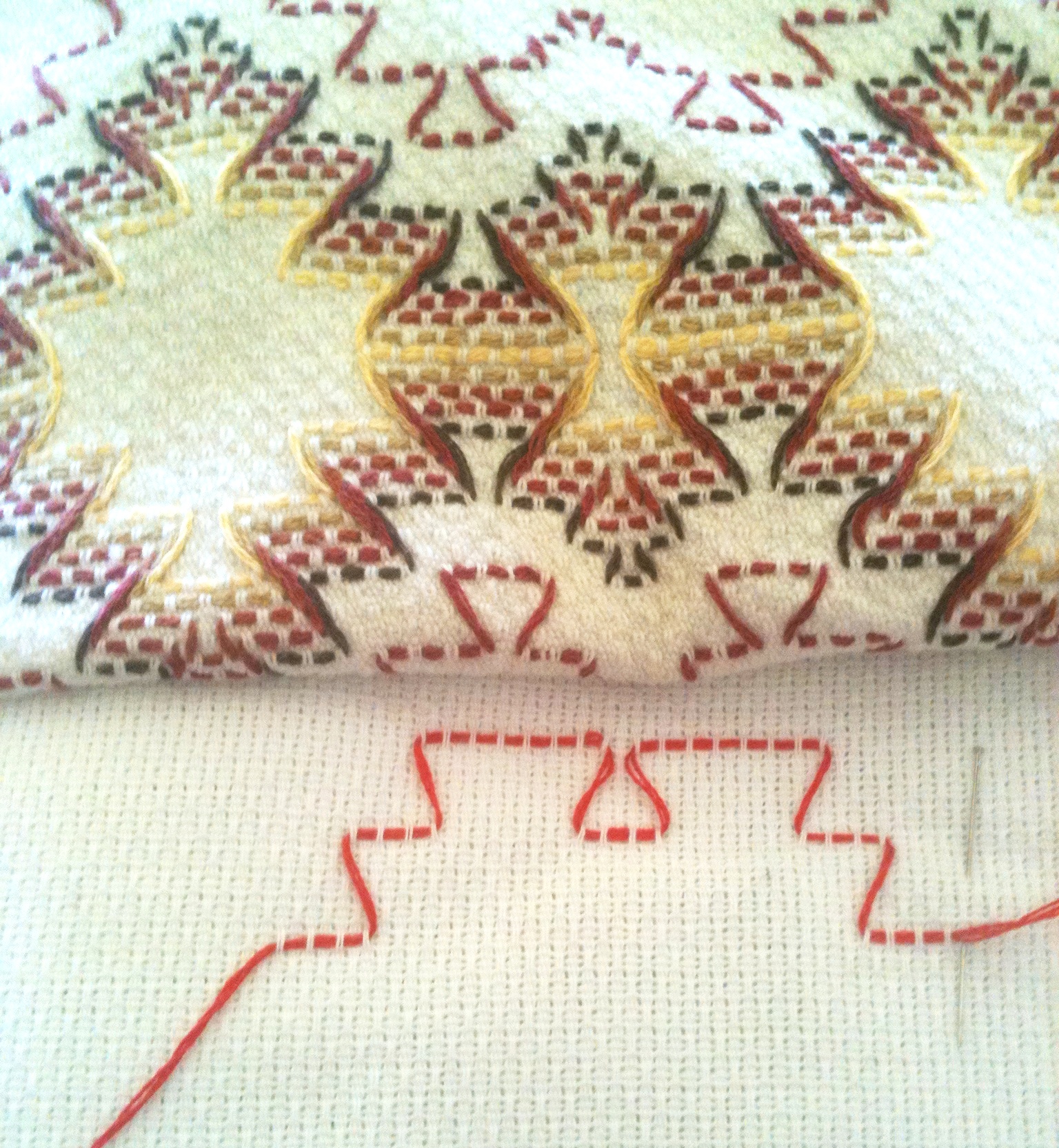
Using red thread, a practice Row 1 was completed and compared to the original design (lower yellow row) to determine if revisions were needed.

The pin in the picture is marking the design and towel  center.

After practice, comes the real thing.

Another thing about Huck Towel embroidery – no knots!  Scroll down for more on that subject.

Using a piece of thread about 4 times longer than the towel is wide, pull it through a design float somewhere near the pin (marking design and towel center) to its halfway point.  Work design row from center to one edge, then go back and work design from center to other edge.  Repeat for other yellow row.

Photo 4: Two colors completed.

Photo 4: Two colors completed.

Then with second color, embroider floats immediately adjacent to the yellow.  It is very difficult to make a mistake once Row 1 is completed.  All subsequent row stitch and float counts are defined by Row 1.

Photo 5:  Subsequent rows and colors just fall into place!

Photo 5: Subsequent rows and colors just fall into place!

Then stitch the third and fourth colors.  Note the little “Over none, Up 1” bump in Row 3.  They add more visual interest!  Row 4 just falls into place!

Photo 6:  Border and Design Detail

Photo 6: Border and Design Detail

After completing all 5 colors, you should be in love with the way the colors seem to blend together – and be very comfortable with “ups and overs”.

Prior to starting the border rows, look carefully at the design photo.  While the border counts vary in both “ups and overs” and straight runs from the design counts – the finished detail is worth having to pay attention!!
Back of Towel - Knot Free!
Back of Towel – Knot Free!

NO KNOTS!

Huck Towel Embroidery is Knot-Free.

The photo to the right shows the back of the towel – nary a knot in sight!

This stitcher’s trick is also quite simple.

Oh, No!  I ran out of thread!

Oh, No! I ran out of thread! Part 1.

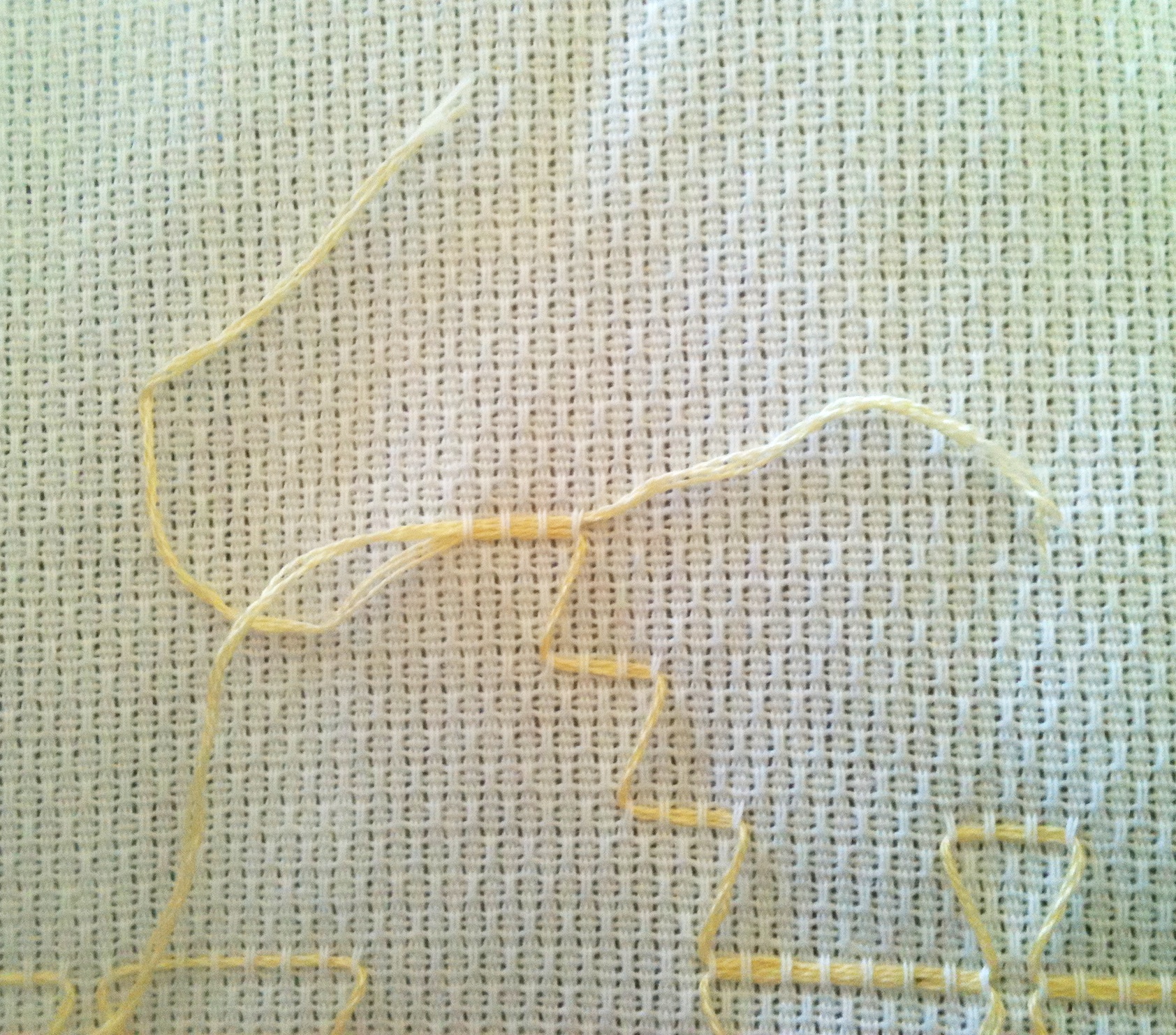
Should a piece of thread be too short to finish a row, end at a straight run as shown.  Thread needle with a new piece of thread and stitch through same straight run of floats.

Oh No!  I ran out of thread.  Part 2.

Oh No! I ran out of thread. Part 2.

This will create two “tails” at the straight run.  Continue stitching design for several inches prior to cutting thread tails.

Stitch several inches prior to cutting tails.

Stitch several inches prior to cutting tails.

The double threads in the straight run will be all but impossible to find when the towel design is complete.

To avoid knots on towel edges, when a row is complete, pass thread back through last 5 – 10 stitches to secure (skipping outermost float or stitching will pull out).

Knot-less!

TENSION:  Don’t be tense!

Huck Toweling makes is easy to create very intricate stitch patterns – but it is important that the threads not be pulled too tight.

Tension:  Pucker and Perfect

Tension: Pucker and Perfect

Pulling too tight will cause puckers.

As long as the towel lies flat – its perfect!

Posted in Home Decor, Huck Towel, Sewing, Stash Couture, Tutorial | Tagged , , | 22 Comments

Stash Couture Top from a Remnant

What does one do with a  remnant of less than a yard?

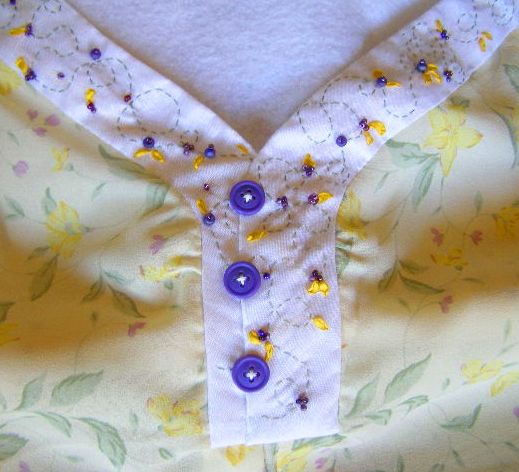
Detail

Detail

The Stash contained a lemon yellow sheer print that just cried out to be transformed into a summer top.  However, most patterns – even the simplest tank tops – require more fabric than the small 3/4 yard piece!

So the pattern search continued..

New Look 6937

New Look 6937

The sleeveless option in New Look 6937 appeared promising. Oddly, the pattern indicated 1.5 yards of fabric were required for the body and and additional 5/8ths yard for the contrast neck band.  A total of more than 2 yards for a sleeveless top?

Fortunately, my mother and grandmother taught me to use those printed yardage requirements as “guidance, not gospel.”

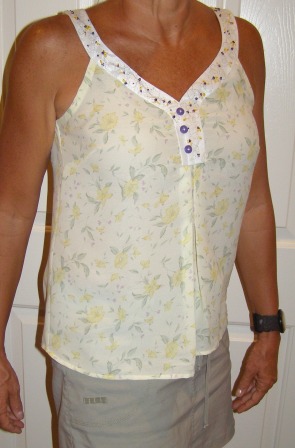
Stash Couture Top from a Remnant

Stash Couture Top from a Remnant

It was necessary to turn the fabric 90 degrees – but there was just enough fabric… once the top was shortened by an inch!

For the contrasting neck band, I used a white quilting weight cotton (but no where near 5/8ths of a yard!)

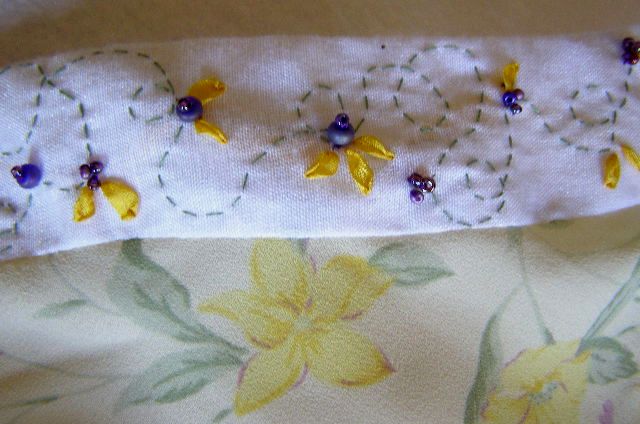
Although it does not show in the photos, the print of the fabric includes very small purple flowers that served as the inspiration for the hand work on the neckband.

Beads, floss, buttons and silk ribbon – all from The Stash – added that Stash Couture touch!

The handwork was completed prior to stitching down the neck band lining so the knots and threads would be hidden.

Handwork Detail at Center Front

Handwork Detail at Center Front

The front of the pattern was revised slightly – the pleats were made wider and moved toward the center – and stitched down for approximately 5″.  The placket was overlapped, and a small amount of gathering was improvised along the vertical portion of the placket to improve fit.

The top works well for the already very hot Arizona weather – and kudos to New Look for designing the neckband just right to hide straps!

Stash Couture New Look 6937

Stash Couture New Look 6937


Posted in Embellishment, Sewing, Stash Couture | Tagged , , | 2 Comments

Stash Couture Huck Towels

Huck Towel Embroidered Design

Huck Towel Embroidered Design – Waves with “Lace Edge”

Graphed Pattern and instructions for the Wave with “Lace” Edge design can be found by clicking here.

Embroidered Huck Towels harken back to the days when women transformed common everyday objects into pieces of art with needle and thread.

Kitchen towels were stitched with pride – and usually put away for use only on “special occasions.”

Stitching huck toweling designs (also called Swedish Weaving) is very simple – embroidery floss or crochet cotton is drawn under raised threads occurring on the fabric.

Huck Towels

Huck Towels

Cotton Huck Toweling has these raised threads.  One side has vertical raised threads – the opposite side has horizontal raised threads.  The above design was stitched through vertical threads.

Arizona Mountains Huck Towel Design

Arizona Mountains Huck Towel Design – Final

Mildred Krieg (copyright 1936)

Mildred Krieg (copyright 1936)

There are designs and instructions available commercially.  Mildred Krieg’s 1930’s booklets are considered by many to be the original reference.  These books can still be found on ebay and Etsy.

However, just picking up needle and thread and beginning to stitch the threads can create beautiful original designs.

Original Arizona Mountains Design

Original Arizona Mountains Design

The Arizona Mountains design resulted from a two step process.  The original design fell a bit short of the desired effect.  Infilling additional rows of thread created the desired effect.

I pulled Huck Toweling from The Stash, but it is available at most fabric stores.  It seems to run about $5.00 per yard – and 3/4 yard (27″) is just about right for one kitchen towel.

The Embarrassing Embroidery Thread Stash

The Embarrassing Embroidery Thread Stash

The Stash also provided the embroidery thread.  I used three strands, but if a stronger color statement is desired, four or six strands will work.

The Embarrassing Embroidery Thread Stash has been amassing itself for more than 4 decades!  But, it is usually successful at  providing most any color for most any project!

Simple Huck Design

Simple Huck Design

Because of the ease and the low cost of attempting a project, Huck Embroidery is a great first try stitching project.  My children stitched many towels for Grandma presents when they were quite young.

The diagram shows a simple Huck Design and illustrates how the colored threads simply pass underneath the raised vertical thread of the Huck Toweling fabric.

Waves and Lace Edge Design Detail

Waves and Lace Edge Design Detail

While Huck Embroidery in a single thread color is beautiful,  part of the fun of Huck Towel Embroidery is the interplay of the tread colors.  As illustrated in the Waves with Lace Edge Design Detail,  color gradations look very different in the longer vertical stitches than in the shorter horizontal ones.

One aspect of these Huck Embroidered Towels that will vary from those created by our foremothers – they will be used.  Not just on special occasions – but for everyday – and often!

These towels will not be stored in a drawer to be saved for a special occasion.  They will be used to dry dishes – to wipe up spills – and hung on the oven handle to dry – maybe they will help make everyday a  special occasion!

Huck Embroidered Towels

Huck Embroidered Towels

Posted in Beginner Sewing Projects, Embellishment, Home Decor, Huck Towel, Sewing, Stash Couture | 15 Comments

From Lozenges to Lovely! The Purple Dress

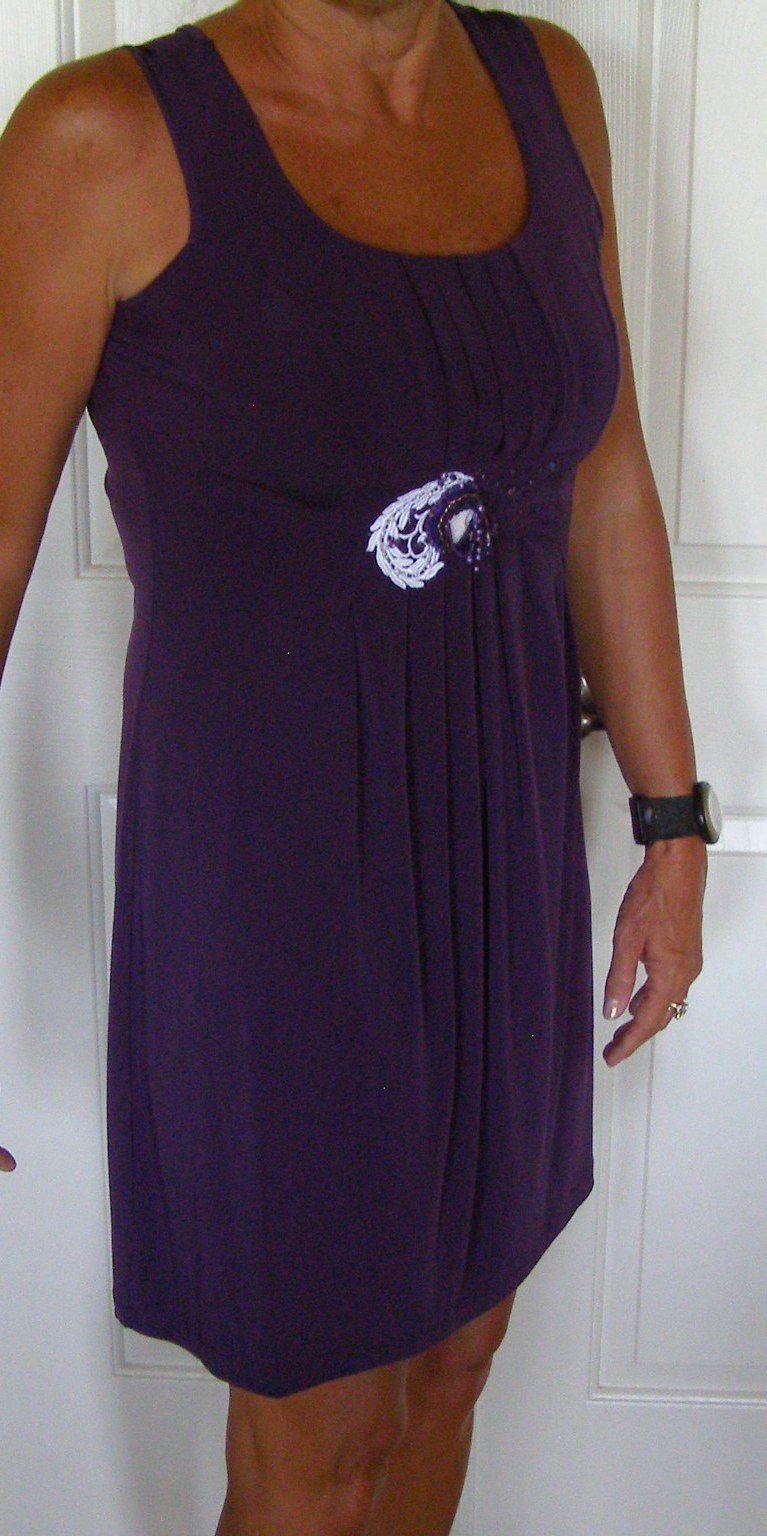
A beautiful purple dress presented itself while cruising the aisles at a National Off-Price Store.

Embellishment Detail

Embellishment Detail

It was knit (so very comfortable) with a pleated front that had empire waist shaping defined by a small rectangle.

Comfort and shaping – a rather unique combination!

With a price of less than $14 – it was purchased.

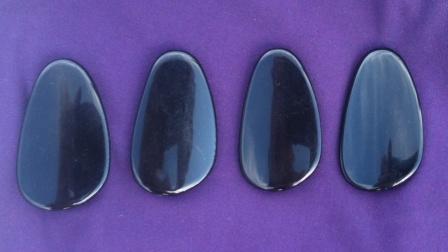
The empire waist rectangle was embellished with 4 (ugly) large black, plastic ovals.  I guess they might  be referred to as “lozenge” shaped.

The lozenges were sewn on – which, of course, to we-who-sew means they are not permanent.

The black plastic lozenges.

The black plastic lozenges.

Oddly, when I showed the dress to my teenage daughter – she thought the lozenges were the “best part” of the dress?

Apparently, the lozenges were sewn on by Sew-zilla.  They were sewn on to stay! Removing them left very obvious stitch marks.

But as the design plan was to embellish the rectangle, the stitch marks could easily be “disappeared.”

Embellished Empire Waist Detail

Embellished Empire Waist Detail

A goddess face, some embroidery, lace, and beads (all from The Stash!) and the dress transformed from Lozenges to Lovely!

Wish all dresses were this comfortable!

Comfort, shaping and embellishment!  Stash Couture!

Comfort, shaping and embellishment! Stash Couture!

Posted in Embellishment, Goddess, Sewing, Stash Couture | Tagged , | Leave a comment