Stash Couture for Father’s Day

Stash Couture Adult Spill Absorber

Stash Couture Adult Spill Absorber

Small motor skills may diminish in one’s hands after 75 years of serving one’s country and working to provide for one’s family.

However, dignity should not diminish with age…

A small gift for one who has given so much….

Based on Simplicity 2687, this combined the smaller and larger versions and a few additions. It is machine washable and used only items from The Stash.

Tie Detail

Tie Detail

The bowtie was hand stitched at the tie ends so that it would retain its shape during washings.

I wish it could be more….


Posted in Accessories, Sewing, Stash Couture | Tagged | 2 Comments

The Destashification Make-Up Bag: Finishing Touches

Another zipper, a few seams and the Make-Up Bag is done!

Part X (I lost count) The Zipper:
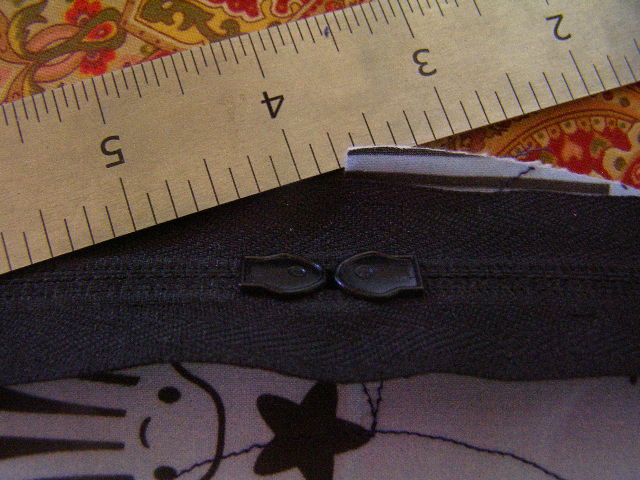
Match centerpoint of zipper to notch in exterior.

Match centerpoint of zipper to notch in exterior.

1.  Find the center point of the longer zipper (lengthwise).  Mark it with a pin.

2.  Match the zipper centerpoint with the small notch at the top of one of the quilted exteriors.

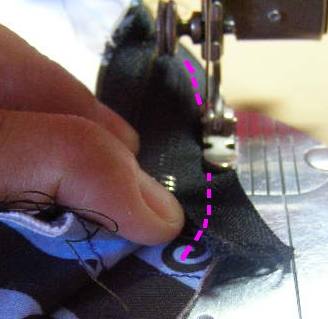
Sew across end of zipper tape

Sew across end of zipper tape

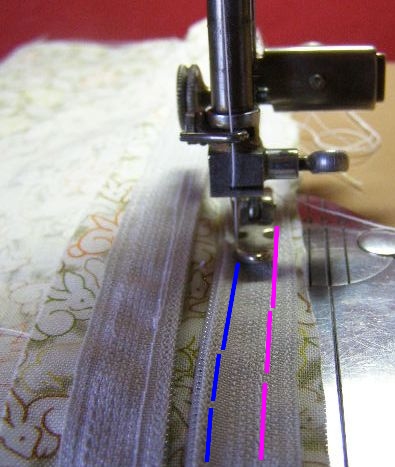
3.  Sew from the centerpoint toward the end of the zipper, approximately 1/4″ from the outer edge of zipper tape.  At the end of the zipper, push the zipper tape AWAY and stitch across it as shown in photo.  This will hide the raw edges of the zipper tape.

4.  Repeat in other direction.

Zipper showing first (pink) and second (yellow) seams.

Zipper showing first (pink) and second (yellow) seams.

5.  Sew a second zipper seam closer to the zipper teeth, as shown in the photo.

6.  Repeat on other side of zipper using the other quilted exterior fabric.

Now it is the lining’s turn…

7.  Place one of the lining pieces on top of the exterior piece – right sides together – align edges (see Photo Step 7A).
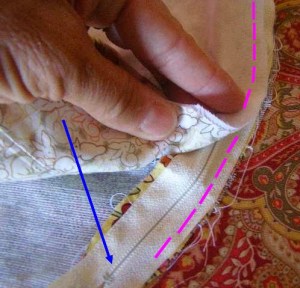
Place lining on top of exterior piece - align edges - sew along pink line.

Step 7A: Place lining on top of exterior piece - align edges - sew along pink line.

Sew along the second seam line used to sew the zipper to the exterior piece (See Photo Step 7B).

Sew along second zipper seam

Step 7B: Sew along second zipper seam

8.  Repeat for other side of zipper, using other lining piece.

This is a second bag, made in my current favorite color scheme – yellow, pink and red (with a bit of brown to keep it from being too loud).

The lining is of a fabric with little tiny bunnies, foxes, and birds…

You never know what The Stash holds!

Congratulations!

A Zipper – in a lined and curved seam –  can now be listed the sewing repertoire!

…And Zipper-phobia has been replaced by Zipper-ease-a-mania!

Part Y:  The Body

9. Pull the zipper pull until it is halfway opened (to get the zipper pull out of the way of the side seams)

Pull the bag flat so that it looks like the picture in the Step 9 Photo.
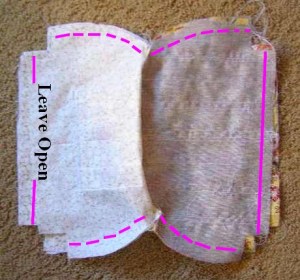
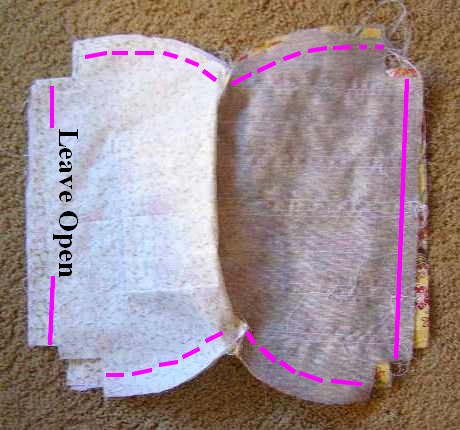
Final Body Seams

Step 9A: Final Body Seams

Perhaps this shape could best be described as two lima beans stuck together?

Sew along the seam lines shown in pink in the Step 9 photo.

Note that the lining bottom seam should be stitched no further than 2″ from the edge (otherwise, there is no way to turn the cosmetics bag right side out!)

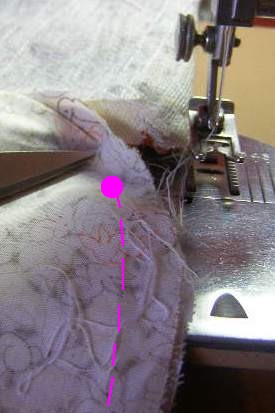
Stop the side seams about 1/2″ -1/4″ from the zipper.
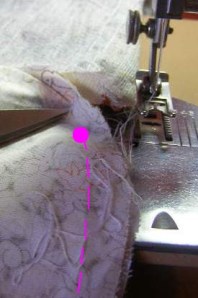
Step 7B:  Sew side seam to pink circle

Step 7B: Sew side seam to pink circle

The scissors in the Step 9B photo are pointing to the end of the zipper seam.  Do not try to sew all the way to that point.  The pink circle in the photo is within 1/2″ -1/4″ of the end of the zipper seam.  End the side seam at that point.

Step 10. Turn right side out

Step 10. Turn right side out

10.  Reach through opening in the lining bottom seam and turn bag right side out.

Marvel at it for a few minutes, then turn it inside out again.

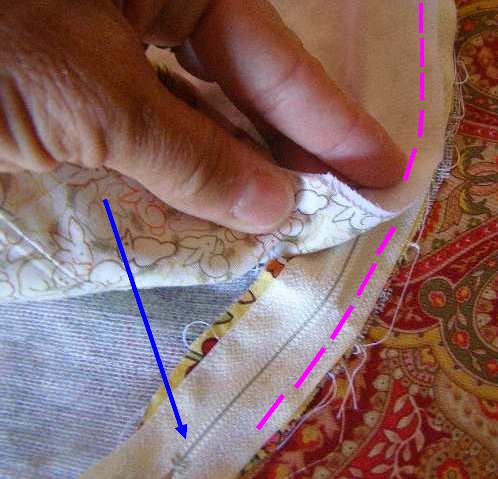
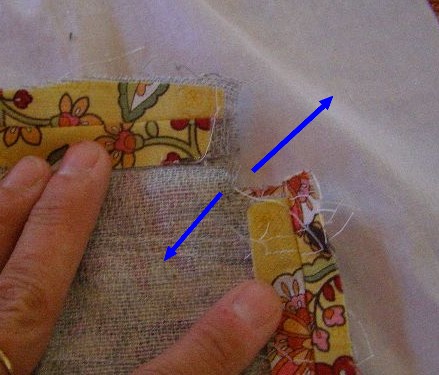
Step 11.  Lay flat and then pull sides apart.

Step 11. Lay flat and then pull sides apart.

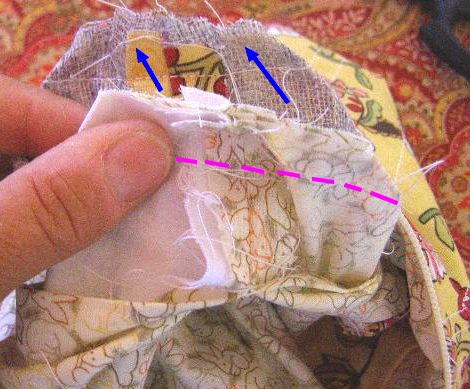
11. Iron bottom and side seams open (to the extent possible).  Lay the exterior piece flat as shown in Photo Step 11.

Put your index fingers into the square opening and gently pull the sides apart in the direction of the blue arrows.

This forms the gusset (flat bottom) so the bag does not fall over.

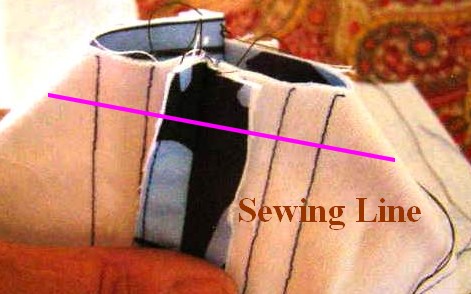
Step 12:  Gusset Sewing Line

Step 12: Gusset Sewing Line

12.  Line up the side seam with the bottom seam as shown in Photo Step 12.  Sew along the Sewing Line as pictured by the pink line in Photo Step 12.

Repeat this for other side of bag exterior and both side of the lining.
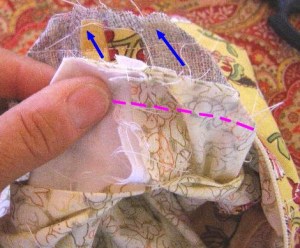
Step 13:  Align gusset seams of lining and exterior.

Step 13: Align gusset seams of lining and exterior.

13.  Align the lining gusset seams with the exterior gusset seam on one end of the bag as shown in Photo Step 13.

Sew the two gussets together along the same seam line used to sew the lining gusset seam.

By sewing the two gussets together, the lining will not come loose in the bottom of the bag.

Turn bag right side out again.

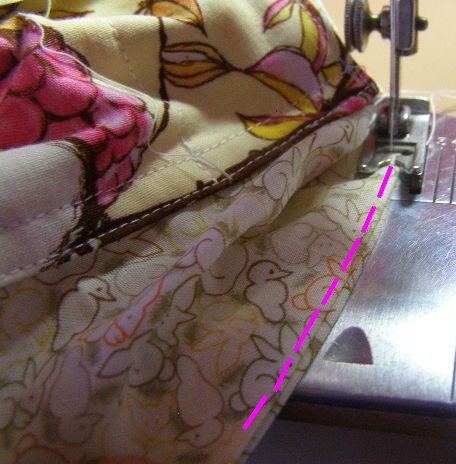
14.  Two options exist for sewing the opening in the bottom seam of the lining:  Machine stitching or hand stitching.

Step 14:  Closing Lining opening by Machine

Step 14: Closing Lining opening by Machine

I tend to do it by hand, because it is invisible.  However, it can be accomplished quite quickly by machine as shown in the Step 14 Photo.

Either way, when that opening is closed…the Cosmetics Case/Make-Up Bag is complete!

Posted in Accessories, Purses, Sewing, Sewing for a Teenager, Tutorial | Tagged , , , , | 3 Comments

Destashification Make-Up Bag, Part 3: The ZIPPER!

 Z-I-P-P-E-R

Second Lining with Zipper

Second Lining with Zipper

A great scrabble word.

But putting one in a project can stop some needleartists in mid-seam!  The second side of the lining of the Destashification Make-Up Bag has a zippered pocket.

But relax…it is sewn in without basting, tears, or frustration. Just follow these steps.

Part E:  Cutting the second lining pieces

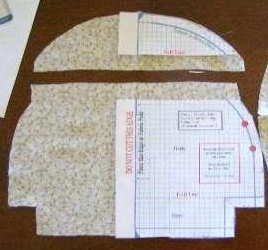
1.  Cut one mushroom from the second fabric scrap.  This piece will be the inside pocket. It will only show when the pocket it opened.

Second Lining Piece Cutting Lay Out

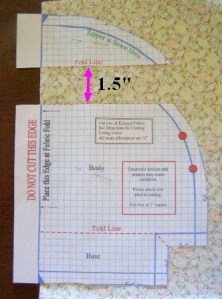
Second Lining Piece Cutting Lay Out

Second Lining Pieces Cut Out

Second Lining Pieces Cut Out

2.  Cut the pattern piece in two along the upper fold line. Fold lining fabric once and press. Place pieces with left side along fabric fold and 1.5″ between the upper and lower pieces.  Pin in place.  Cut out pieces along upper, right and lower edges.  Cut between the two pieces dividing the 1.5″ in half.  This will provide 3/4″ seam allowances.

Part F:  The Zipper

Zipper Opening and Seam in Lining

Zipper Opening and Seam in Lining

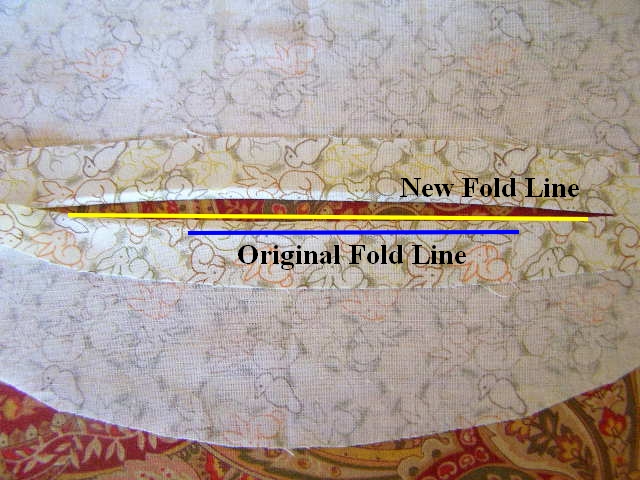
3.  Sew the upper piece to the lower piece leaving the middle section open.  The seams should be approximately 2″ long on the left and right side, but the middle (length of zipper) is not sewn.

4.  Fold along seam and press open (blue line in photo).  Then pull the seam open just a bit more (yellow line in photo) and press again.


Zipper in Lining Opening

Zipper in Lining Opening

Pin Zipper to Lining

Pin Zipper to Lining

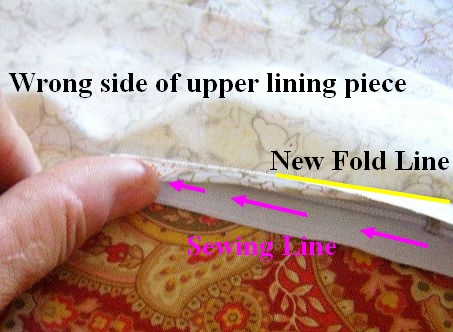
5.  Place zipper in the opening.  Pin the right side of the zipper to the seam allowance that extends beyond the “new” fold line. Do not pin the right side of lining – just the seam allowance.

First Sewing Line for Zipper

First Sewing Line for Zipper

Sewing zipper to Lining Seam 1

Sewing zipper to Lining Seam 1

First Zipper Seam, showing Second Seam Line

First Zipper Seam, showing Second Seam Line

6.  Sew as shown in photo.  The seam will be approximately 1/4″ from the zipper teeth.

7.  Sew a second zipper seam closer to the zipper teeth.

Lining Zipper Seams 1 (pink) and 2 (blue)

Lining Zipper Seams 1 (pink) and 2 (blue)

8. Repeat with the other side of the zipper.   Try the zipper!

Sew Lining to Inner Pocket Piece

Sew Lining to Inner Pocket Piece

Place Zippered Lining on top of Inner Pocket Piece

Place Zippered Lining on top of Inner Pocket Piece

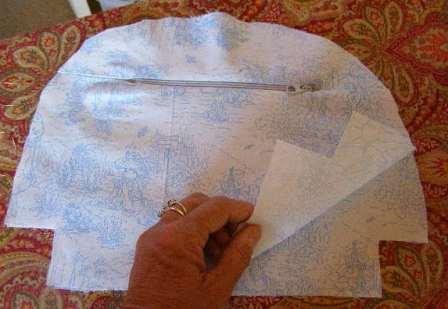
9.  Place the lining piece on top of the scrap fabric mushroom (inner pocket).  The right sides of both pieces should be up.  Fold the “mushroom top” of the lining piece down to expose the seam where the zipper was sewn in.  Stitch again along the same seam line to secure lining to inner pocket.

Zippered Lining Final Seam Lines

Zippered Lining Final Seam Lines

10.  Press lining top up.  Pin lining to inside pocket (scrap mushroom).  Sew lines from ends of zipper to base as shown.  Using tape will help produce straight seams.  Sew along lower fold line.  These seams will make the pocket smaller, but prevent smaller cosmestic items from being lost in the corners when in use!

Using tape to keep sewing lines straight

Using tape to keep sewing lines straight


Using tape will help keep the seams straight.

……and the second lining piece is now complete!

Next:  Completing the Cosmetic Bag!


Posted in Accessories, Purses, Sewing, Sewing for a Teenager, Tutorial | Tagged , , , | Leave a comment

Another Tutorial: Destashification Make-Up Bag, Part 2

Now that the quilting of the exterior is complete, it is time to move onto the interior of the Destashification Make-Up Bag.

Part C:  Cutting/Sewing the Lining Pieces and Vertical Seamed Pocket

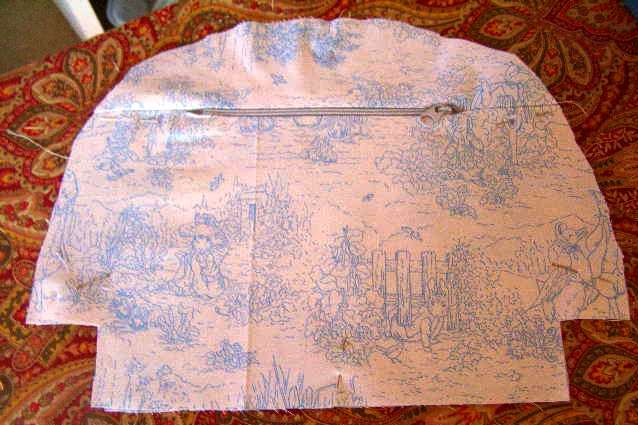
1.  Cut one lining “fat mushroom” in the same manner as the exterior pieces.  The second lining piece(s) will be cut at another time.  Fold along fold lines and press with steam iron.  Then open the folds. These fold lines are used for quidelines – they are not to remain folded.

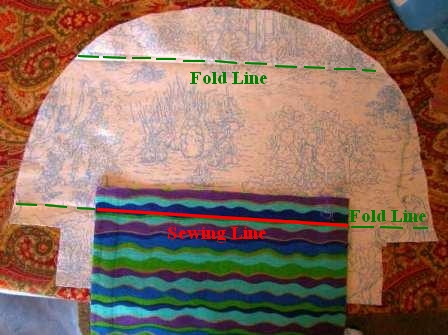
The fabric lining is a Beatrix Potter toile.  The pocket is an FUDOS (Fabric of Unknown Date and Origin from the Stash).

Step 2:  Lining with Fold Lines and Pocket ready for sewing

Step 2: Lining with Fold Lines and Pocket ready for sewing

2.  Using the approximately 10″ by 12″ fabric scrap, cut a 9″ by 11.5″ rectangle.  Fold it in half, right sides together, to create a 9″ by 5.75″ rectangle.  Sew side seams as shown in photo.  Turn pocket right side out and press.

Step 3:  Lining and Pocket showing Sewing Line

Step 3: Lining and Pocket showing Sewing Line

3.  Place cut edge of Interior Pocket fabric 1/2″ above lower fold line of lining. Sew along the sewing line as shown in photo.  Press pocket upward.  Trim the 1/2″ inch pocket seam allowance to approximately 1/4″.  Pin pocket to lining.

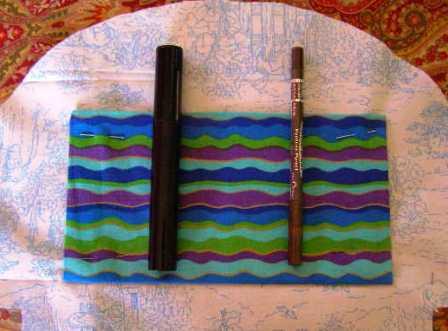
4.  Place make-up on pocket to estimate widths of vertical pockets.  Typically 1″ to 2″ will work.

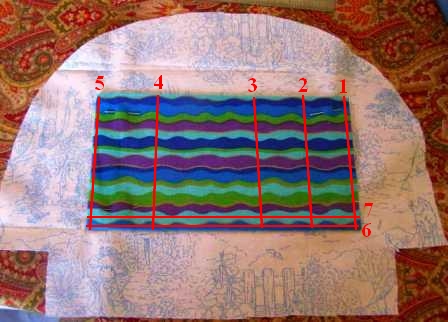
5.  Sew one pocket edge to lining (Seam 1 in Step 5A Photo).

Step 4:  Estimating pocket widths

Step 4: Estimating pocket widths

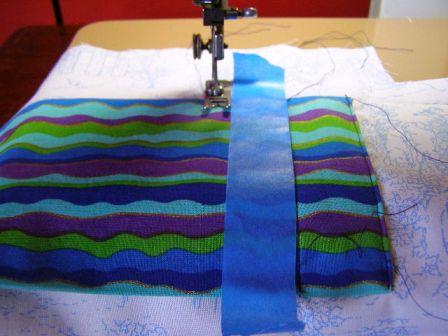
Step 5B:  Tape may help keep seams straight and even.

Step 5B: Tape may help keep seams straight and even.

Working across the pocket, sew additional vertical seams in pocket at desired widths (Seams 2 – 5 in Step 5A Photo).

Step 5A:  Suggested order to sew pockets seams.

Step 5A: Suggested order to sew pockets seams.

It may help to use tape (blue painter’s tape works very well) to maintain straight and even seams.

6.  Sew along the bottom edge of the pocket close to the edge (Seam 6 in Step 5A Photo).  and then again approximately 1/4″ above that seam (Seam 7 in the Step 5A Photo).

First Lining Piece Completed!

First Lining Piece Completed!

7:  The first lining piece is complete!

Posted in Accessories, Sewing, Sewing for a Teenager, Tutorial | Tagged , , , , | Leave a comment

Another Tutorial: Destashification Make-Up Bag

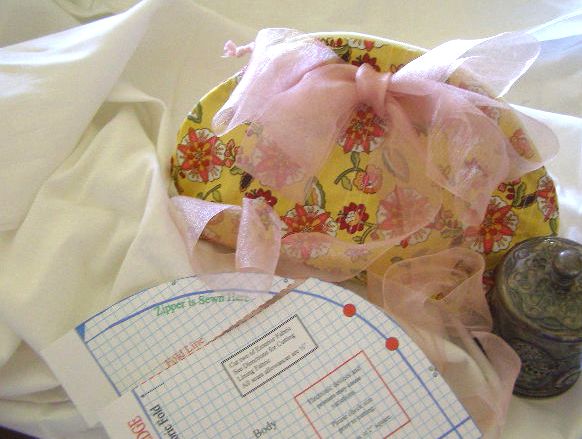
Completed Destashification Make-Up Bag

Completed Destashification Make-Up Bag

With all the travel planned for this summer, my DD really needed a new cosmetics case.  However, I have learned the term “Cosmetics Case” is apparently outdated – it is a “Make-Up Bag.”

Make-Up Bag: Interior Zippered Pocket

Make-Up Bag: Interior Zippered Pocket

While I was making the bag, I put together this short tutorial.  For a new sewer needleartist, the bag presents a small project with  opportunities for trying new skills.

Make-Up Bag: Interior Sectioned Pocket

Make-Up Bag: Interior Sectioned Pocket

These include:

  • Quilting
  • Zippers (2)
  • Lining
  • Pockets

The fabric I used is called “Wondersquid” by Melisza.  It is available on Spoonflower. (One website does not provide sufficient space to describe the fabric available there!)

Make-Up Bag Pattern

Make-Up Bag Pattern 

Items Required:

  • Exterior = One fat quarter
  • Interior = One fat quarter
  • One piece:  approximately 12″ by 12″
  • One piece : approximately 10″ by 12″
  • Interfacing, flannel, or VERY thin batting (the size of one fat quarter)
  • Two zippers (see below)
  • Freezer Paper (yes, really, Freezer Paper)
  • Make-Up Bag Pattern

OR;

What ever The Stash can provide!

My Stash contains numerous zippers.  I used a 12″ purse zipper (has two zipper heads and neither end opens) and a 6″ skirt zipper, but any zipper up to 18″ and a 7″ will work.  The red dots on the pattern indicate the “zipper zone” or the space within which the zipper ends should fall.

Part A:  Cutting the Fabric.

1.  Print out Make-Up Bag Pattern.  Verify that the red square is approximately 2″ square.  Trim away excess paper.

2. Lay the exterior fat quarter fabric flat with the longer side horizontal.  Bring right and left edges together and then bring upper and lower edges together.  The folded fabric will be 4 layers thick and approximately the size of an 8.5″ by 11″ sheet of copy paper.  Press with steam iron.

3.  Turn the fabric so the 4 cut edges of the fabric are to the top and the right.  The left side should have a single fold visible and the lower edge should have two folds visible.

Two Fat Mushrooms

Two Fat Mushrooms

4.  Place the left side of the pattern (marked “place along fold”) along the left side fold of fabric.  Pin pattern in place.  Cut along cutting line (the outermost line) along the top, right side and lower edge.  Do not cut the left side.  Make very small notches at the blue triangles to mark the all important center-point.  Remove pins and unfold fabric.  You should have two pieces of fabric that can best be described as “fat mushrooms”.

Part B:  Quilting the Exterior Fabric

1. Using the 2 mushroom shapes as patterns, cut interfacing, flannel or batting (referred to as interfacing from this point on) in same shapes as the exterior fabric.

If interfacings are too heavy, sewing the zipper may be difficult.  I used flannel from The Stash and it worked well. A mid-weight or suit-weight fusible interfacing will also work well.

2. If interfacings are fusible, iron them to BACK of exterior fabric mushroom shapes.  If not, pin them to the BACK of the fabric in several locations to them secure.

CD and Scalloped Quilting Design drawn on Dull Side of Freezer Paper

CD and Scalloped Quilting Design drawn on Dull Side of Freezer Paper

3.  Cut two pieces of Freezer Paper slightly larger than the size of the mushrooms.  Note that the freezer paper has a shiny side and a dull side.  Draw a pattern for quilting on the DULL side of the paper.  I used a CD to draw a shell pattern.  Vertical lines at random distances also looks nice.  Crease paper along Center Line.

Although these are small pieces, difficulty will be encountered if the quilting design requires complete or nearly complete circles.  The fabric will “bunch up” against the sewing machine base while turning.  To avoid unnecessary frustration, draw a pattern that does not require turning the fabric more than 180 degrees (half way around).

Freezer Paper ironed onto Fabric

Freezer Paper ironed onto Fabric

3. Aline the Center Line fold of the quilting design with the center-point notches on the fabric.  Using a medium iron, iron the shiny side of the paper to the RIGHT side of the fabric mushroom. Your design should be facing up.  The interfacing should be facing down.  The freezer paper will adhere to the fabric (it comes up later).  Trim excess paper.

"Follow the Line" Quilting Complete

“Follow the Line” Quilting Complete

4.  Select a thread to quilt with.  This color can be coordinating or contrast – but be aware that it will be visible.  Using a slightly shorter stitch than normal, sew along the lines of your quilting drawing to quilt.  The stitching will past through the paper, the fabric, and the interfacing.

Removing Freezer Paper

Removing Freezer Paper

5.  Peel off paper.  Or better yet, have the children help.  They love this step and feel as though they have contributed to the finished product!  The stiching will act as serations so the paper will come up fairly easily.

Removing small pieces of paper may require Tweezers

Removing small pieces of paper may require Tweezers

A few small specs of paper may get stubborn at seam intersections – tweezers will help.

Congratulations – The quilting is complete!
Tomorrow:  Creating the first pocket in the Lining.

Posted in Accessories, Quilting, Sewing, Sewing for a Teenager, Tutorial | Tagged , , , | 7 Comments

Can you Make Me a Dress for Tonight?

Two malls, three mail order catalogs, and at least 8 stores later, it became apparent that current junior fashions are not constructed for a girl over 6 feet tall!

So, the decision to “let Mom try to make something” was finally made  – with less than 10 hours to go.

She did not like any of fabrics in The Stash so, a quick run to the Fabric-Store-that-cannot-be-named was required.

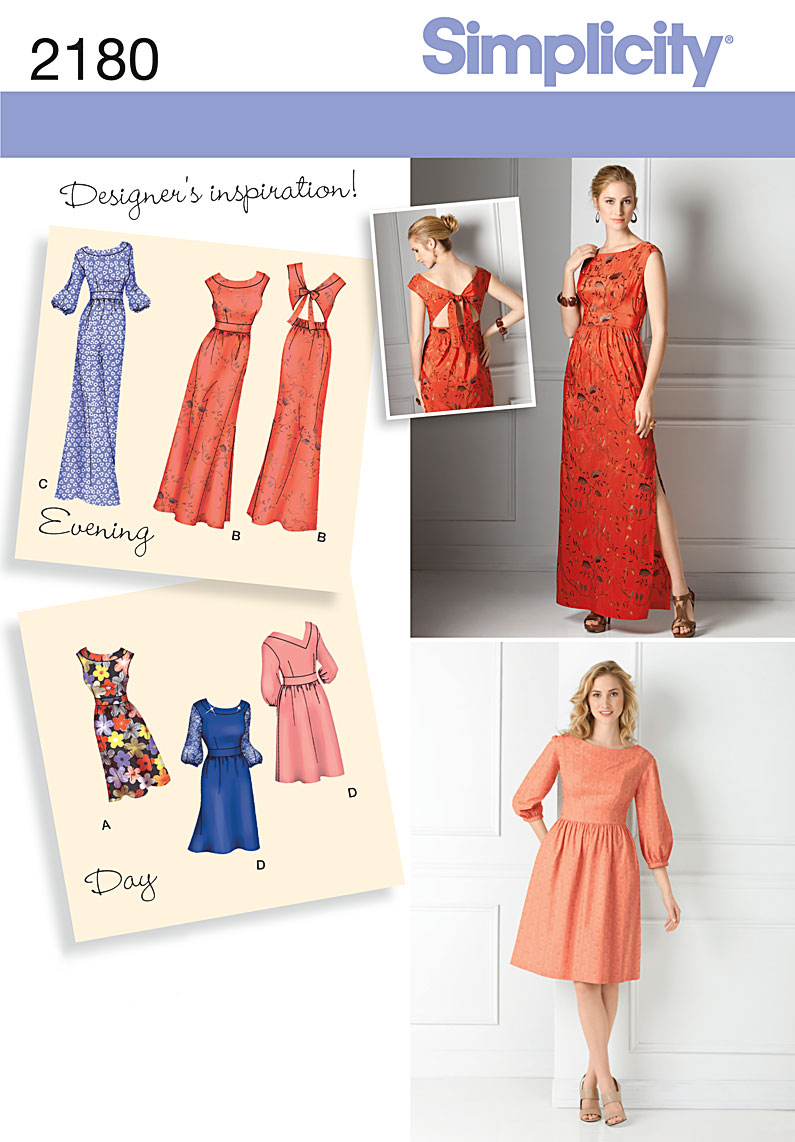
Simplicity 2180

Simplicity 2180

Simplicity 2180 and a blue/gold polyester brocade in a sari-type weave were selected.

The ability to look at a pattern and envision how it might look in a different color or fabric comes naturally to someone who has sewn their own clothing for a number of years.

To a 15-year old who does not sew, however, the vision is limited to just pictures on the pattern.

Well, on the bright side – she loved the fabric!

Cut the skirt with the border along the hem – 8″ longer than suggested by the pattern.  Cut the body length in a 14, the waist in an 8, and the bust in a 10.  (Love multi-sized patterns!)

It was almost done when she got home from track practice.

…and with 2 hours left – it did would not button at the waist!

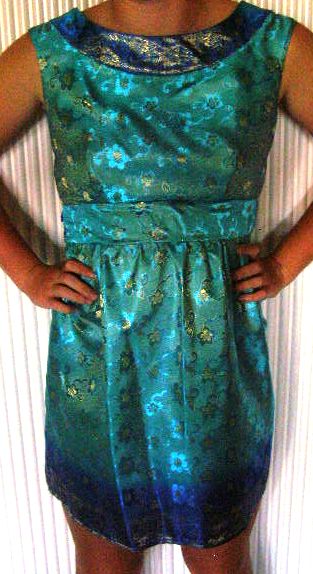
DD Dress - Front View (the stance indicates how happy she was to pose for the pix!)

DD Dress - Front View (the stance indicates how happy she was to pose for the pix!)

The body should have been another 2″ longer to place the waist at her waist.  So, a quick recut of the waist band to now be an “empire waist” waist band….and with 15 minutes to go the dress was done!

She looked beautiful!  The lighter blue is the color of her eyes!  The color was very striking.

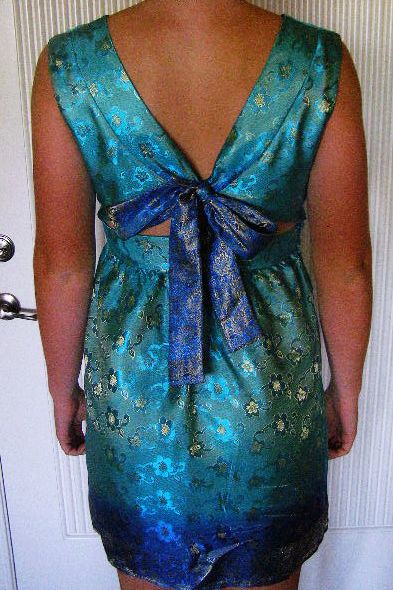
DD Dress - Back View

DD Dress - Back View


The tie-back was really worth the effort.  It required more than a yard of fabric just for the ties.  They were cut to transition to the royal blue color for the bow.  The fabric does not have  a great deal of body, so the ties also required full interfacing (courtesy of The Stash).


DD Dress- Back Tie Knot

DD Dress- Back Tie Knot

The pattern is very nicely designed for an athletic figure.  The wider shoulders and V-back visually narrow the waist.  I am sure I will be making another dress with this pattern in the future (with a longer waist length).

I saved scraps of the dress fabric for crazy quilting.  It will work well in small pieces – with large seam allowances.  It presented difficulties to sew the dress with, though, as it raveled almost upon cutting – even before I could get it to the serger!

The highlight of this project was that she actually choose it to wear again – so must be she likes it after all!


Posted in Sewing, Sewing for a Teenager | Tagged , | Leave a comment

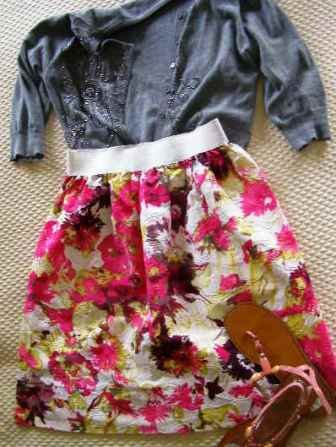
The Instant Gratification/Destashification Skirt

Instant Gratification/Destashification Skirt

Instant Gratification/Destashification Skirt

My daughters requested skirts – the type with the wide elastic as the waistband.

A trip to the mall was required before I understood what was being requested, but the girls were correct – the skirts were going to be simple and quick to sew!

They got to pick out the fabric.  The Stash provided the rest, including the elastic.

This skirt is a floral linen jacquard blend in pinks, bright green, and a dull grey.  Others included a quilting weight black, coral linen and two of grey linen.

If this print skirt looks longer than most of these skirts, it is.  My 15-year old daughter is 6 feet tall and the length of skirts available in stores is one of the reasons she requested I make her the skirts.

IGD Skirt

IGD Skirt

The skirt was cut as a rectangle, 5″ longer than the requested (required)  length and 8″ wider than her widest hip measurement.  I would reduce this to no more than 4″ or 5″ now as she thinks this skirt is a bit too “fat”.

Serging once around the rectangle is a good idea to prevent raveling.

I then turned up 1/2″ on the bottom and stitched it down.  Then turned up another 3.5″ to form the hem, but stitched it only in the middle, leaving the first and last 8″ of the hem open (for now).

Notched Upper Edge and pinned elastic.

Notched Upper Edge and pinned elastic.

Along the upper edge, I notched (cut very small triangles – maybe 1/4″) at the center front (fold fabric in half to find) and then again at the two side points (fold in half again).  So the notches were cut at the 1/4 point, the 1/2 point and the 3/4 point on the upper edge.

I cut a piece of 2″ wide elastic the same size as my daughter’s waist.  Pins were used to mark the 1/4, 1/2 and 3/4 points on the elastic.

In the photo above, the yellow line is 1″ from the upper edge of the skirt fabric.  The elastic should overlap the skirt approximately 1″ for stitching.

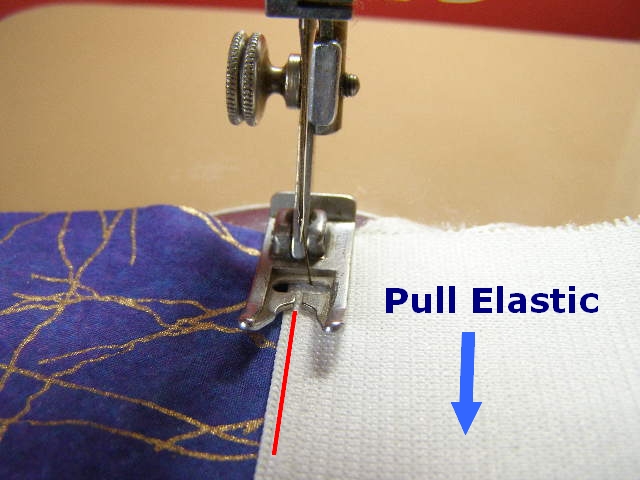
Secure and then pull elastic while stitching

Secure and then pull elastic while stitching

To attach the elastic to the skirt, stitch forward and back approximately 1/2″ to secure, and then continue stitching while pulling elastic to align 1/4 notch with 1/4 pin.

Stitching will gather skirt fabric

Stitching will gather skirt fabric

Once past the 1/4 marks, repeat until stitching reaches the 1/2 marks, and then again until it reaches the 3/4 mark and then to the edge.

Stitch down ends of elastic

Stitch down ends of elastic

Sew center back seam.  Complete the remaining section of the hem.

Stitch ends of elastic to secure.

Instant Gratification

Instant Gratification

And the Instant Gratification/Destashification Skirt is complete and ready to wear!

Posted in Sewing, Sewing for a Teenager, Stash Couture, Tutorial | Tagged , , | 13 Comments

The Destashification Mystery Project Revealed with Tutorial

It will probably be used more than any other project I ever made.

Destashification Mystery Project closed

Destashification Mystery Project closed

It is small, fits in a purse or backpack, and when closed, the contents cannot be identified.

It is the Destashification Mystery Project and takes less than an hour to make with scraps from The Stash!

please click here for the ID and Tutorial

Posted in Accessories, Sewing | Leave a comment

Arizona AC-Proof Destashification Sweater

The Arizona Desert in the summer is hot, but the AC is not.  Most buildings are air conditioned to a surprisingly cool temperature, although even 80 degrees is chilly after being in 110+ degrees.

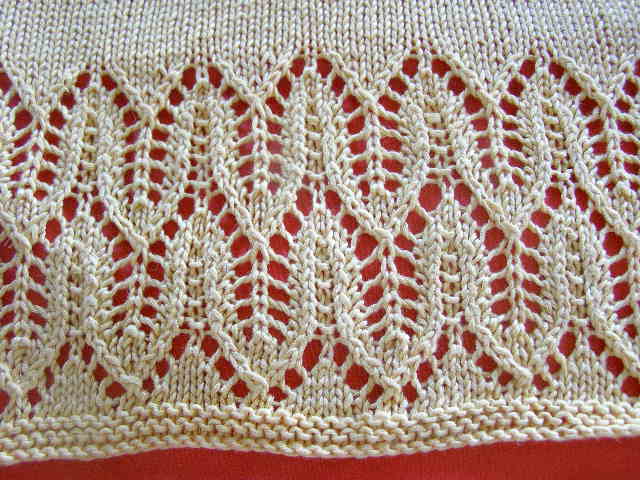
AC-Proof Sweater Lace Detail

AC-Proof Sweater Lace Detail

To ward off the summer indoor chill, the AC-Proof Destashification Sweater was knit.

The pattern used was a combination of two patterns.  The Oriel Lace Cardigan by Kirsten Hipsky is what the cardigan was based on, but the lace pattern came from Bamboozle Cropped Lace Cardigan by Gail Tanquary.

AC-Proof Destatshification Sweater

AC-Proof Destatshification Sweater

The yarn is a Bamboo worsted weight from The Stash.  I do not know the name of the yarn.  The color is a warm yellow, not the pale yellow in the detail photo.

The Oriel Lace Cardigan Pattern is a top-down pattern – which I prefer.  No pieces and no seaming.  I have a “stash” of FABS (finished – all but the sleeves) pieced sweaters that I lost interest in. Someday….

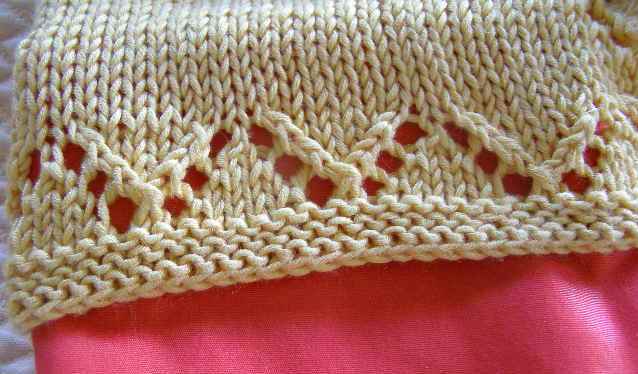
Sleeve Lace Detail

Sleeve Lace Detail

The lace on the sleeves is just the first few rows of the lace pattern from the Bamboozle sweater.

The yarn does not have much body – it is “slinky”, more like a rayon.  However, that is one of its benefits.  Sweaters in Arizona need to be “packable”.  Once one returns to the 110 degrees outdoors, it is just too hot to wear or even carry a sweater.

AC-Proof and Wrinkle-Proof!

AC-Proof and Wrinkle-Proof!

But this yarn does not wrinkle!  The sweater can be squished into a purse (or maybe a tote) and taken out again when needed!  A quick shake – and AC-Proof again!

AC-Proof and Wrinkle-Proof (OK, Wrinkle-resistant)!  What more could one ask of a sweater!

The links on this page are to the sweater patterns on Ravelry, the ultimate knitting site.  Ravelry is free, but I believe it still requires a password. 

Posted in Knitting, Stash Couture | Tagged , | Leave a comment

Destashification Mystery Project: Another Hint

Destashification Mystery Project Exterior

Destashification Mystery Project Exterior

The Mystery Project remains a mystery.

Destashification Mystery Project Interior

Destashification Mystery Project Interior

Perhaps a picture of the interior will help identify this very useful and discrete item.

Posted in Accessories, Sewing | 3 Comments