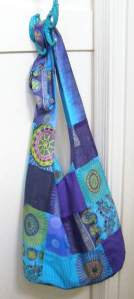
Boho Sling Bag Tutorial: Using “Fat Quarters”

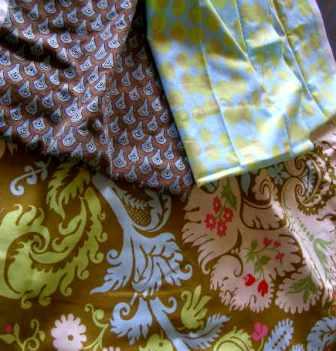
The fabrics available in Fat Quarter cuts are just beautiful…just too nice to pass up!

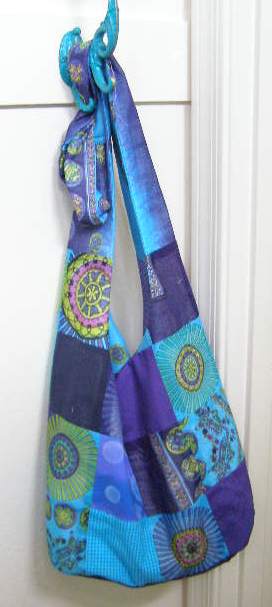
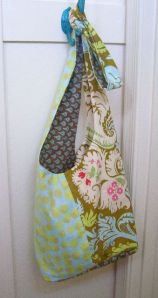
Completed Boho Sling Bag - the blue green fabric is a "Fat Quarter"

Completed Boho Sling Bag - the blue green circle fabric is a "Fat Quarter"

One simple seam allows them to be used in the Boho Sling Bag.

Use the same pattern used to cut the other Boho Bag pieces.

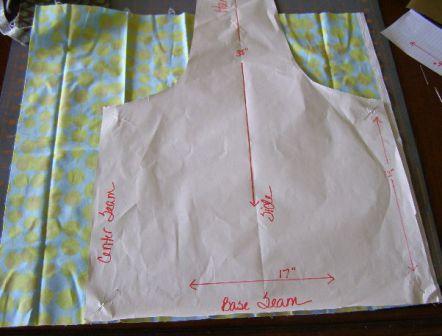
1. Laying pattern on Fat Quarter fabric.

1. Laying pattern on Fat Quarter fabric.

Lay the pattern on the Fat Quarter as shown in Photo 1.  Most Fat Quarters are cut “square” so the lay the pattern close to one corner.  Pin and cut out – but do not remove pins yet.

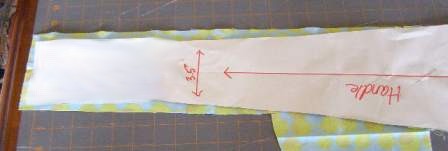
2.  Not quite enough!

2. Not quite enough!

There will be a portion of the handle section of the pattern for which there will not quite be enough fabric.

3.  Using remaining fabric to complete handle portion

3. Using remaining fabric to complete handle portion

There should be more than enough fabric to make that handle portion from the pieces of the Fat Quarter that remain.

Making sure to overlap the fabric pieces at least one inch, pin remaining portion of the pattern to the fabric.

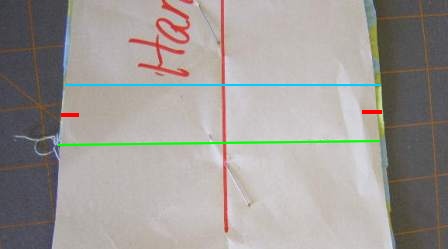
4.  Fabric 1" overlap between blue and green lines.  Make 1/4" cuts at red lines.

4. Fabric 1" overlap between blue and green lines. Make 1/4" cuts at red lines.

Photo 4 shows the fabric overlap between the green and blue lines.  Cut 1/4″ slits at locations shown with short red lines.


Pattern can now be unpinned from fabric.

5.  Align red dots - RIGHT SIDES together

5. Align red dots - RIGHT SIDES together

Place the smaller handle piece on top of the larger piece – lining up the small cuts made at the red line locations as shown in Photo 5.


6.  Sew straight across handle from one slit to the other

6. Sew straight across handle from one slit to the other

Sew straight across handle from one slit to the other as shown in Photo 6.


The small seam is difficult to see!

The small seam is difficult to see!

Press seam open and your piece is complete!

When complete, the small seam in the handle is very difficult to find!

One suggestion – this “piecing” method works well with smaller prints.  The seam all but disappears in the print.

However, if a larger print was used, such as the print on the right, the seam would be much more visible.


Posted in Accessories, Purses, Sewing, Sewing for a Teenager, Tutorial | Tagged | 8 Comments

Boho Sling Bag Tutorial

Boho Sling Bag

Boho Sling Bag

Patchy Boho Sling Bag

Patchy Boho Sling Bag

The Boho Sling Bag – plain or fancy.  A sewing project for everyone – regardless of their sewing pedigree or experience!

The Boho Sling Bag seems to be fairly popular among those that could form the next generation of needle-artists.  It would make a great first project to start their sewing careers!

This Tutorial starts with the “plain” bag.  The few extra steps required to create the Patch Bag are found here.
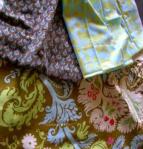
Select Fabrics

Select Fabrics

Just a few items are required to make the Boho Sling Bag.  Some fabric, a sewing machine, thread, scissors, and an iron.

About the fabric:  I have a HUGE STASH of fabric (thus “The Destashification Project”), but if selecting fabrics require purchase, here are some suggestions.
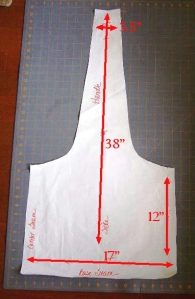
Boho Bag Pattern Sketch

Boho Bag Pattern Sketch

The purse requires four of the pieces shown in the pattern sketch.  The pattern sketch is drawn on a 1″ grid so it may be sketched or click here for a downloadable pattern that may be printed and enlarged.

Four pieces are needed because two for the outside of the bag and two for the lining.

Each piece requires approximately 1/2 yard of 45″ wide fabric.  If a fat quarter catches your eye, I have included instructions for piecing so they may be used here.

Two purse bases (the bottom of the purse) will also require two 8 by 12″ rectangles (download the pattern for boho bag base here – no enlargement required) and the inside pocket requires another rectangle that is 18″ by 13″.

One yard of fabric will be enough for one bag piece, the bases and the pocket.

To give some structural stability to the purse (so it is not flat) the lining purse base is strengthened with a 8″ by 12″ piece of felt/quilt batting/old mattress pad/washcloth, towel, etc.
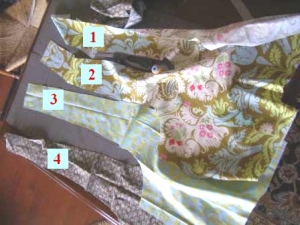
Boho Bag:  4 pattern pieces cut and ready to sew

Boho Bag: 4 pattern pieces cut and ready to sew

Cut out the four bag pieces.  We will be working first with the two pieces for the lining.  The lining of the bag pictured above is made from the pieces numbered 1 and 4 in the photo.

But even before working with the lining, we will prepare the pocket.

Cut out a pocket using the pattern included with the bag pattern or just measure an 18″ by 13″ rectangle.
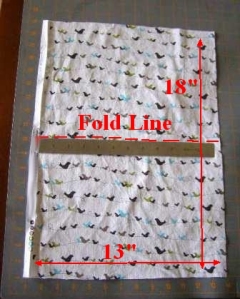
1.  Boho Bag Pocket Rectangel showing fold line
1. Boho Bag Pocket Rectangel showing fold line

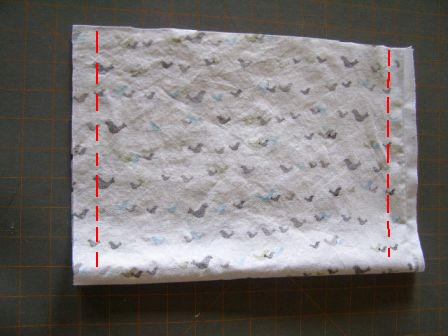
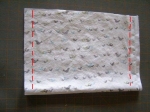
2. Sew seams along red dotted lines

2. Sew seams along red dotted lines

Fold along fold line shown in Photo 1 – RIGHT SIDES together.

Sew along two shorter sides as shown in Photo 2.  Use 1/2″ seam allowance.
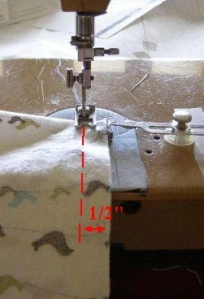
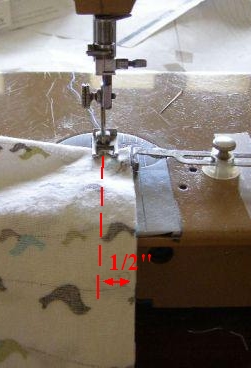
3.  This is a 1/2" Seam Allowance

3. This is a 1/2″ Seam Allowance

Photo 3 illustrates a 1/2″ seam allowance.  The 1/2″ is measured between the stitching and the cut edge of the fabric.  Most sewing machines will have a tool such as the “arm” looking device that is screwed into the sewing machine that assists keeping a nice even seam allowance.

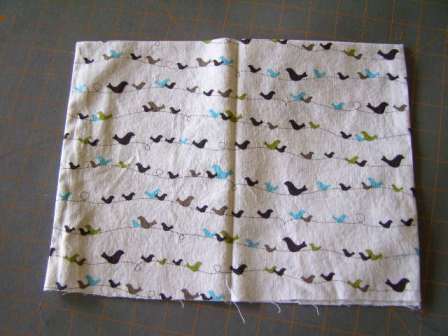
4.  Clip corner

4. Clip corner

Clip corner edge of seam as shown in Photo 4.  It will help produce a nice even corner.
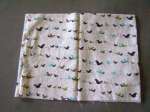
5.  Pocket - Right side out with centerline pressed.

5. Pocket – Right side out with centerline pressed.

Turn pocket right aside out and iron.

Fold pocket by bringing the two seams together and press to make a center line as shown in Photo 5.  Set aside.
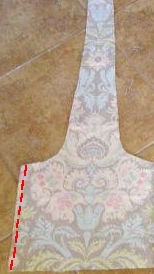
6.  Sew two lining pieces together along ONE side seam

6. Sew two lining pieces together along ONE side seam

Take two bag lining pieces and place them RIGHT SIDES together.

Sew two lining pieces together along ONE side seam using a 1/2″ seam allowance as shown in Photo 6.

7.  Side seam pressed open

7. Side seam pressed open

Press seam open as shown in Photo 7.

Lay linings flat on table with right side facing up.

8.  Placement of pocket on seamed lining pieces

8. Placement of pocket on seamed lining pieces

Place pocket on RIGHT SIDE of Linings, so that upper folded edge is approx. 1.5″ from top edge of lining and pressed centerline of pocket is aligned with the side seam – as shown in Photo 8.

Place a pin at each of the red dots.  The pins should be placed in the lining, 1/2″ from  the lower edge of the pocket.
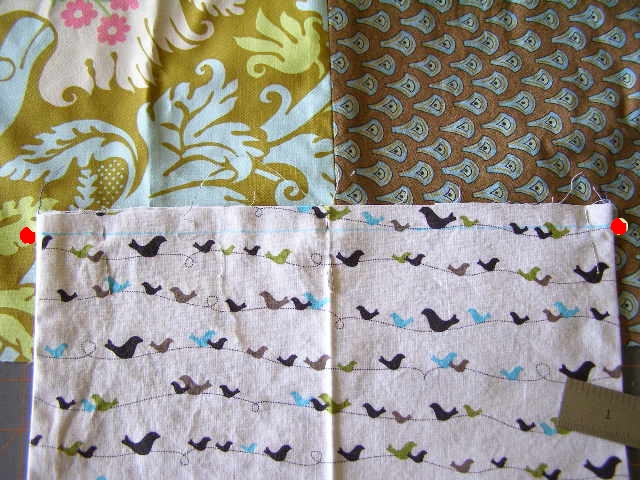
9.  Pocket flipped, with stitching line drawn between red dots (pins)

9. Pocket flipped, with stitching line drawn between red dots (pins)

Flip the pocket upside down (unsewn or “raw” edge upward) as shown in Photo 9.   The raw edge should extend 1/2″ above the pins located at the red dot positions.

Using a pencil or a disappearing marker (they are soooo cool!) draw a line on the pocket connecting the two red dot pins.  This will be the sewing line.
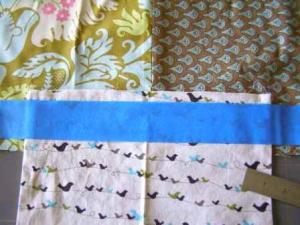
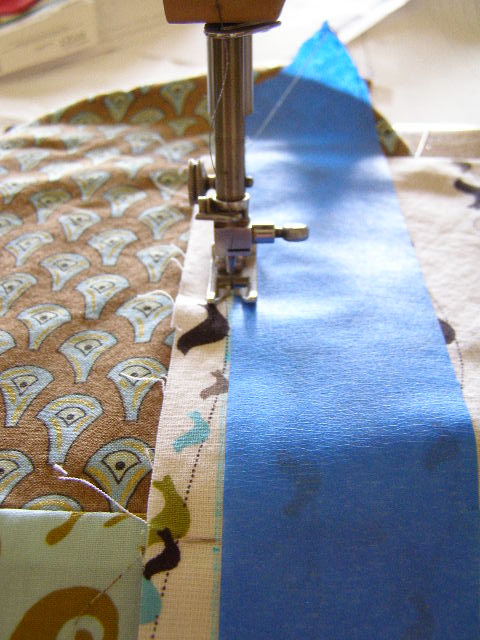
10.  Painters Tape makes sewing a straight line easy!

10. Painters Tape makes sewing a straight line easy!

OR, if drawing on fabric is not something you are willing to do, connect the red dots with blue painters tape.  Either will work fine.
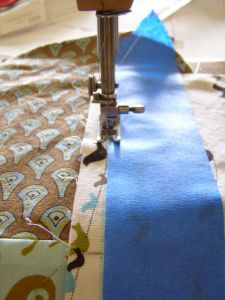
11.  Sewing a Straight Seam the Easy Way!

11. Sewing a Straight Seam the Easy Way!

Sew along the line.  The next time you hear someone say “I can’t even sew a straight line!”  You can respond, “Where’s your painters tape? – I show you an an easy way!”

Flip pocket back up (remove tape first).  Press with Iron.  Pin to lining.
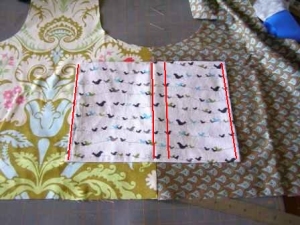
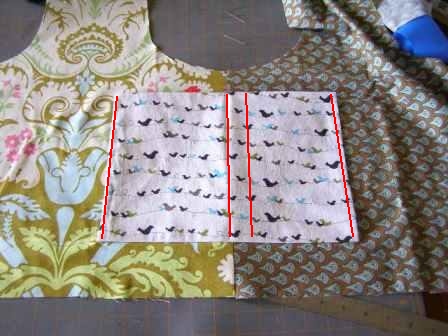
12.   Top-stiching lines for Pocket

12. Top-stiching lines for Pocket

Sew very close to right and left edge, along center fold and 1.5″ left of center fold as shown in Photo 12.  Painters Tape will help keep two middle seams straight.

Because this stitching is done on the
top” of the  fabric, it is called “Top-Stitching”.
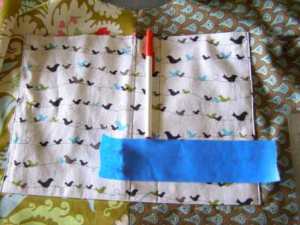
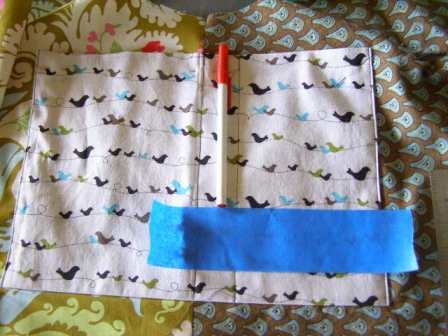
13.  Determining pocket depths and stitching line location.

13. Determining pocket depths and stitching line location.

The narrow center section of the pocket is for a pen.  The section on the right is a cell phone pocket.  Because the pockets are too deep for these items to be easily removed, another top-stitched seam is required.

The depth of the pockets can be easily estimated with a pen as shown in Photo 13.  Use a piece of Painters Tape to keep seam straight and level.  Do not top stitch across the left larger pocket – so it can be used for a larger item.

Now onto the outside of the bag…

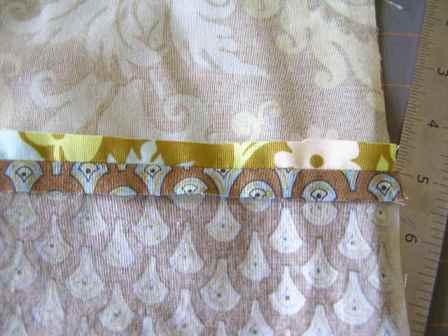
Take the pieces that will form the outside of your bag and place them RIGHT SIDES together.  Sew them together along the side seam, just the same as the two lining pieces were sewn together in Photo 6.
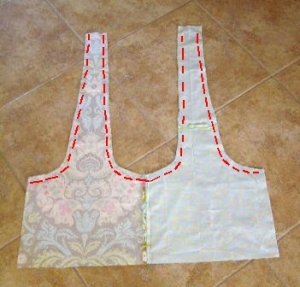
14.  Sew lining to outer fabric along red dotted lines.

14. Sew lining to outer fabric along red dotted lines.

Iron seam open.  You will have a piece that looks like Photo 14.  The lining should look similar – and should have a pocket!

Place the lining on top of the outside pieces – RIGHT SIDES together – and pin together.  Sew together along the red dashed lines as shown in Photo 14.

“Clipping” and “trimming” is required when sewing curves, so the curved portions of the seams you just sewed must be clipped and trimmed.

15.  The right side has been trimmed and clipped.

15. The right side has been trimmed and clipped.

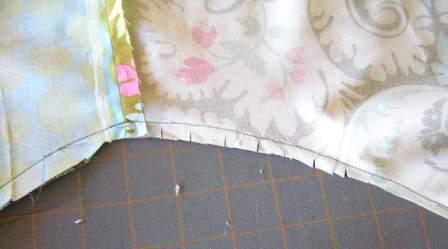
“Trimming” is simply narrowing the 1/2″ seam allowance to 1/4″ by cutting away 1/4″ from the raw edges.  “Clipping” is a series of cuts made perpendicular to the seam as shown in Photo 15.

After clipping and trimming, turn the bag right-side out.  Press with iron.
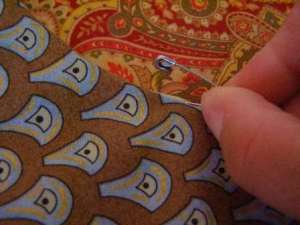
16.  Using pin to pull seam for pressing with iron.

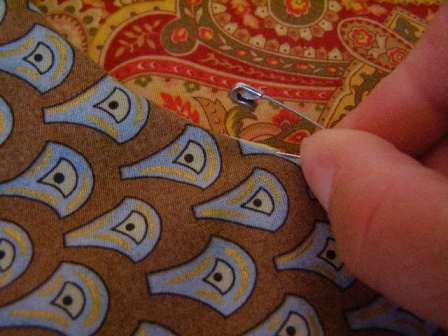
16. Using pin to pull seam for pressing with iron.

To get seams to press nicely – use a larger pin/needle/safety pin to pull the seam as you press as shown in Photo 16.

Now it is time to sew the other side seam…
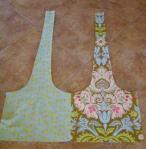
17.  Pressed and ready to sew second side seam.

17. Pressed and ready to sew second side seam.

Lay bag on a flat surface as shown in Photo 17.

18.  Bring far corners together.

18. Bring far corners together.

Bring the two far corners of the outer fabrics together as shown in Photo 18.
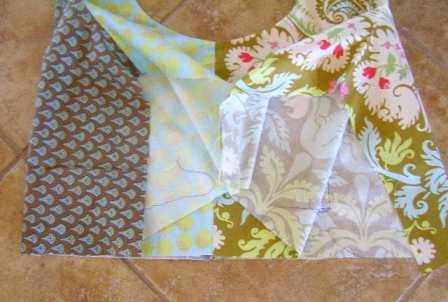
19.  Pinning second side seam

19. Pinning second side seam

Pin those corners together and then pin again approximately 4″ further down unsewn side seam.  This is shown in Photo 19.

Continue pinning the side seam together.  Match the upper seam carefully.
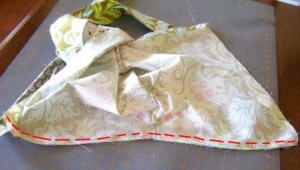
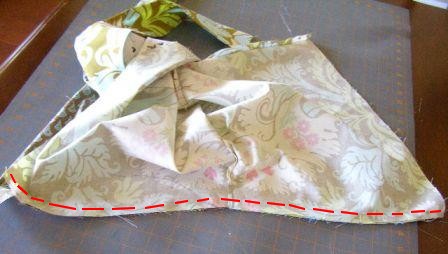
. Second Side Seam completely pinned and ready to be sewn along dotted red line.

20. Second Side Seam completely pinned and ready to be sewn along dotted red line.

When pinning is complete, the bag will be inside out and resemble the odd shape shown in Photo 20.
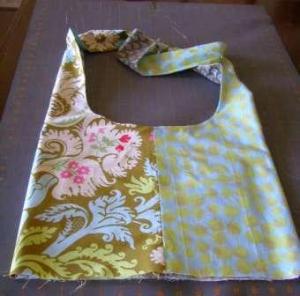
21.  Starting to look like a Boho Bag

21. Starting to look like a Boho Bag

Press seam open. Turn bag right side out.  It should start to resemble to Boho Bag at this point..

Part Two Here.

Posted in Accessories, Purses, Sewing, Sewing for a Teenager, Tutorial | Tagged | 87 Comments

Simple Boho Sling Bag

"Like this one only in purple and turquoise"

"Like this one only in purple and turquoise"

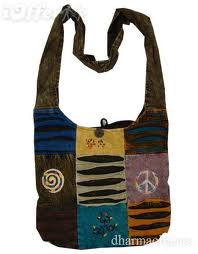
My niece requested a bag “kinda like” this one, “but in purple and turquoise”.

Simple Boho Sling Bag

Simple Boho Sling Bag

This is the result.  Tutorial here.

Many of these boho bags – in a variety of colors – can be seen slung over shoulders.

They also make a very nice sewing project for beginning needleartists, so I thought I might post a tutorial later this week.

The Stash has a number of purple, blue and turquoise fabrics – as they are my daughter’s favorite colors.

However, when combined in a patchwork pattern, the result too brightly colored and  not the boho-look desired.

So, off to my favorite off-price store to better define boho.

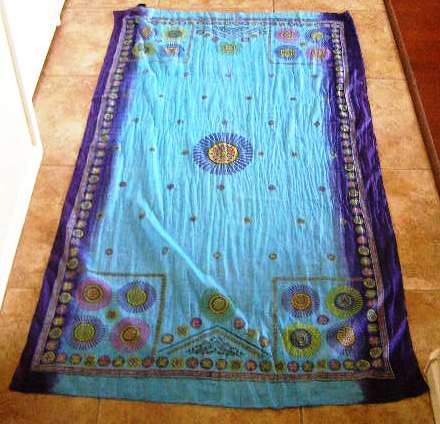
Started with a Scarf

Started with a Scarf

This scarf was the requested colors – and reminded me of the 70s cotton bedspreads (that were typically hung from dorm room ceilings!).  Combine that with the clearance price – and it was perfect!

Cutting Squares

Cutting Squares

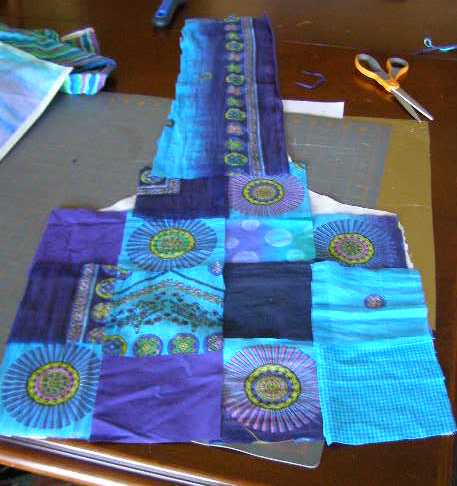
Cutting 5″ squares (for 4″ finished squares) from the scarf produced a variety of motifs.  But just using the fabric from the scarf was a bit overwhelming – so the scarf squares and The Stash squares were combined.

Arranging the Squares on the Foundation Fabric

Arranging the Squares on the Foundation Fabric

The squares were arranged in a pleasing pattern and then sewn to a foundation fabric.  The scarf fabric was very light – and too fragile for “regular” patchwork, so a foundation piecing method was required.

To simplify the sewing process, the stitching lines for the squares were drawn directly onto the back of the foundation pieces.

Note to self:  Once the squares are arranged in the chosen pattern – take a picture because your memory is just not that good!

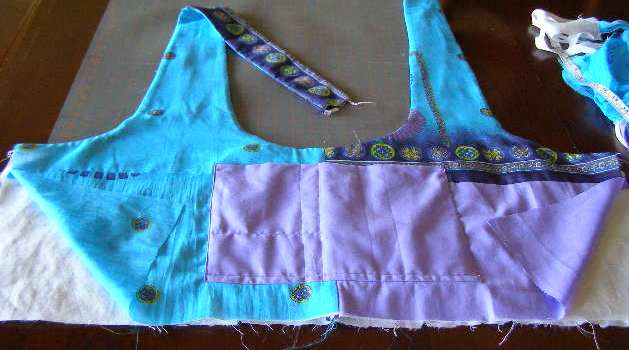
Interior Pocket

Interior Pocket

The interior of the bag includes a very large pockets with compartments for a pen and a cell phone.

Beaded Button Closure

Beaded Button Closure

Finishing touches included a beaded button closure and a few embroidered embellishments.

Posted in Accessories, Embellishment, Purses, Sewing, Sewing for a Teenager | 4 Comments

Destashification Challenge: Drapes from 2,000 miles away…

“Mom,” said the son, “Mom, could you make some drapes for my new apartment?”

Words every sewing mother waits to hear from her grown children….

Coordinating Pillows

Coordinating Pillows

The Stash provides many yards of silk dupioni in a blue-grey, and the coordinating pillows were sent earlier this summer.

While the finished drapes are beautiful (silk dupioni is very forgiving) the journey toward their completion was long and sinuous….

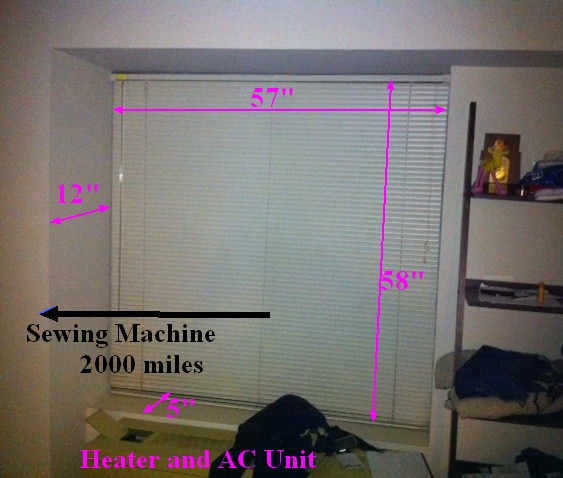
Recessed Window - currently decorated in the "Thrown Coat Motif"

Recessed Window - currently decorated in the "Thrown Coat Motif"

Let us start with the window, apparently intended to be an architectural feature of some note.

The window is recessed – but not uniformly.  The top and left side are recessed approx. 12″ while the right side and the bottom are only recessed 5″.

The actual window (glass) fills almost the entire 57″ * 58″ opening.

At the base of the window is a “hotel style” heater and AC unit.

This architectural puzzle prohibits wall-mounted and/or floor length drapes.  Needless to say, an actual cross-country trip (tape measure in hand) to view this window and its special features (and visit with the son, of course) was required!

So, inside-mount (like a shower curtain) sill-length drapes it is!

Tape Measure was not quite long enough

Tape Measure was not quite long enough

Step two:
Measurements – check again – remeasure – go have coffee – remeasure.  Go workout.  Remeasure – Add 4″ – then cut.

Then do same for lining.

Sewing

Sewing


Step three:  Sewing.  Then do the same for lining.

Step four:  Take the “pull-the-threads” pleater tape back and get real pleater tape.  The pull-the-threads type is great fun – but produces pleats that look more like uneven gathers.

Attaching "Real" Pleater Tape

Attaching "Real" Pleater Tape

Step five:  Sew on the pleater tape.

 Step six:  Return pleater hooks to store.  Apparently, there are a several types of pleater hook available.  “Ceiling” hooks have the hook part near the top of the drape, “wall” hooks have their hook further from the top of the drape.  Other pleater hooks remain a mystery to me.

Along the mystery lines….Fabric Stores all seem to carry “Brand X” pleater tape and “Brand Y” pleater hooks.  (Brand names were changed to protect the innocent).  Apparently this serves to further confound the drapery making process.

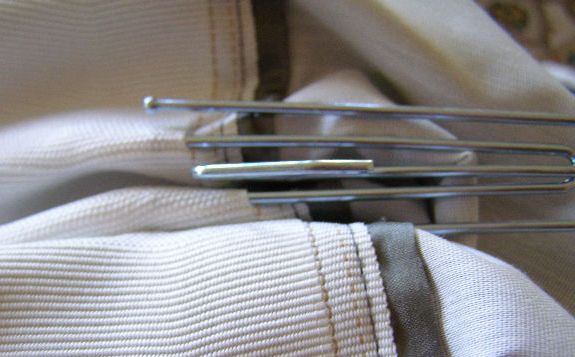
Pleating with pleater hooks

Pleating with pleater hooks

Step seven: Place pleater hooks in pleater tape pockets.  I remember helping my mother do this as a child.  It still seems like fun to take something flat and create nice even pleats!

Except the pleats do not look so “nice” or so “even”.

Not so nice or even pleats

Not so nice or even pleats


Step Eight:  Hand sew each set of pleats so they are nice and even.

Step Nine:  Find an inside mount drapery rod that does not look like Great Aunt Helen’s kitchen cafe curtain rod – and has sufficient structural strength to hold up a set of lined drapes.  Drive 1 hour north to purchase.  Visit fabric store next door.  Add a few things to The Stash.  Drive 1 hour home.

Step Ten:  Place drapes and rod on floor to see if the length is correct (no real margin of error for inside mount drapes).  Realize drapery hooks are too narrow to fit over drapery rod.

Step eleven:  Drive to several ready-made drapery stores to view options.  Visit fabric stores in the vicinity.  Add a few things to The Stash.  Purchase drapery rings with clips in color to match rod on clearance.

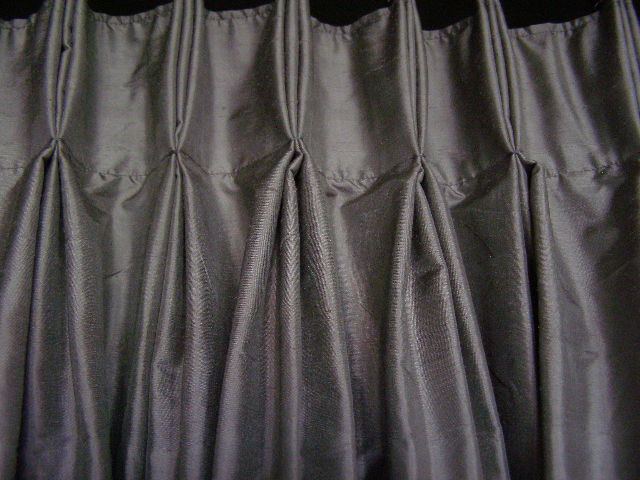
Hand sewn pleats

Hand sewn pleats

Step 12:  Place drapery rings on rod, attach clips to drapery to determine if length is correct.  Realize that the 1.25″ inches added by the rings/chain/hooks makes draperies too long for 58″ vertical opening.

Step 13:  Ask daughter to help cut wire chain and clips off drapery rings.  When she picks up “the sewing scissors” to do so, instruct her quietly and patiently that the sewing scissors are only to be used for fabric… Then go get the wire cutters and cut the wires yourself!

Step 14:  Hand sew drapery rings to hand sewn triple pleats.

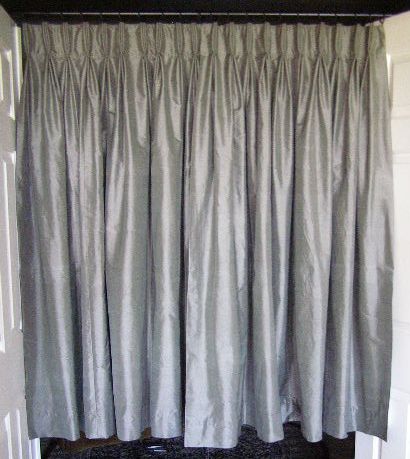
Finally Completed:  Beautiful Drapes!

Finally Completed: Beautiful Drapes!

Step 15:  Place ring/drapes on rod and hang to view.

Step 16:  Measure to verify length is correct….

Remeasure…

Check sketch and initial measurements.

Step 16:  Remove hem and lengthen 1″!

Step 17:  Mail to son.  Insured.  Return Receipt Requested.  With stencil for where and how to place rod in recessed window and instructions for ironing before hanging – knowing full well that ironing is just not going to happen!

Step 18:  Call son and let him know that although the drapes for his bedroom are complete and in the mail, sewing the drapes for his Living Room will be delayed for a while!


Posted in Home Decor, Sewing | Leave a comment

Another Destashification Prom Purse

The Original Prom Purse

The Original Prom Purse

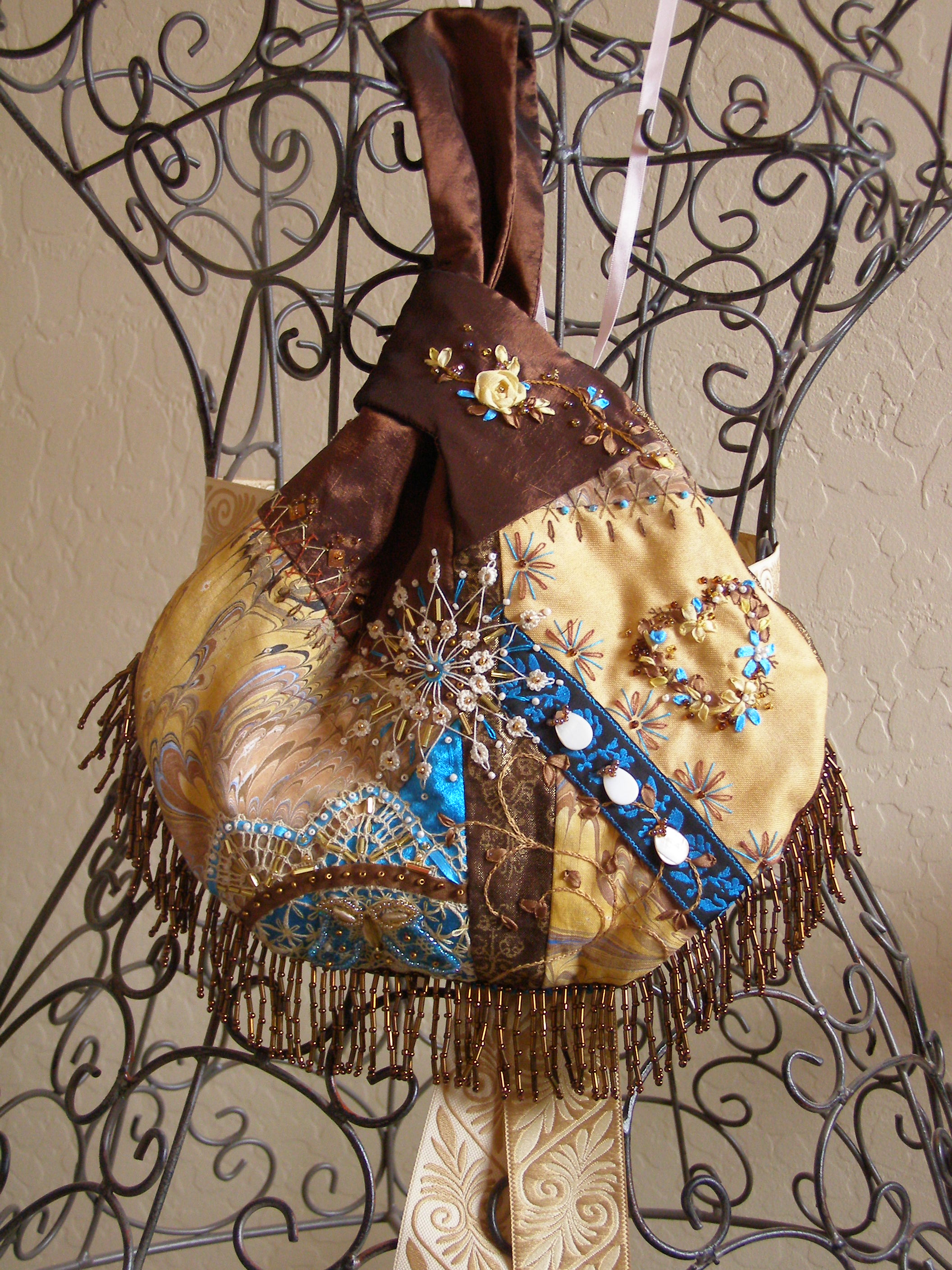
This Prom Purse was the Original Destashification Prom Purse.  Fabrics and trims from The Stash were combined in this prototype.

Reverse side of purse

Reverse side of purse

The brown/blue/yellow colorway was inspired by one of the fabrics and the rest just fell into place.

After it was finished, I could not decide which side was the “front” and which was the “back”.

Tatted Detail

Tatted Detail

Although this detail picture is not very clear, the multi-point star tatted lace motif can be seen.  I taught myself to needle tat just so I could add this motif to the bag.

The silk ribbon heart used an iron-on transfer – something else I had in The Stash!

Lace Detail showing hand marbled fabric

Lace Detail showing hand marbled fabric

The other side of the bag includes a beautiful piece of old lace embellished with silk ribbons, butterfly beads and Stash buttons.

The lower portion of the picture shows the hand marbled fabric that served as the inspiration for the colors used in this bag.  I have a small Stash (a sub-Stash?) of hand-marbled scraps.

Fish in the Sea Scape and other Seam Embelishments

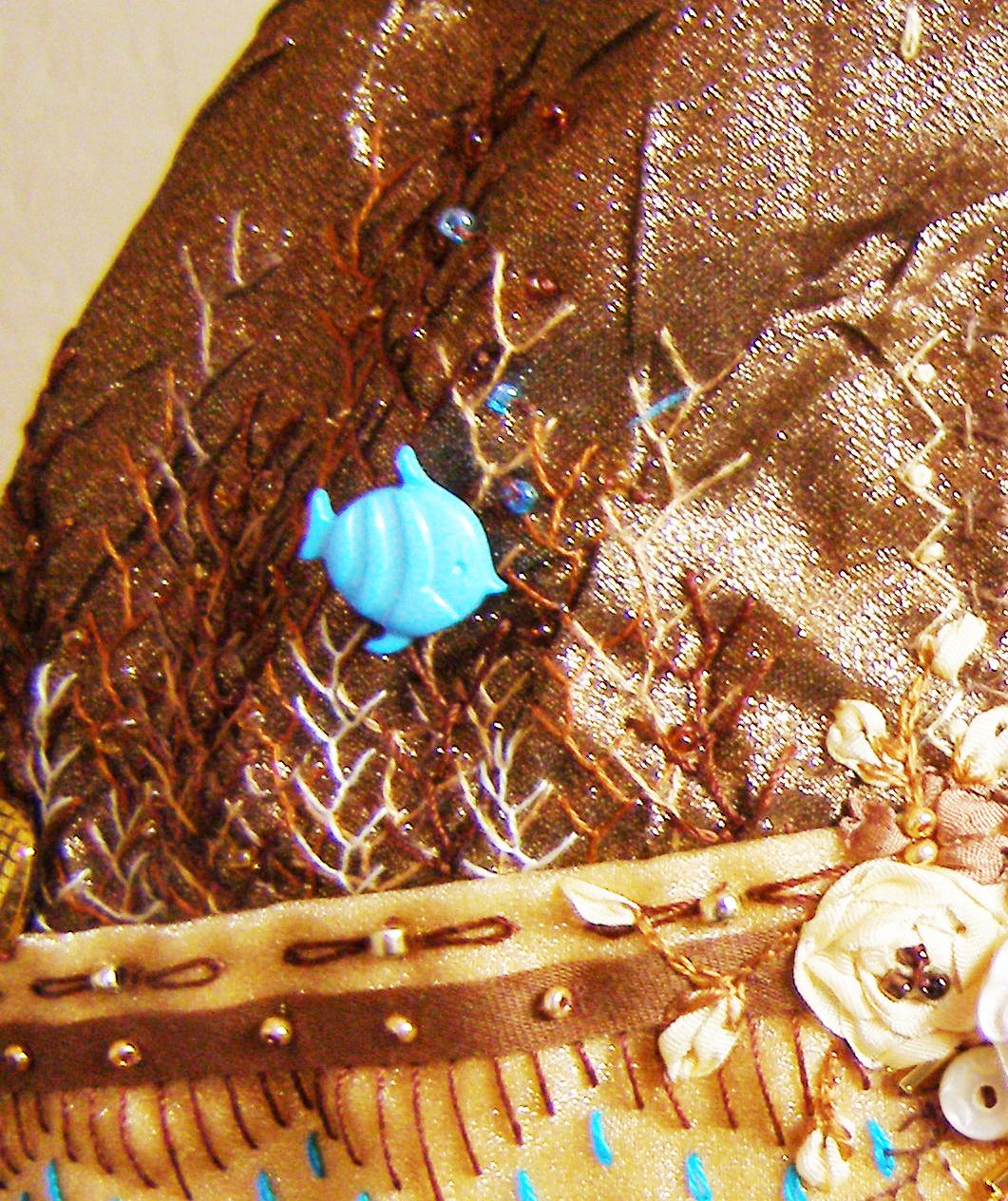
Fish in the Sea Scape and other Seam Embellishments

The blue fish button was purchased specifically for this purse.  The Sea Scape just cried out for just such a fish!

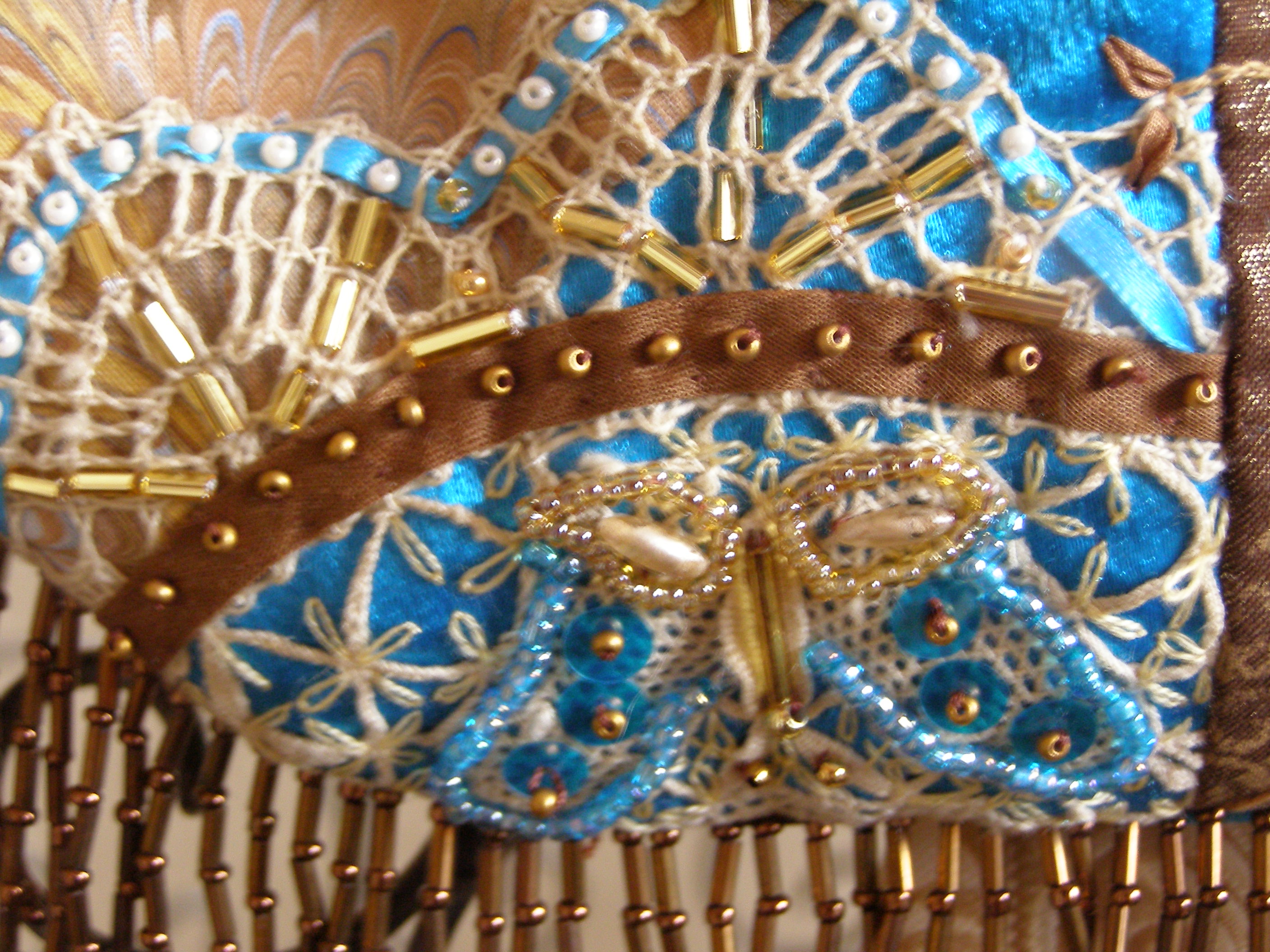
Beaded Butterfly and Fringe

Beaded Butterfly and Fringe

A beaded butterfly floats upside down near the beaded fringe at the base of the bag.

This purse is listed in my Etsy Store

Posted in Accessories, Crazy Quilting, Embellishment, Purses, Sewing | Tagged , , | Leave a comment

Stash Couture Jacket

Embellishing is so much fun!  The level can range from fully encrusted to just a few seam treatments.

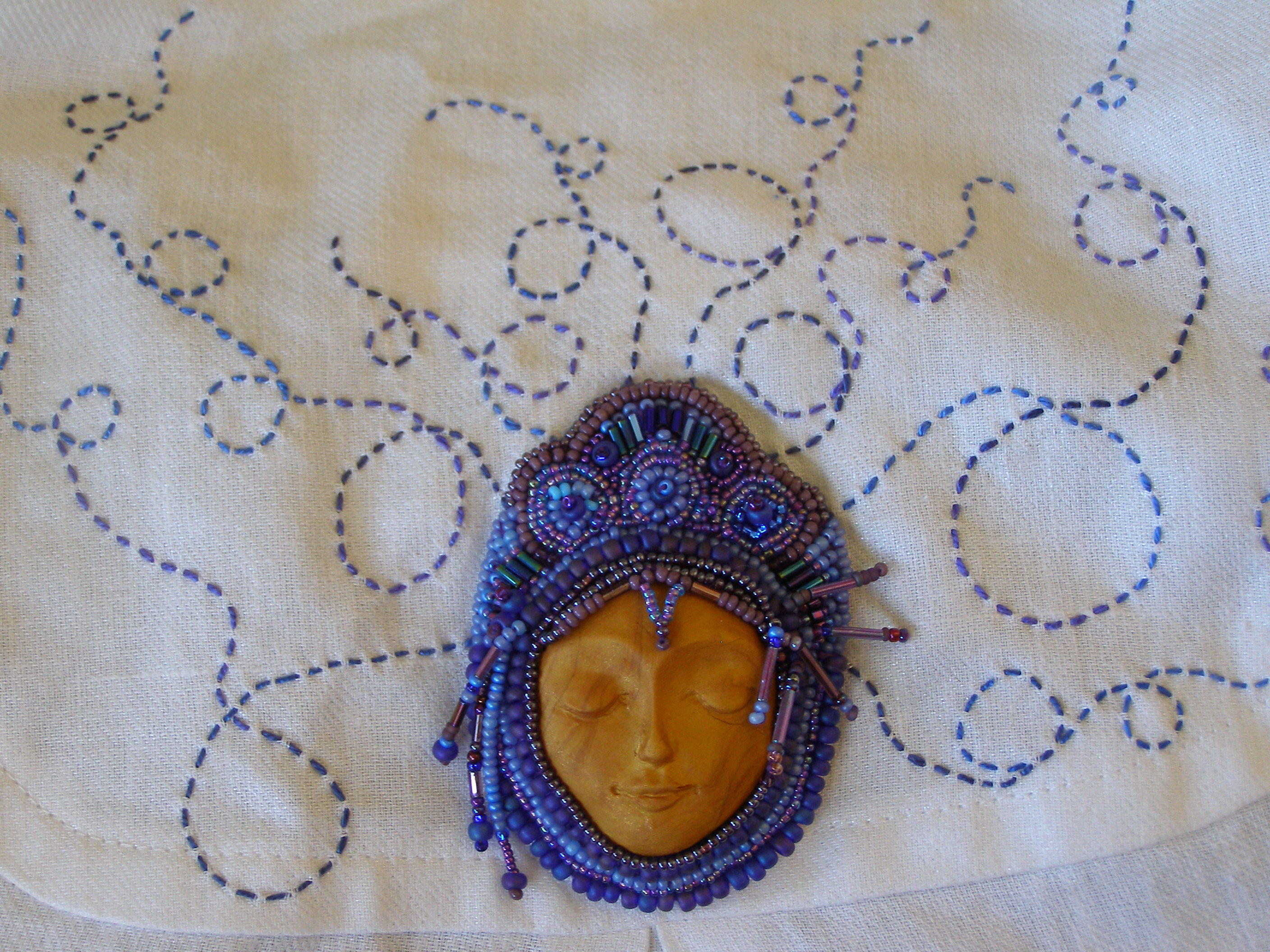
Embellishment on Jacket Back

Embellishment on Jacket Back

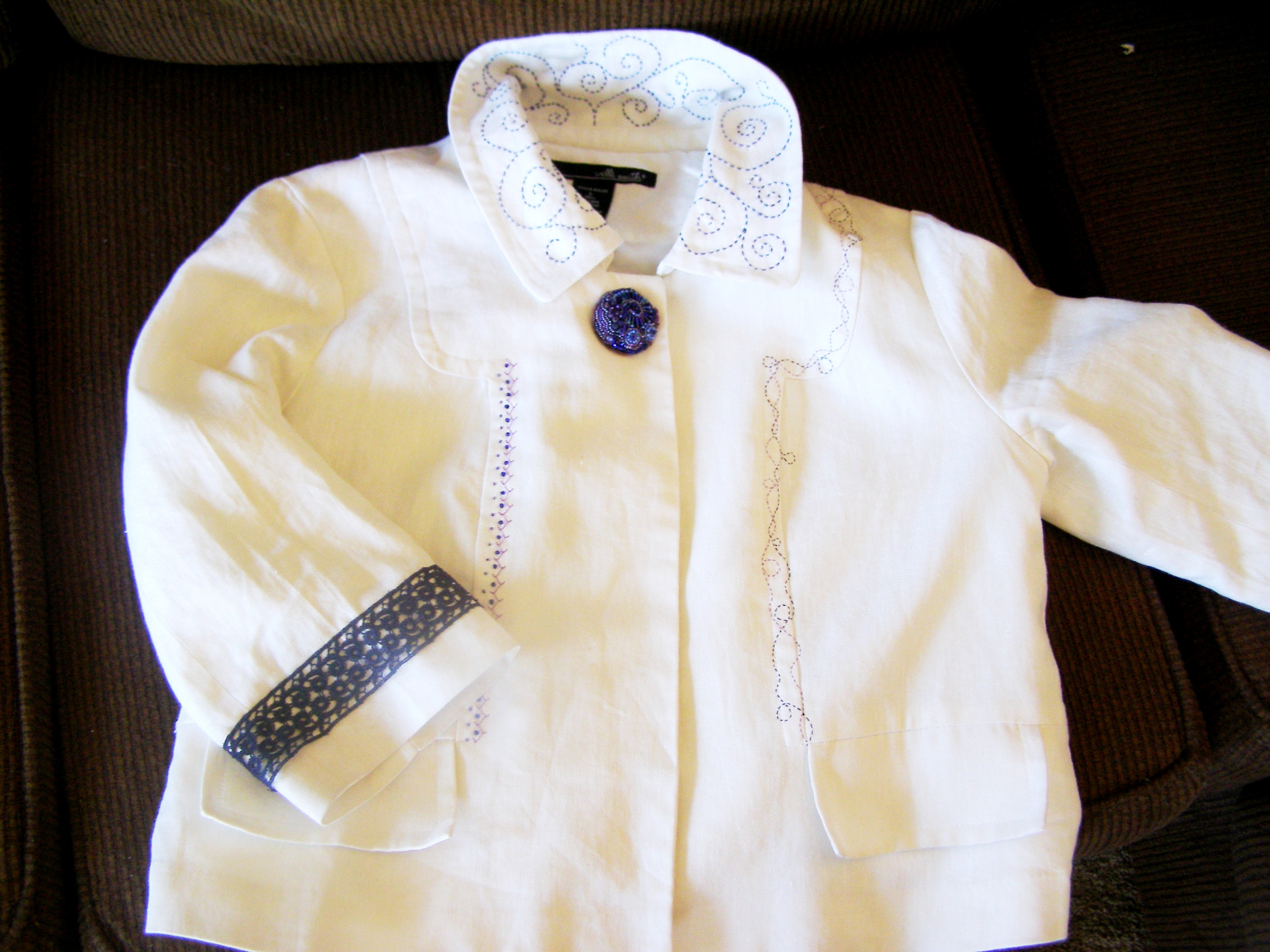
I found a simple white linen jacket at an off-price store.  The jacket had great lines, including a rounded back yoke, but the starkness of the white needed something

Embellishments in darker colors, such as blues and purples would be a nice contrast against the white – and would coordinate nicely with darker (AKA: Mom) jeans.

Polymer Clay Goddess Face cabochons encrusted with beading seem to be a theme with me (although my niece recently informed me they are “scary”).  The image in the Destashification Project Banner is the cabochon on the back yoke of this jacket.  The purple and blue beading stand out on the white linen.

Jacket Front

Jacket Front

The jacket is the perfect topper for running errands – and it even gets the daughter’s seal of approval.  (OK, “approval” is a bit strong – but she does not cringe in embarrassment when I wear it!)

Now that I look  at this picture, I think the jacket needs a bit more embellishment.  It is still too much stark white – maybe on the packet flaps and extending from the lace on the sleeve.

Beaded Button

Beaded Button Detail

The button on the jacket is a fabric covered button encrusted with beads to balance the heavy beading on the cabochon on the back.

Jacket Back

Jacket Back

Posted in Embellishment, Goddess, Stash Couture | Tagged , , | 3 Comments

The Three Generation Destashification Quilt

Good to be back home…

While I was traveling, the Long Arm Quilter Extraordinaire (please visit her website to more beautiful quilts) worked her magic on the New York Beauty Quilt wall hanging.

New York Beauty Quilt

New York Beauty Quilt

This quilt is extra special to me as it includes fabric from my grandmother’s stash – some of which were used to make dresses for my mother and her sisters.

The blue triangles are from my Grandmother's Stash

The blue triangles are from my Grandmother's Stash


The New York Beauty pattern is wonderful in its precision – but simple – as it is paper pieced.  Because the pieces range from 1/2″ triangles to 12″ arches, it is perfect for using stash fabrics.

I will be working on the binding and the hanging rod pocket his week, but could not wait to upload these pictures.

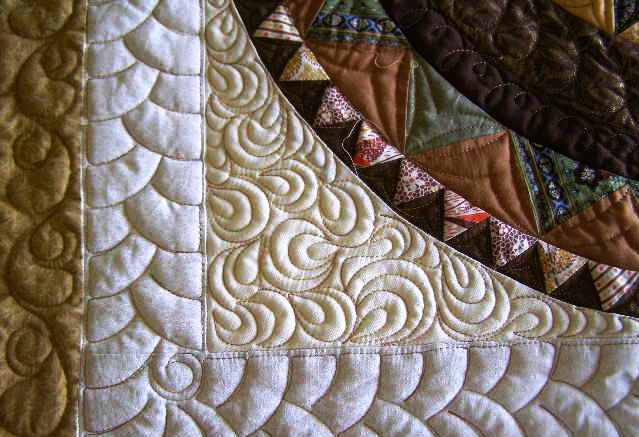
Compass Points and curved quilting

Compass Points and curved quilting

Isn't this quilting just stunning?

Isn't this quilting just stunning?

Beautiful quilting.

Beautiful quilting.

Love the colors!

Love the colors! Love the quilting!

The red 1/2" triangles include fabrics from my Grandmother's Stash

The red 1/2" triangles include fabrics from my Grandmother's Stash

Posted in Home Decor, New York Beauty, Quilting, Sewing | Tagged , | 5 Comments

A Tablecloth and a Shower Curtain..
A Table Cloth and a Shower Curtain.

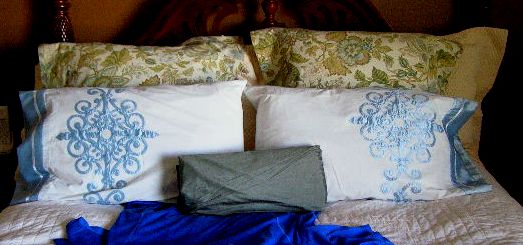
Completed Pillows and Dupioni

Completed Pillows and Dupioni

They combine for more than 5 yards of Raymond Waites fabric!

The colors were perfect for my son’s bedroom.  They coordinated with the greyblue/green dupioni from The Stash that will be used to make the curtains.

Best color photo of fabrics

Blues are difficult to capture

The fabrics are not as photogenic as I had hoped.  The photo to the right shows the greens in the print, but faded the blues and the dupioni.  The silk is the color of the green leaves in the print.

The royal blue shirt in the photos is the best I could do for his comforter.  His comforter (and apartment) are 2,000+ miles away, the shirt was the best I had.

Pillows and Dupioni with Royal Blue

Pillows and Dupioni with Royal Blue

The larger flower in the print has a darker blue at the base of the petals that coordinates well with the royal.

One of the advantages of using a tablecloth for the Euro Shams is that it is 60″ wide.  The pillows could be  cut to 30″ squares side by side.  A 54″ fabric is too narrow to do so, requiring extra yardage.

Now to measure for those curtains…


At a well known

Posted in Home Decor, Sewing | 3 Comments

The Purse d’Resistance – Stash Couture

Purse d-Resistance Detail

Purse d-Resistance Detail

A Stash Couture summer handbag – with embellishment for fun!

The Stash provided the fabric, the embellishments and even the snaps!

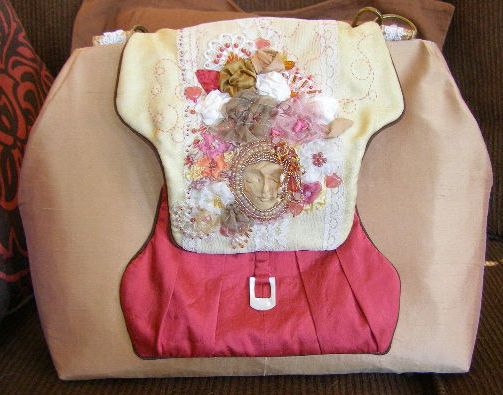
Stash Couture Purse d'Resistance

Stash Couture Purse d'Resistance

The pattern was a modified Indygo Junction Streetcar Bag.  The flap just called out for embellishment – and the bag was the perfect size for carrying all the items required for summer travel!

The modifications included enlarging the opening with a gusset, adding multiple internal pockets, and revising the straps.

The purse body and pocket are apricot and dark coral dupioni.

The base of the flap is a yellow linen overlain with a yellow metallic sheer.

The Stash contains several Mother-of-Pearl buckles (I cannot remember from where).  I placed a small one on the outer pocket and a larger one on one of the straps.

Stash Couture Embellishment Detail

Stash Couture Embellishment Detail

The embellishments add that Stash Couture touch – and are just soooo much fun to create!!!  The Goddess cabochon is polymer clay. The larger flowers, leaves, and roses were constructed as detailed in the tutorials.   Silk ribbon details provided color and fill.

Interior of Purse d'Resistance

Interior of Purse d'Resistance

With the modifications, the interior of the purse is easily accessible and HUGE! I will be able to carry everything I need for summer travel – including my Kindle and a knitting project!

The pen/cell phone/notebook interior pocket adds a bit of whimsy.  The Opal Owl fabric was “rescued” from the original Kindle Cover.

As with most purses, the construction of this purse followed the same basic steps as the Make-Up Bag.

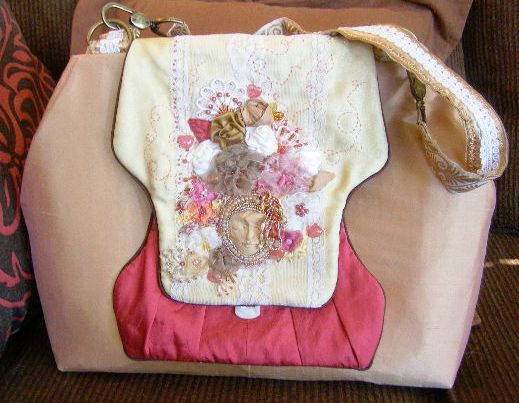
Purse d'Resistance

Purse d'Resistance

Light-colored straps raised concerns of appearing “dirty” after use.  So, they were made removable and washable   (and easily replaceable, if need be) by using D-rings and swivel clips.

Feet for keeping base clean(er)

Feet for keeping base clean(er)

Feet were added in a effort to reduce wear on the dupioni, but I think a wiser plan would have been to use a less delicate fabric for the base.

Posted in Accessories, Crazy Quilting, Embellishment, Goddess, Purses, Sewing, Stash Couture | Tagged , | Leave a comment

Stash Couture Prom Purse

Beautiful Dress, Beautiful Daughter, Beautiful Shoes…

But the Prom Purse, small and lightweight – just a cell phone, the ticket, and make-up for the touch ups, – is a true necessity for such an event.

Stash Couture Prom Purse

Stash Couture Prom Purse

The dress was navy, the shoes were silver…and this was the Purse:

Silver Grey silk dupioni, silk ribbon bluebells, a small piece of  hand marbled fabric, beads, buttons, and bits and pieces of  appropriately colored treasures!

And with one exception – all from The Stash!

The only purchase was the silver “M” on the lower left side.  It provided that personal touch.

Silver and blue are not colors I typically collect, so it took some intensive Stash Searching to find the fabrics and beads – but for such a small project – The Stash had more than enough!

Detail Stash Couture Prom Purse

Detail Stash Couture Prom Purse

The wristlet design works well for an evening purse as it is can be worn rather than tucked under one’s arm (or placed on a table and forgotten) as a clutch would.

It also opens sufficiently wide to allow easy access to that all important cell phone so no pictures are missed!

The pattern is my own, although I Vogue 7354 has two options that are similar.

Silk Ribbon Lupines

Silk Ribbon Bluebells

I have a small stash of silk and cotton hand marbled fabric pieces.  I use them in Crazy Quilting.  They are all beautiful, but this one really makes this purse special.

She looked beautiful and the purse tied the dress and the shoes together perfectly!

Even the girlfriends were impressed (and wanted one for the next semi-formal!)

As the daughter is only 15, the importance of having a small purse for such an event was not immediately apparent to her.

When she muttered something about “I’ll just use my backpack”  – I gasp loudly, and dropped everything for the three days it took me to finish the purse. 

I think she understands now!

Purses like this one, colors, designs and embellishments of choice, are available through my Etsy site.

Posted in Accessories, Crazy Quilting, Embellishment, Purses, Sewing, Stash Couture | Tagged , | 2 Comments