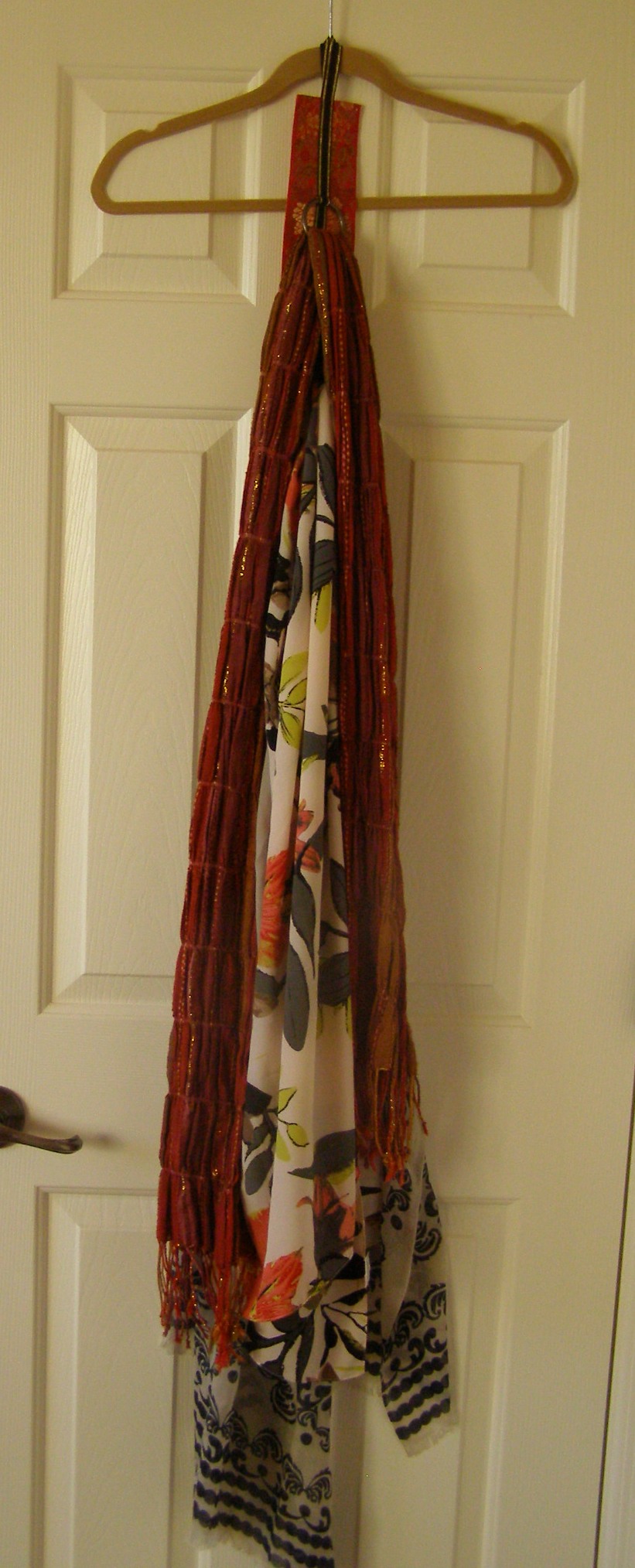
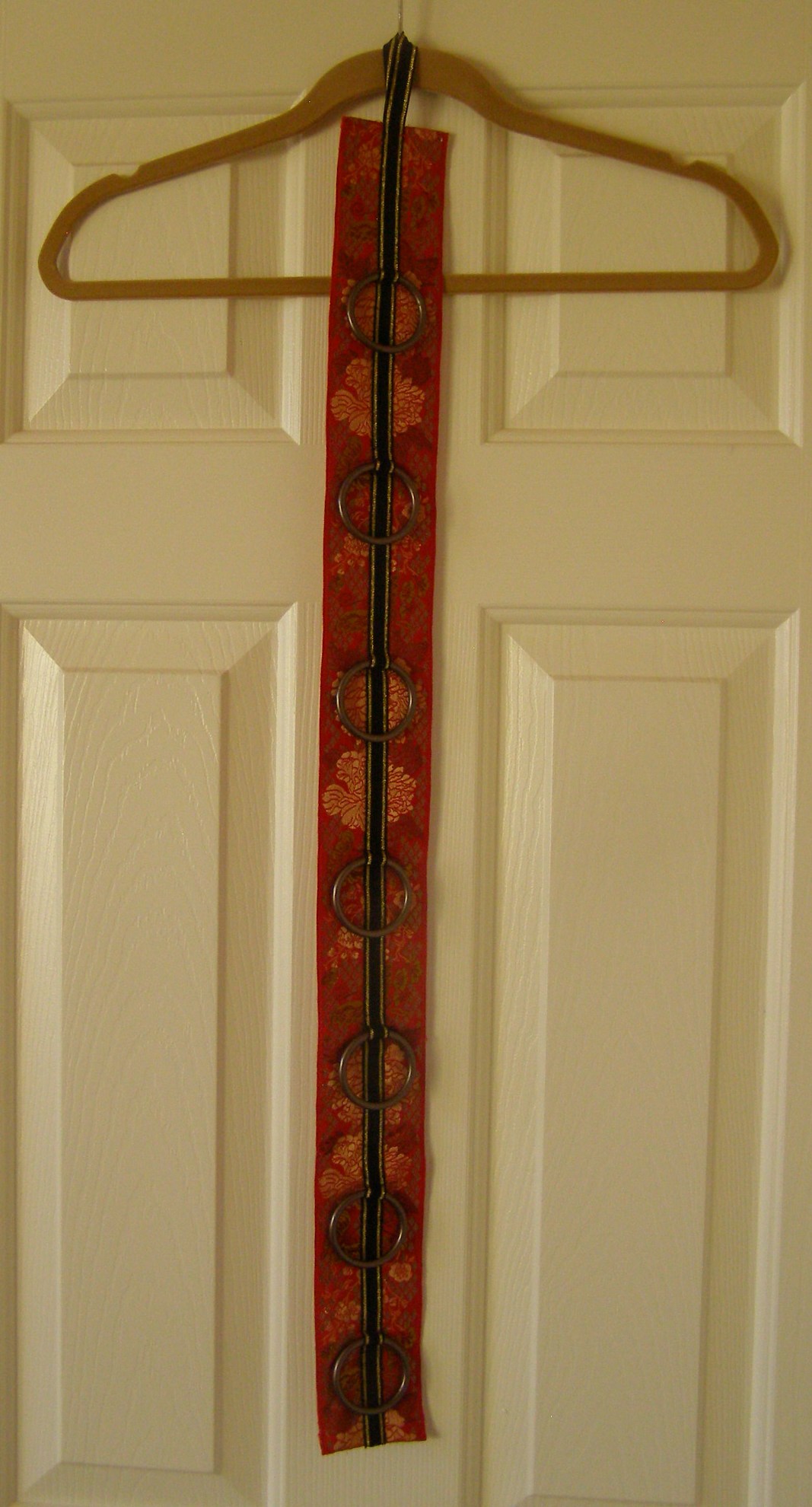
Destashification Scarf Hanger

Destashification Scarf Hanger

…..doing its job!

Destashification Scarf Hanger

Destashification Scarf Hanger….

Such an Issue….

Many scarves sewn up using Stash Fabrics and the DD’s Infinity Scarf Directions – and no place to hang them.

Stash to the Rescue.

Materials:

  • 4 – 5 foot long piece of 3″ – 4″ wide ribbon.
  • 1/2″ – 1″ ribbon 12″ or so longer than wide ribbon
  • 7 – 10 plastic or metal 2″ – 3″ rings
  • Fabric 1″ wider and longer than wide ribbon to cover back
  • Fusible web – 1/2″ wide (comes in a roll)
Metal rings - remove clips

Metal rings – remove clips

Finding plastic rings was a problem – but drapery clips with the clip part removed were perfect!

  1. Fold 1/2″ of top and bottom of wide ribbon to back and press.
  2. Iron fusible web down the center of the face of the ribbon – paper side up.
  3. Remove paper from fusible web.
  4. Leaving a 1″ tail, place narrow ribbon over fusible web and iron only 2″ or so to adhere.
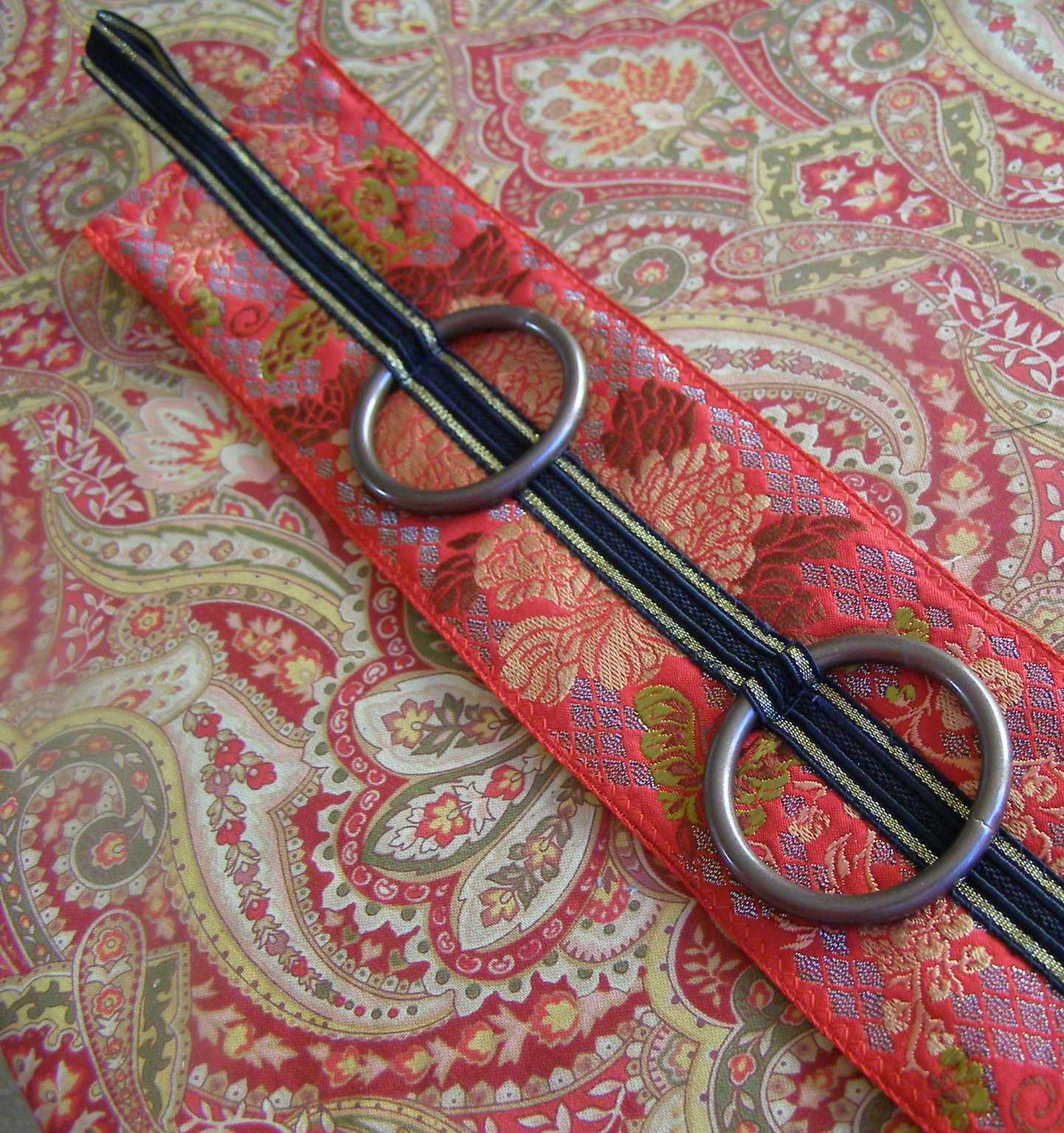
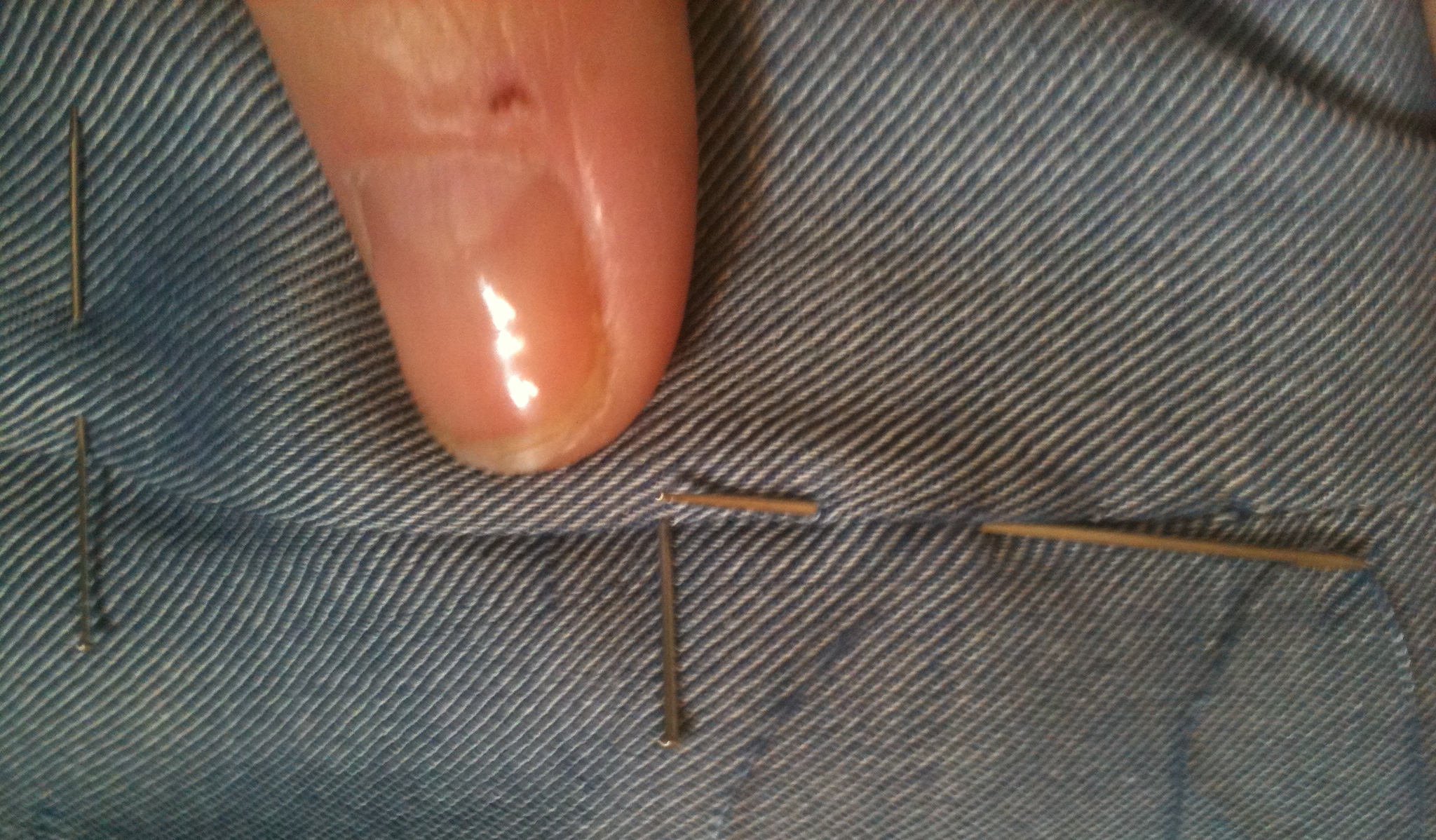
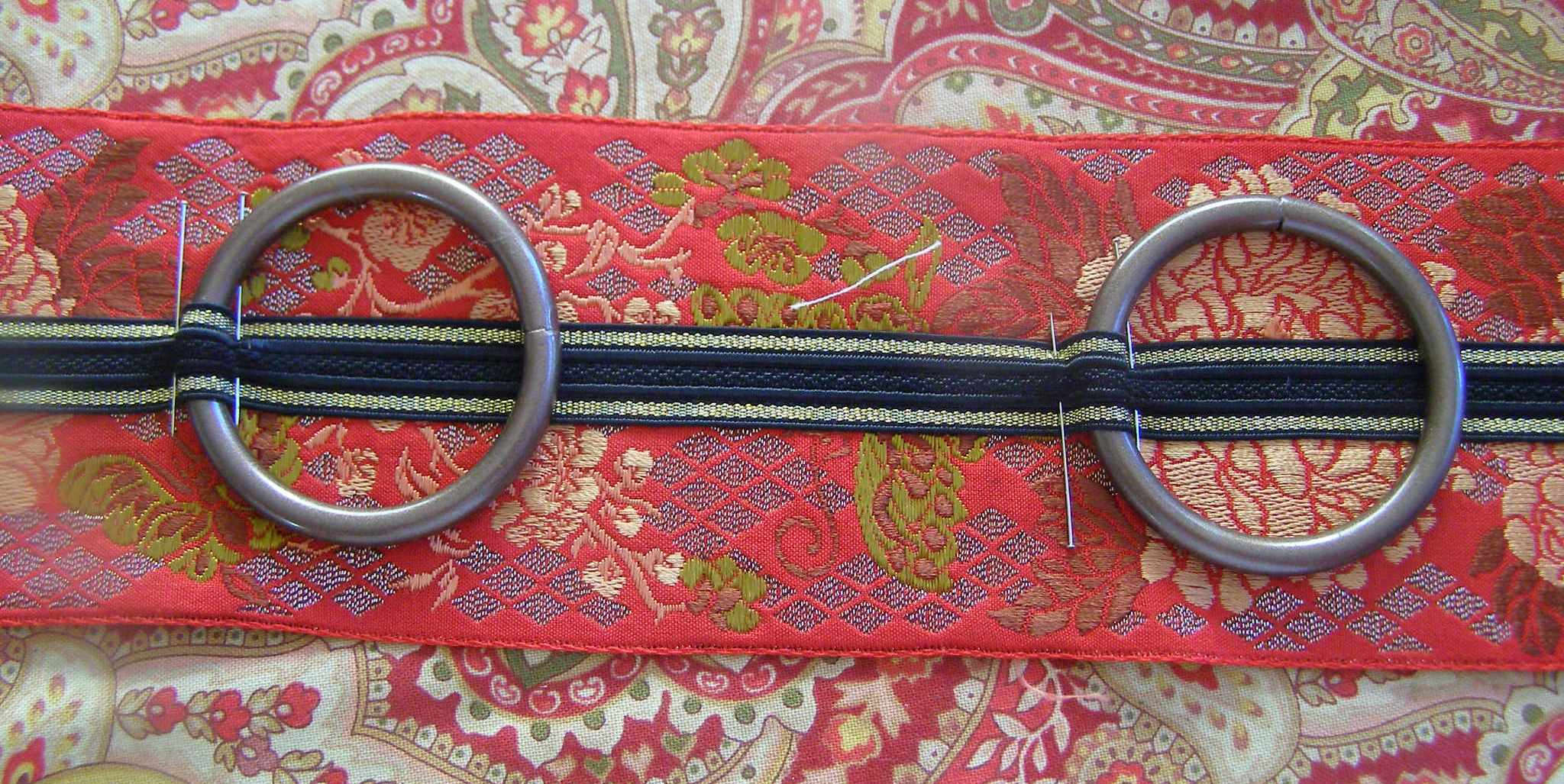
  5. Narrow ribbon placed over fusible web.  Rings pinned suggly in place.

    Narrow ribbon placed over fusible web. Rings pinned snuggly in place.

    Place ring and pin snuggly.

  6. Move up 3″ – 4″ and place and pin  another ring.
  7. Continue until all rings are pinned. The narrow ribbon should extend 10″ or so above top of wide ribbon.
  8. Adjust ring placement if needed.

    Adjust ring placement if needed.

    Adjust ring placement if needed.

  9. Iron narrow ribbon to fusible web – use point of iron to get as close to rings as possible.  If using plastic rings – avoid touching them with the iron as they will melt.
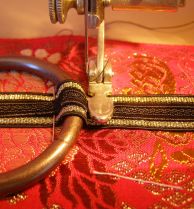
  10. sew back and forth across narrow ribbon to secure rings.

    Using Zipper Foot sew back and forth across narrow ribbon to secure rings.

    Take to sewing machine.  Using zipper foot, sew back and forth across narrow ribbon as close to rings as possible to secure.

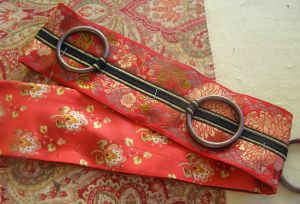
  11. Narrow ribbon folded to back to form hanger.

    Narrow ribbon folded to back to form hanger.

    Fold extension of narrow ribbon so that 2″ or so is on the back side of the wide ribbon to form hanger.  Fold narrow ribbon at bottoom to back.

  12. Change to “regular sewing foot” and sew narrow ribbon between and above and below rings – back stitch several times when close to rings.  Zig zag or straight stitch can be used.  Be sure that raw ends of narrow ribbon are secured to back of wide ribbon.
  13. Cut threads (all zillion of them).
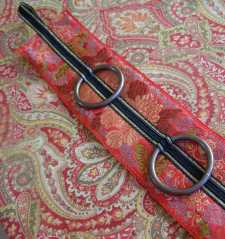
  14. Pin backing fabric to back of wide ribbon - wrong sides together

    Pin backing fabric to back of wide ribbon – wrong sides together.

    Fold in edges of backing fabric to width and length of ribbon.

  15. Place wrong sides together and pin.
  16. Using a narrow zig zag stitch sew all the way around.
  17. Done!
  18. Completed!

    Completed!

    Now all those scarves will hang wrinkle-free!
Posted in Scrap Couture, Sewing, Sewing for a Teenager, Tutorial | Tagged , , | 1 Comment

Instructions for Tweed Stitch Scarf

Beautiful Yarn = Beautiful Scarf

Beautiful Yarn = Beautiful Scarf

The Tweed Stitch Scarf is a simple knit project perfect for those beautiful hand dyed/painted yarns – that we just had to have!
The Tweed Stitch is basically a stockinette stitch with a “slip and half-wrap every-other-stitch” on the knit rows. The simple stitch highlights those  beautiful colors of hand painted yarns.

Tweed Stitch

Tweed Stitch

The pattern for Tweed Stitch (in knitting lingo) reads:

  1. Row 1: (Right Side) K1, *yf, sl1, yb, k1*; repeat between *’s to end.
  2. Row 2: Purl
  3. Row 3: *yf, sl1, yb, k1*, repeat between *’s to end
  4. Row 4: Purl
  • yf = yarn forward
  • yb = yarn back
  • sl1 = slip one stitch

So the translated version is:

  1. Row 1:  Knit 1 stitch, *bring yarn forward between needle points, slip the next stitch (without knitting it), move yarn to the back of work through needle points, knit the next stitch*.  Repeat the instructions between the *’s to the end of the row.
  2. Row 2:  Purl all stitches.
  3. Row 3:  *Bring yarn forward, slip the next stitch (without knitting it), move yarn to the back of work, knit the next stitch*.  Repeat the instructions between the *’s to the end of the row.
  4. Row 4:  Purl all stitches.

The yf and yb (yarn forward and yarn back) is like a half-wrap in front of the slipped stitch.

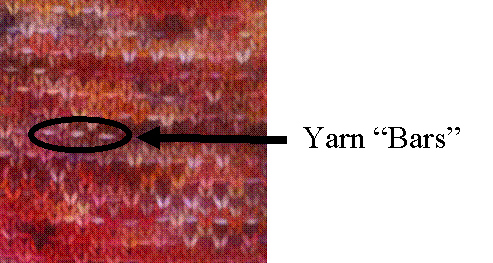
Horizontal Yarn Bars

Horizontal Yarn “Bars” created by the Yarn Forward/Yarn Back in front of the slipped stitch in Rows 1 and 3.

They create the horizontal yarn “bar” in front of the slipped stitch.

Another reason this  pattern is quite simple is that Rows 1 and 3 are actually the same.

Chart for Tweed Stitch

Chart for Tweed Stitch

As shown in the chart, the only difference is that Row 1 starts with a Knit 1, Row 3 starts with a Slip 1. This alternates the “bars” so that they lie over even stitches in Row 1 and odd stitches in Row 3.

Larger needles are typically selected when knitting a pattern involving slipped stitches as the fabric can be fairly dense.  With this sport weight yarn, size 7 needles were used.

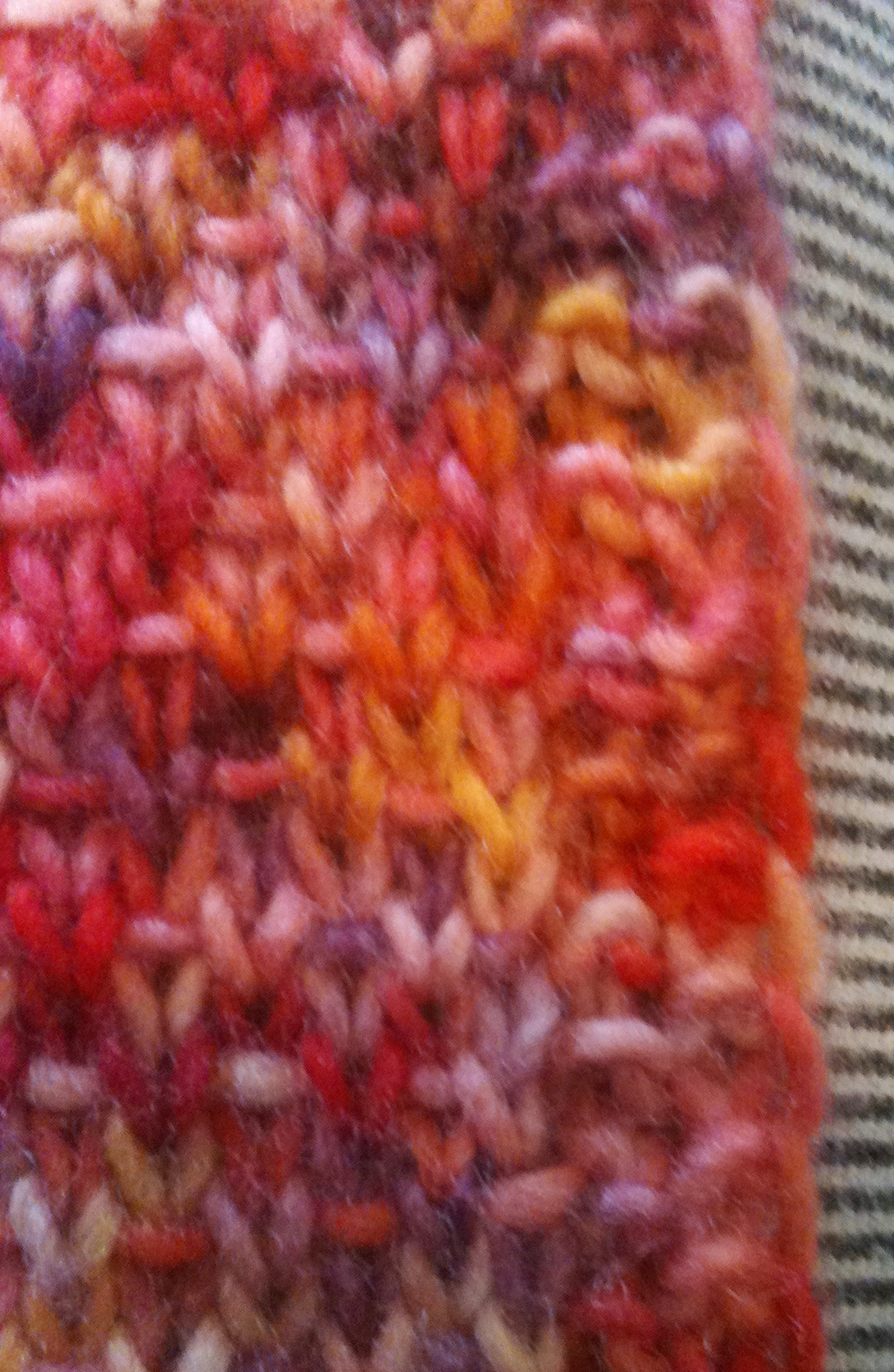
Seed Stitch Edge Detail - Right SIde

Seed Stitch Edge Detail – Right Side

The scarf pattern puts 60 stitches of Tweed Stitch between edgings of 3 stitches of seed stitch (on each side).

The yarn used in the model is Punta Yarns Mericash, a sport weight cashmere and merino. Two skeins of 256 yards were used to create a 10″ wide by 6 foot long scarf.

Materials:

  • 450 – 600 yards of sport weight or sock weight yarn
  • Size 7 knitting needles

Pattern:

Cast on 66 stitches.

Knit first row:  *K1, P1*, repeat between *’s to end of row.

Begin Stitch Pattern:

Row 1:  Slip 1, P1, K1 (these 3 stitches are the seed stitch border), K1, *yf, sl1, yb, k1*; repeat between *’s to last 3 stitches (Row 1 of Tweed Stitch), K1, P1, K1 (seed stitch border).

Row 2:  Slip 1, K1, P1, (seed stitch border) Purl to last 3 stitches (Row 2 of Tweed Stitch), P1, K1, P1 (seed stitch border).

Row 3.  Slip 1, P1, K1(seed stitch border), *yf, sl1, yb, k1*, repeat between *’s to last 3 stitches (Row 3 of Tweed Stitch), K1, P1, K1 (seed stitch border).

Row 4:  Slip 1, K1, P1, (seed stitch border) Purl to last 3 stitches (Row 4 of Tweed Stitch), P1, K1, P1 (seed stitch border).

Repeat these 4 rows until 3 yards (meters) of yarn remains ending with a completed Row 2 or 4.

Final Row:  Slip 1, *P1, K1*, repeat between *’s to end of row.

Bind off.  Weave in ends.

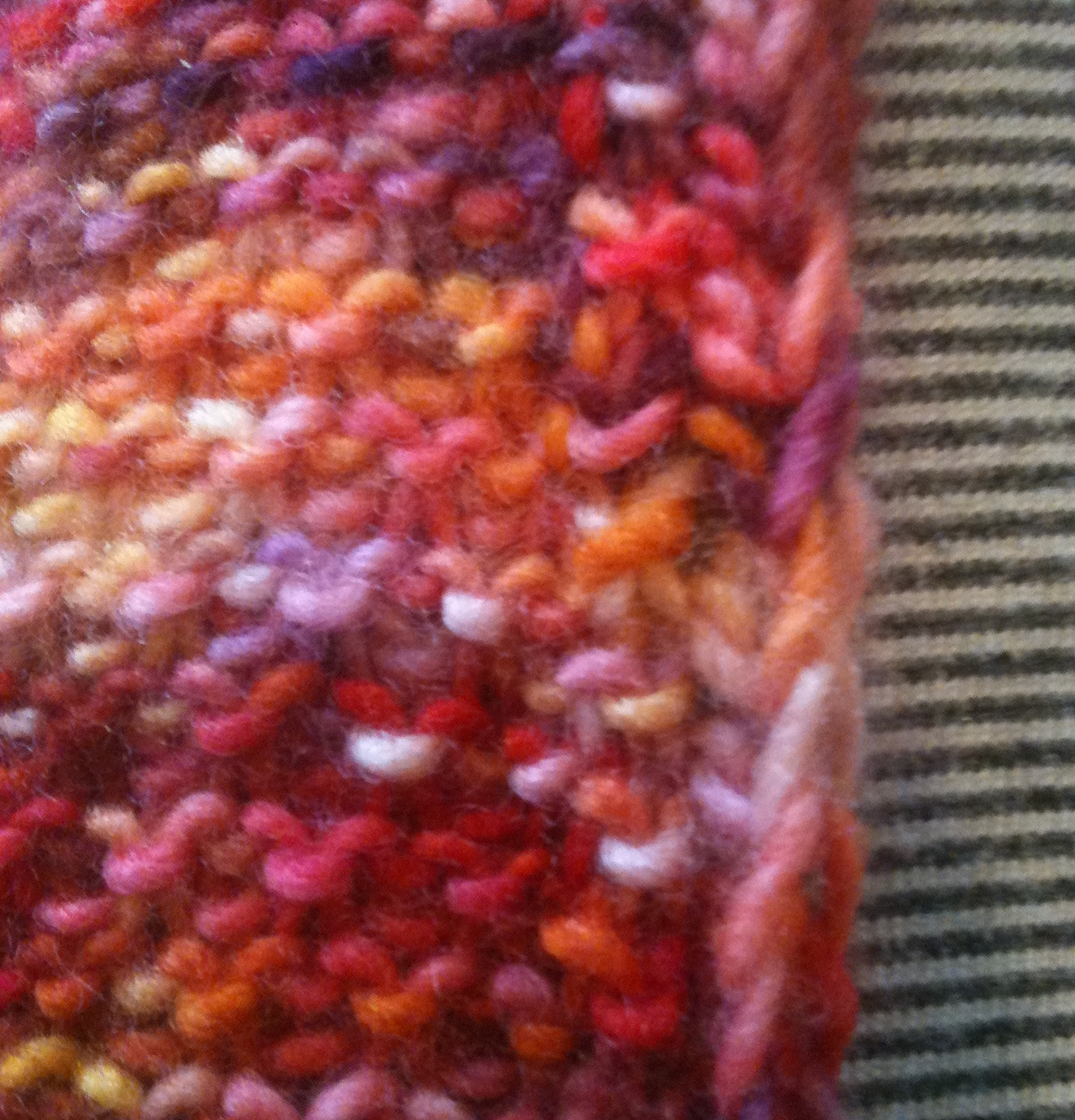
Wrong Side.  Carry yarn is hidden in the first edge stitch.

Seed Stitch Edge – Wrong Side. Carry yarn is hidden under the change from Seed to Tweed Stitch.

Alternating skeins every other row will meld any hand painted yarn variations and prevent pooling (globs of colors) that can occur when knitting with variegated yarns.

Although it is tempting to alternate skeins at the edge of the scarf, it is not recommended as the carry yarn will show.

Alternating skeins between the seed stitch border and the Tweed Stitch in Rows 2 and 4 will hide the “carried” yarn.

Beautiful yarns highlighted by a simple stitch!
Posted in Accessories, Beginner Knitting Project, Free Knitting Pattern, Knitting, Scarf, Stash Couture, Tutorial | Tagged , , | 2 Comments

Tweed Stitch Scarf

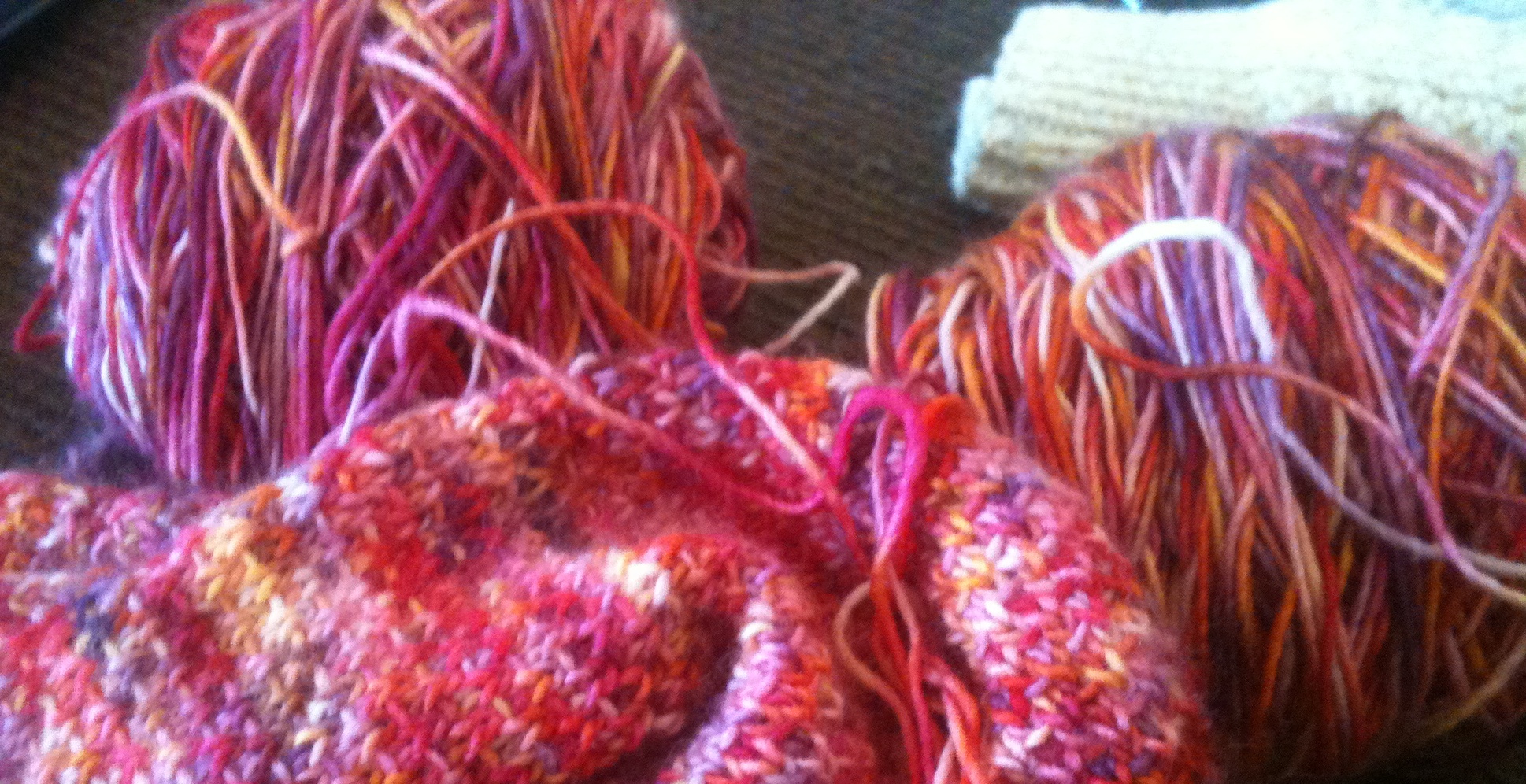
The Yarn Stash contains some very beautiful yarn – both in color and texture.

Variations in Same Dye Lot

Variations in Same Dye Lot

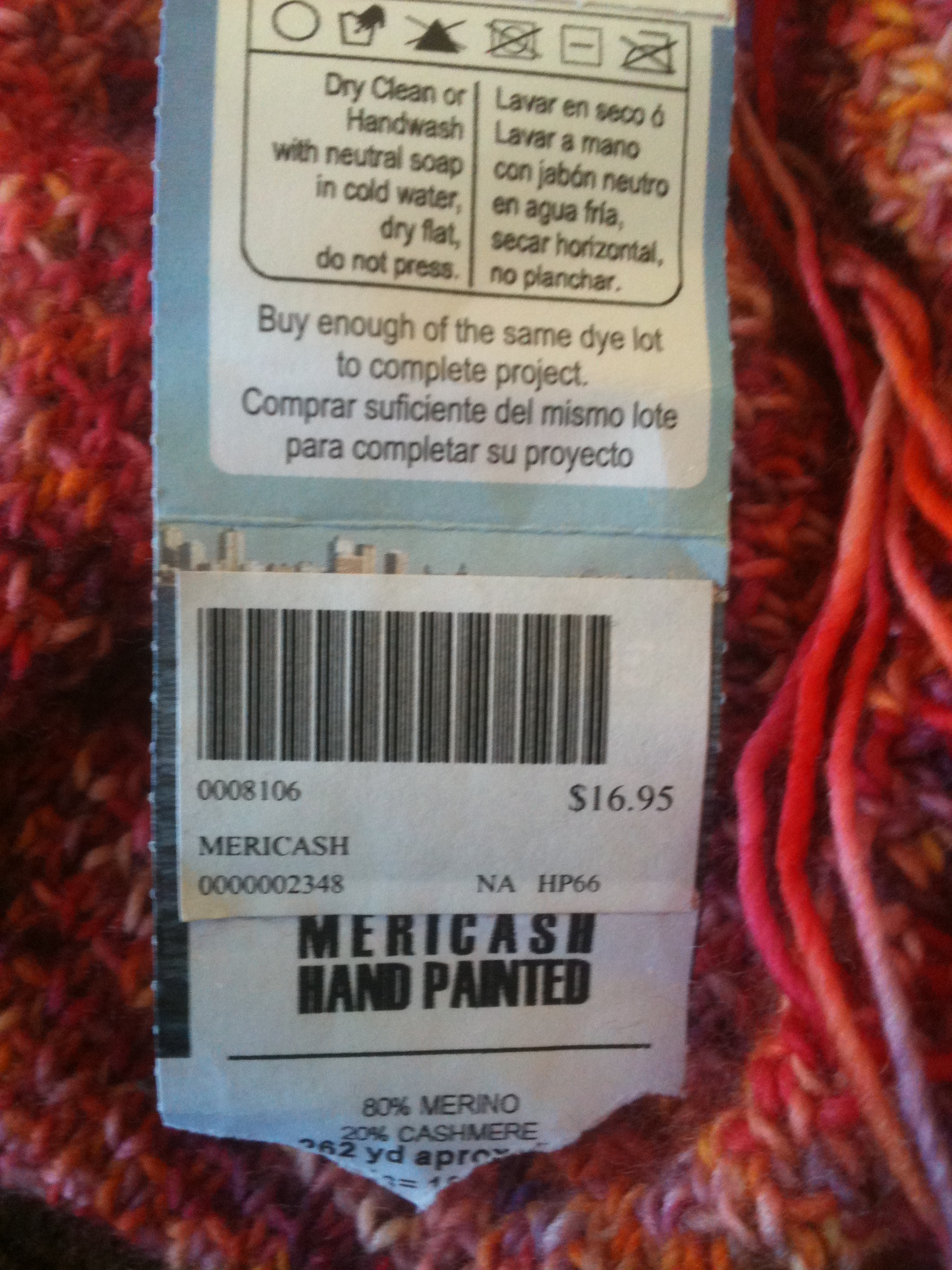
The Stash included two skeins of sportweight Maricash Hand Painted – an very soft cashmere and wool blend hand dyed in a gorgeous red-yellow-purple colorway (HP66).

Mericash Hand Painted

Mericash Hand Painted

The colors changed every few inches.

As with many hand dyed yarns, skeins  of the same dye lot can be quite different.

Both skeins contained the same vibrant colors, but their distribution in the two skeins varied.  The first skein had a great deal more deep violet and cranberry colors.  The second contained more of a very light almost cream yellow.

Color variations – no problem.  Alternate skeins every other row!

Tweed Stitch

Tweed Stitch

I wanted to knit this yarn in a stitch that would highlight and blend the beautiful rich colors.  I tried Linen Stitch, but it just looked confusing.

The Tweed Stitch, which appears to also be called Half-Linen Stitch, worked beautifully with this yarn.

The short lengths of color create an almost Monet painting effect.

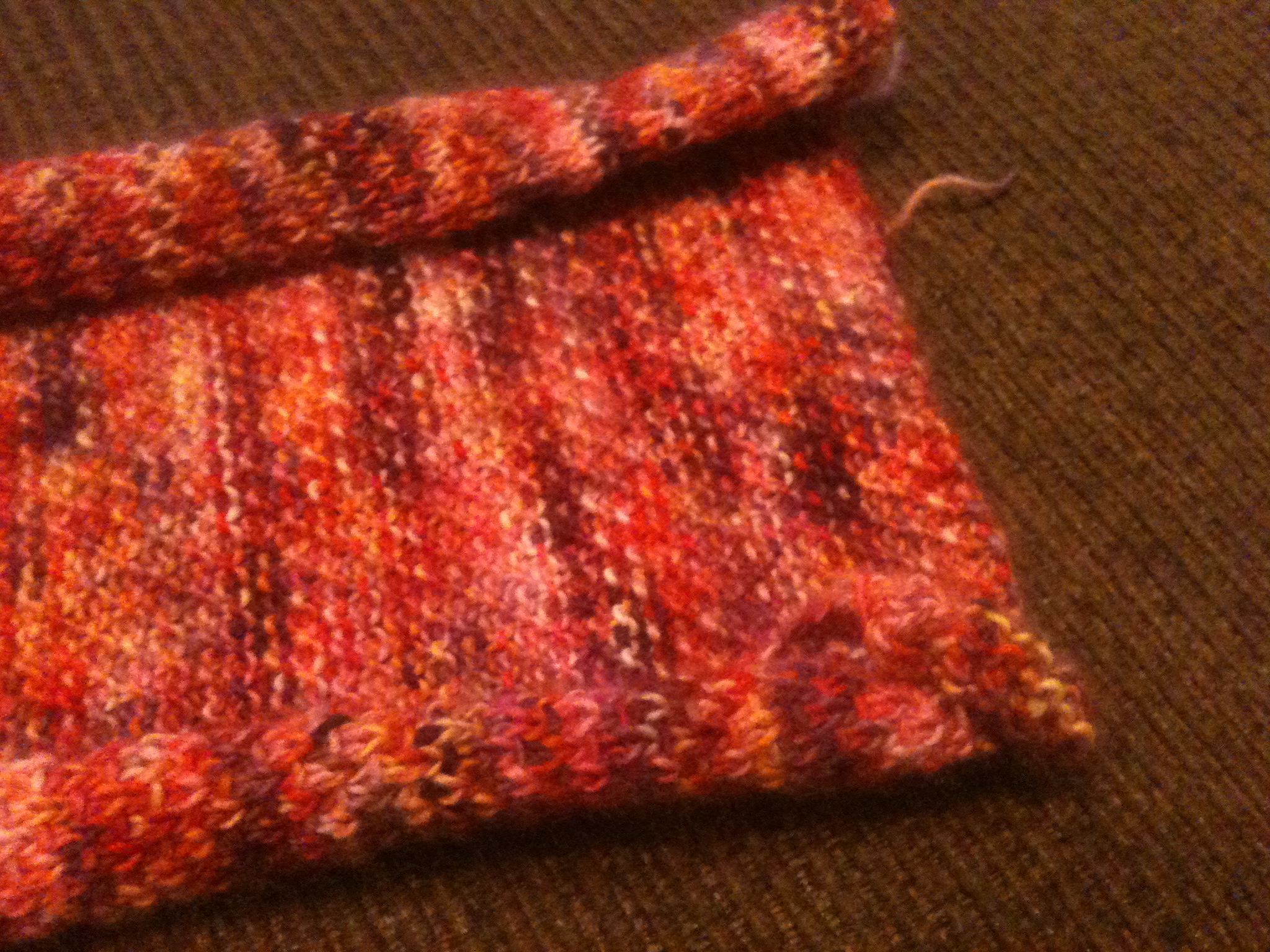
While knitting the scarf did roll, which was easily corrected during blocking.

Pre-blocking

Pre-blocking

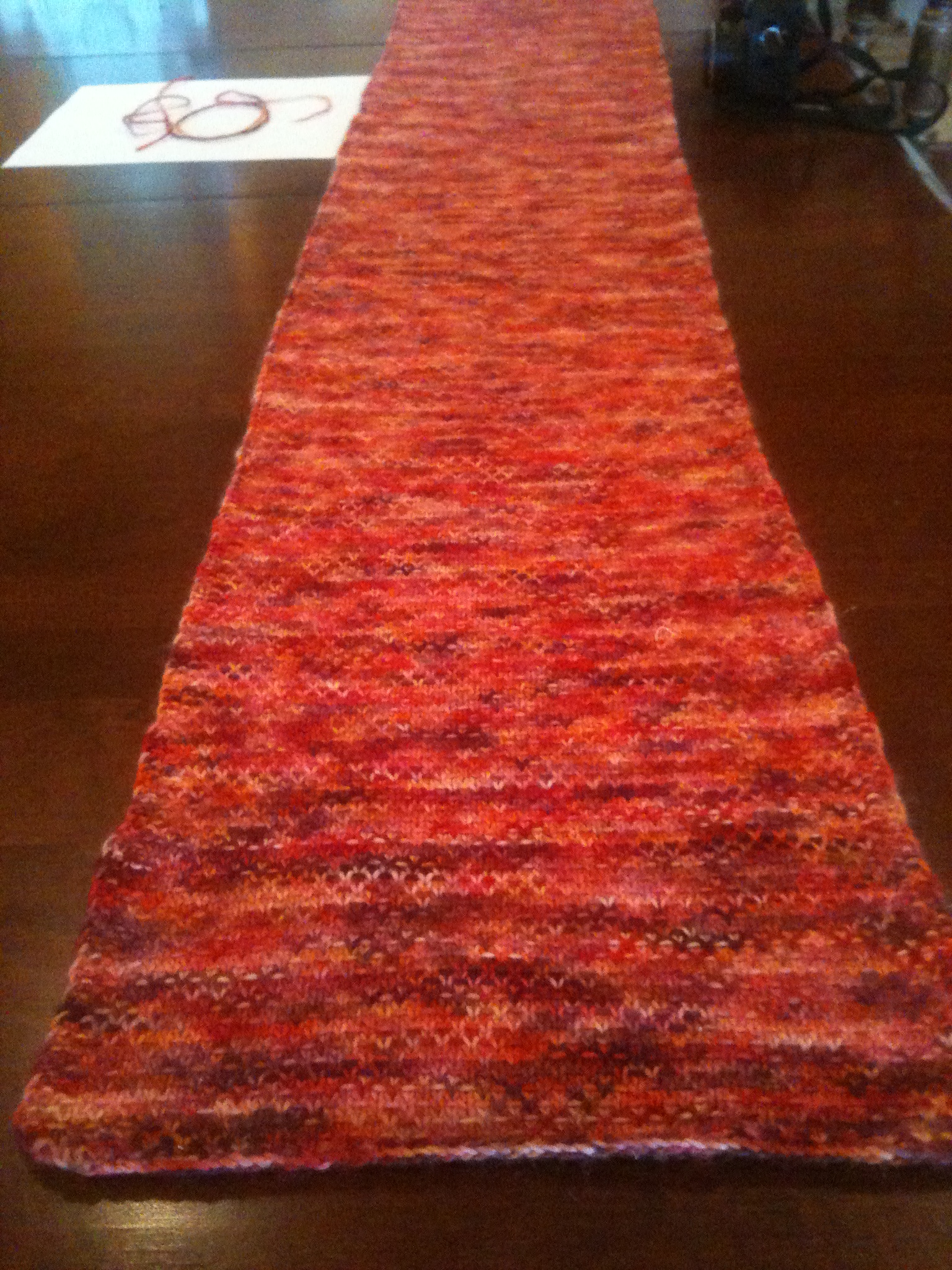
The beautiful colors did not bleed during blocking.

720 square inches of softness!

720 square inches of softness!

The finished scarf is 10″ wide by 6 feet long….. and so soft.

The next post will include the pattern for this scarf.

Posted in Accessories, Beginner Knitting Project, Knitting, Scarf, Stash Couture | Tagged , , | Leave a comment

Stash Couture Ice Jacket

Ice Jacket

Stash Couture Ice Jacket

The Invitation read “Fire and Ice Night – Wear Red or White.”  Sounded like fun.  But what to wear?

Off to the Stash!

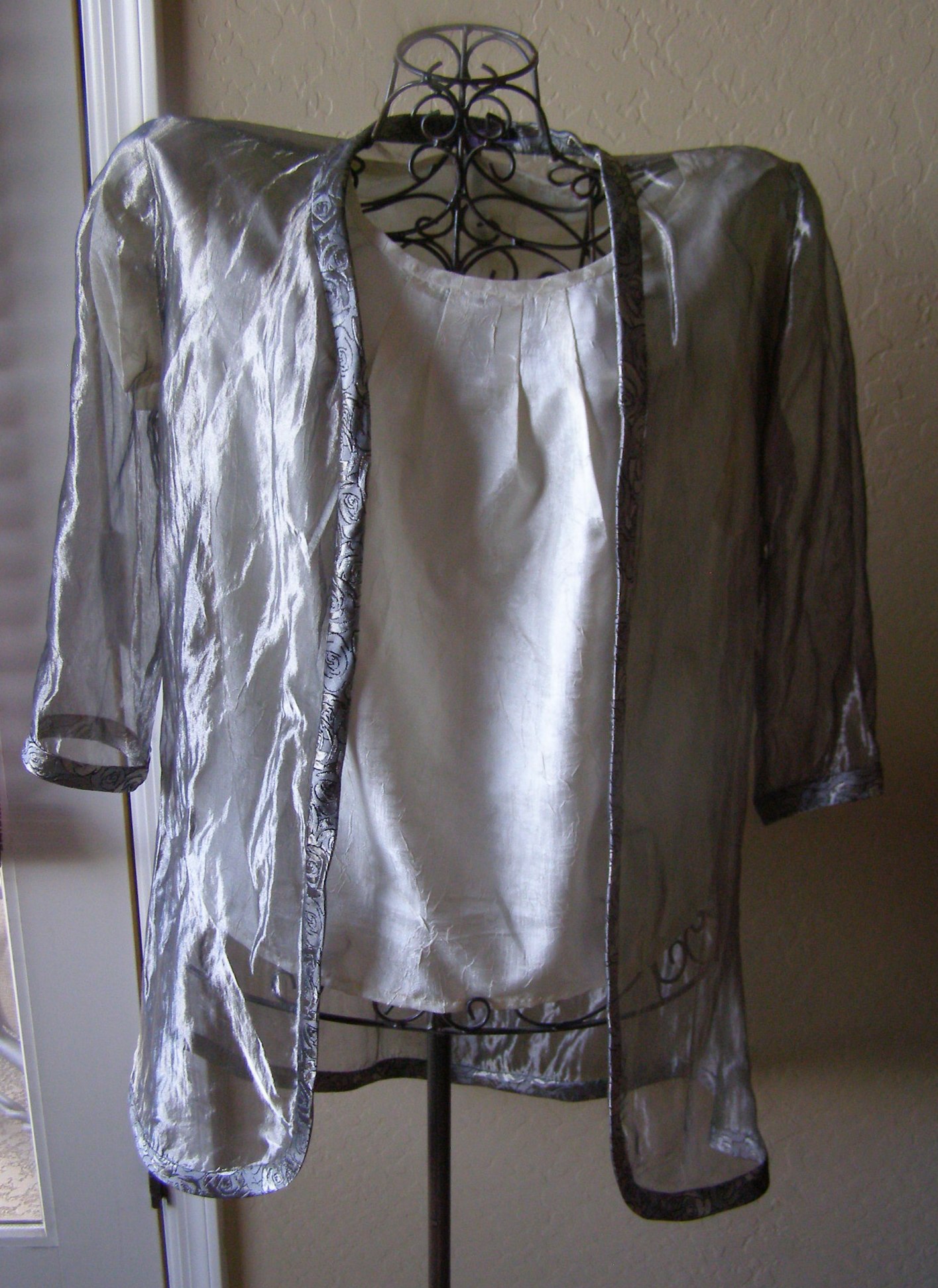
The Fabric Stash contained a gorgeous sheer silk and metal fabric with an ice-like shimmer.  Not white – but silver and even better than white!

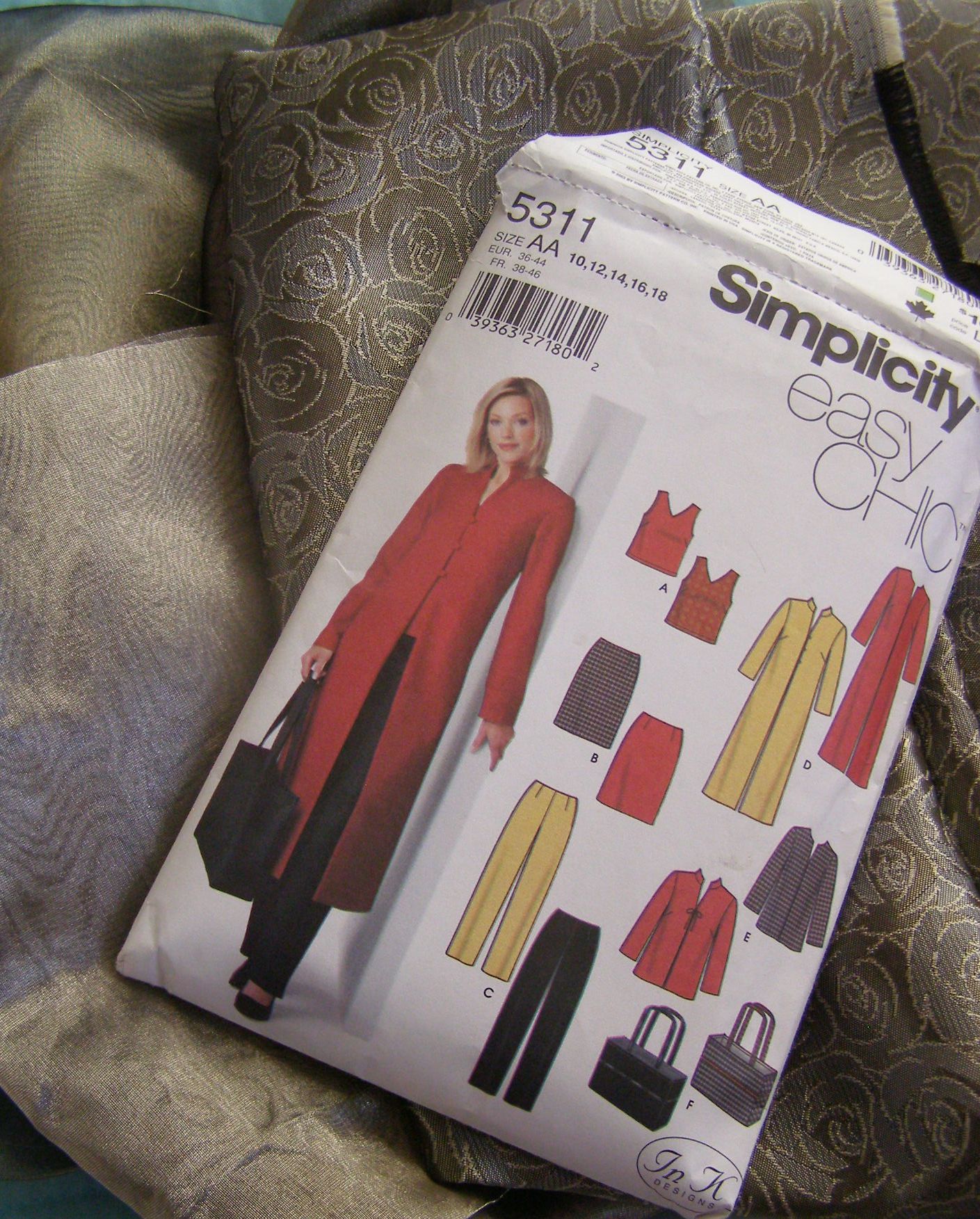
Simplicity 5311

Simplicity 5311

The Pattern Stash contained Simplicity 5311, which included a simple jacket.

The jacket pattern was modified so that all the edges were curved to allow for a simple bias trim edging.  A taupe/sliver/grey brocade was used to make the bias trim.

Simple Bias Edging

Simple Bias Edging

The sleeves were shortened to 3/4 length and the back  cut several inches longer than the front – perfect for wearing over a long white top and light grey leggings!

French Seam

French Seam

As the fabric was sheer, french seams were used.

Sewing with partially metal fabric was a new experience.  Who would have thought metal ravels??

The metal content also gives new meaning to the word “iron” (pun intended.) The creases from years in the Stash would not iron out.  Once finished, the jacket had to be dry cleaned.

Ice Jacket -side view

Stash Couture Ice Jacket -side view

Alas, the jacket has yet to be worn.  The flu saw to it that the only Fire and Ice of our evening was due to fever and chills!

But it hangs at the ready – just in case!

Posted in Clothing, Sewing, Stash Couture | Tagged , | 2 Comments

Fabric Christmas Decorations – No Sew

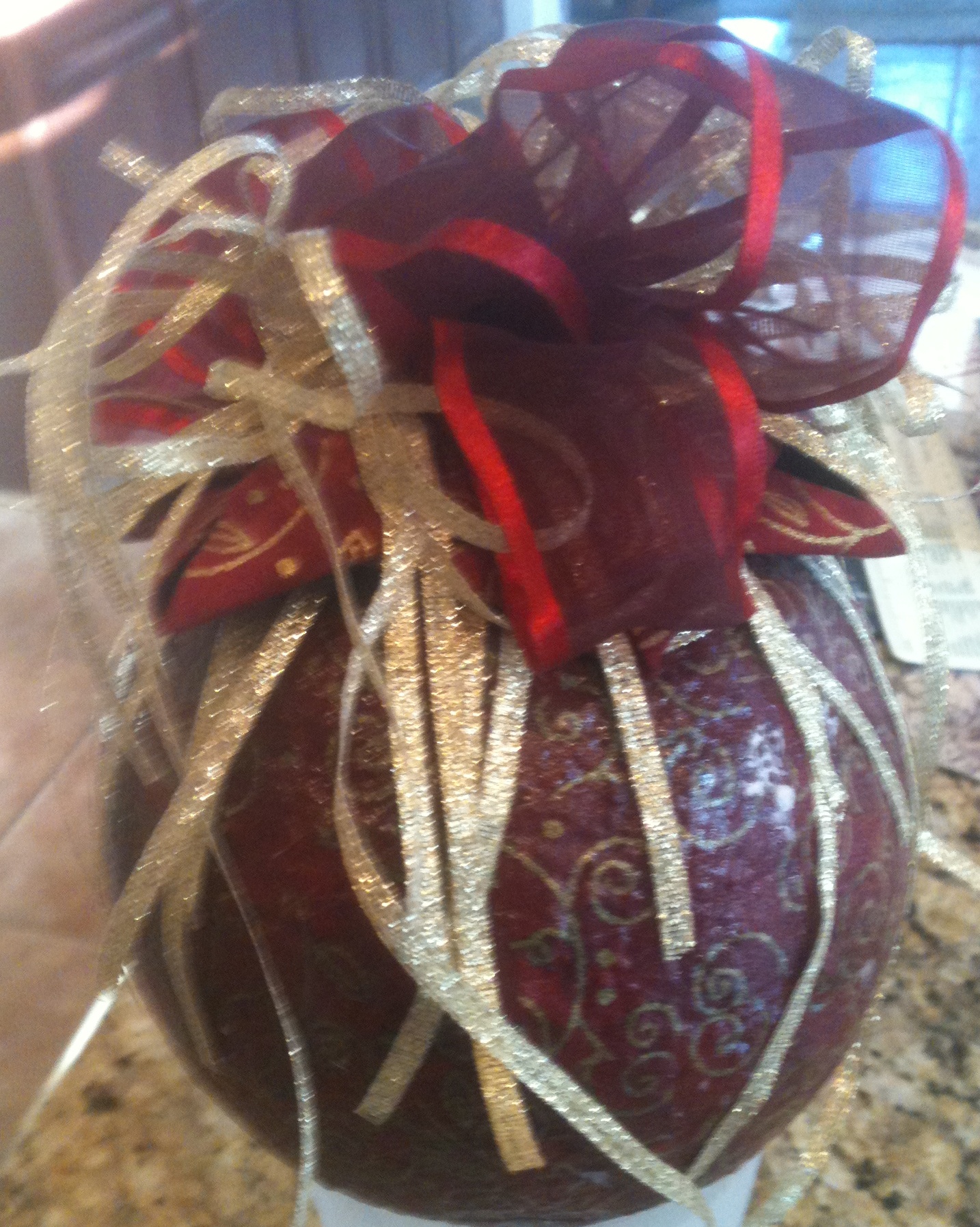
Destashification Christmas Ornament

Destashification Christmas Ornament

We just took down the Christmas Tree – early this year.  We stretch the season as long as possible.

Making Christmas Ornaments is a family tradition.  These use left over Christmas fabric (see note on fabric at end of post.)

Materials:

  • Styrofoam balls (these are 5″)
  • Stash Christmas Fabric
  • Iron
  • Washable white glue
  • Bowl (not your best china – this will be messy)
  • Glasses (not your best crystal)
  • Stash Ribbons
  • Glue gun and glue sticks
  1. Stash Christmas Fabrics

    Stash Christmas Fabrics and Trims become Ornaments

    Cut four 5″ square of the fabric for prairie points and put aside.  Cut 20 or so small (1.5″) triangles of remaining fabric – no need to be neat or precise.

  2. Remove lid of white glue and put about 1/2 of bottle into bowl.  Add about 2 Tablespoons water to thin and stir.
  3. Dip fabric triangles into glue until soaked through.  The fabric will darken.
  4. Place wet fabric triangle onto styrofoam ball.  Stretch it slightly to remove bubbles and creases.

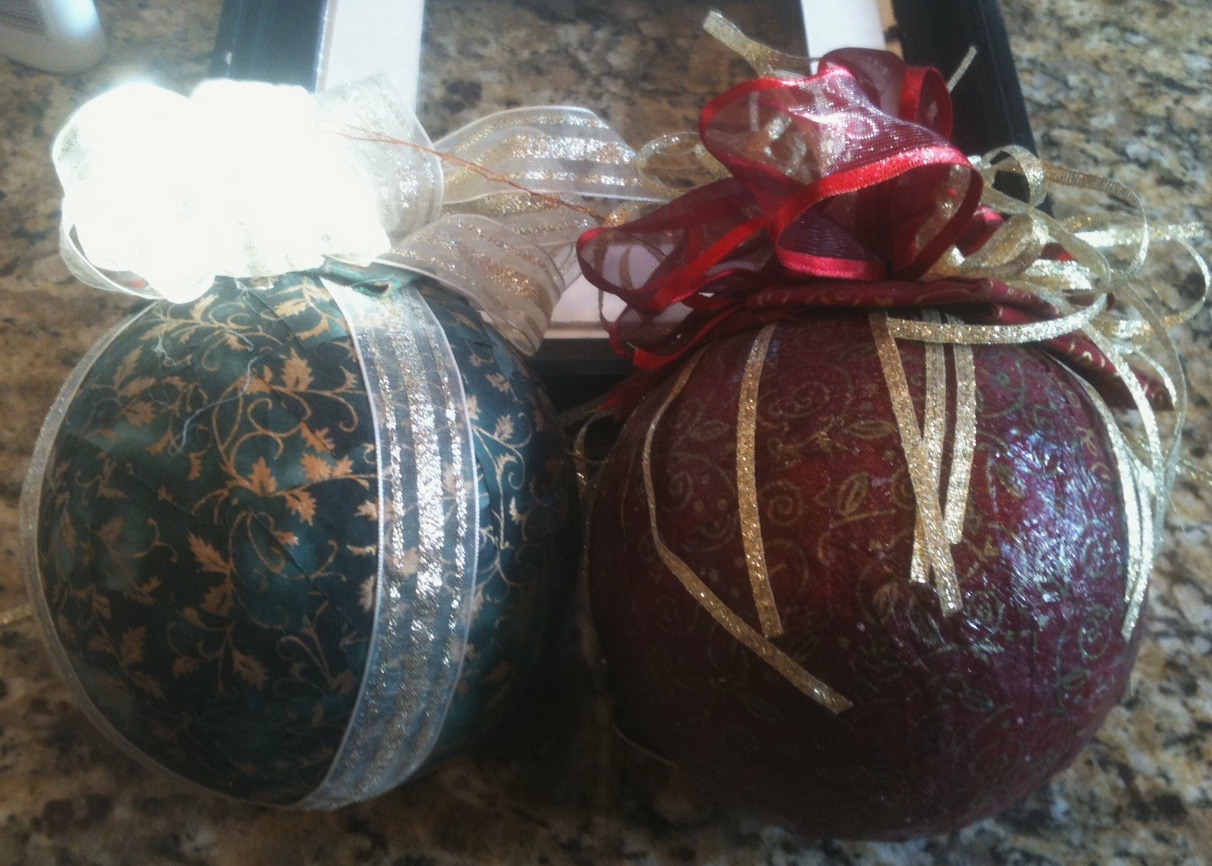
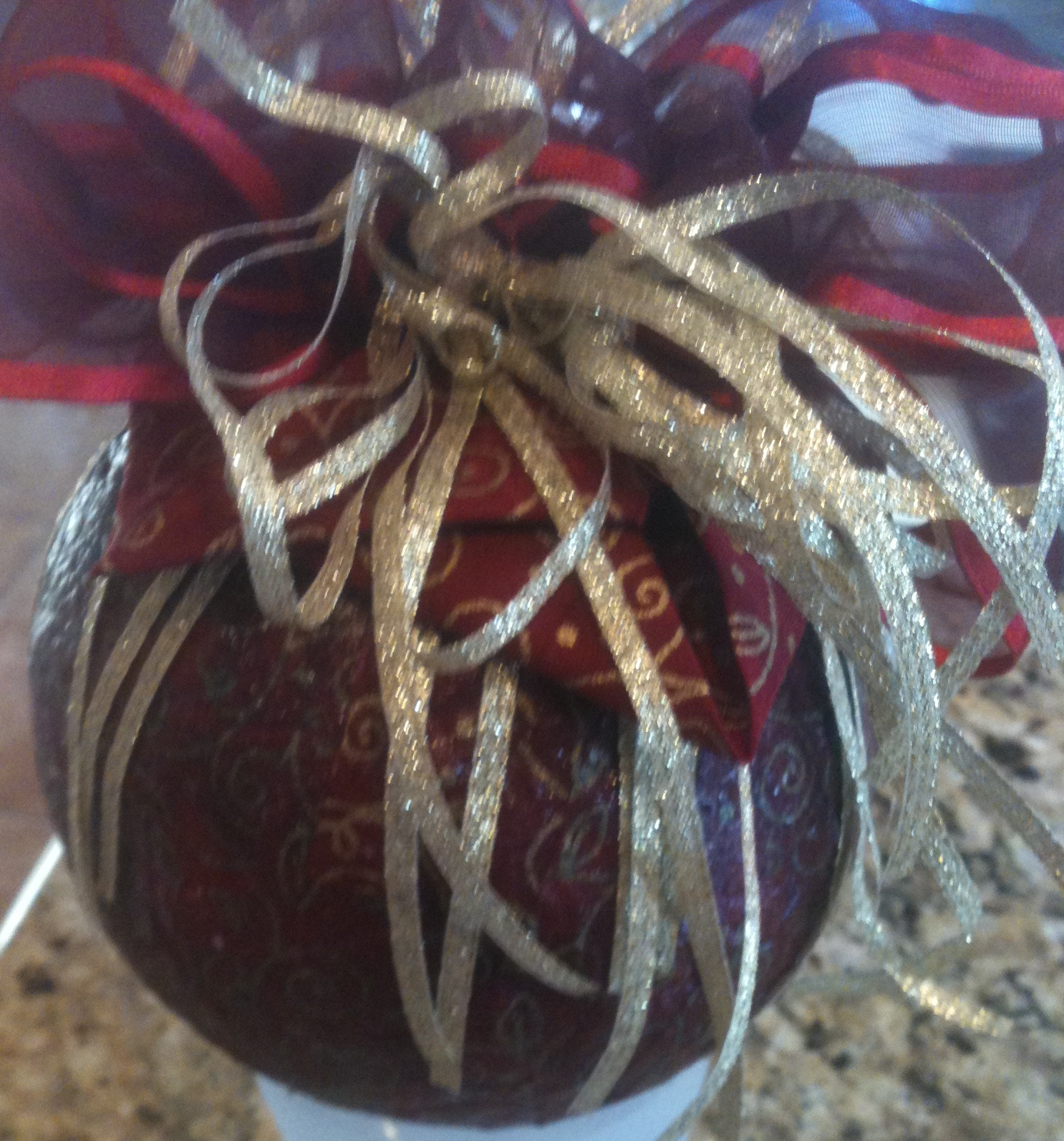
    Red Destashification Christmas Ornament

    Red Destashification Christmas Ornament

  5. Take another wet fabric triangle and place it on ball – overlapping first piece slightly.
  6. Repeat steps 4 and 5 until entire styrofoam ball is covered – except for small (1/4″) at top.
  7. Place wet fabric covered ball on rim of glass to dry.  Drying time will vary – overnight is typically long enough – the glue must be completely dry.
  8. In the meantime, make Prairie Points with 5″ squares.  Iron square flat.

    Folding Prairie Points

    …….To make the Prairie Points, Fold square along mid-line and press.  With folded edge toward top, fold each upper corner down to form triangle as shown in graphic.  Press.

  9. Arrange Prairie Points in a circular pattern along upper 1/4″ opening.  Using glue gun glue into place.
  10. Using ribbon, make bows – including one long hanging loop – and glue into place covering opening.
  11. Allow glue to dry and hang!
Green Destashification Ornament

Green Destashification Ornament

Note on Fabric Selection:
Mid-tone to darker fabrics are better options than light colored fabrics.  The lighter fabrics become translucent (see-through) in the glue.  Smaller prints work better than larger prints.  The smaller prints result in an all-over pattern.

The glue will make the fabric darker – and it will stay darker even after the glue dries. 

From experience – trust me – brown or rust colors are best used for other projects!

Posted in Christmas, Home Decor, No Sewing Fabric Projects, Scrap Couture, Seasonal Home Decor, Tutorial | Tagged | Leave a comment

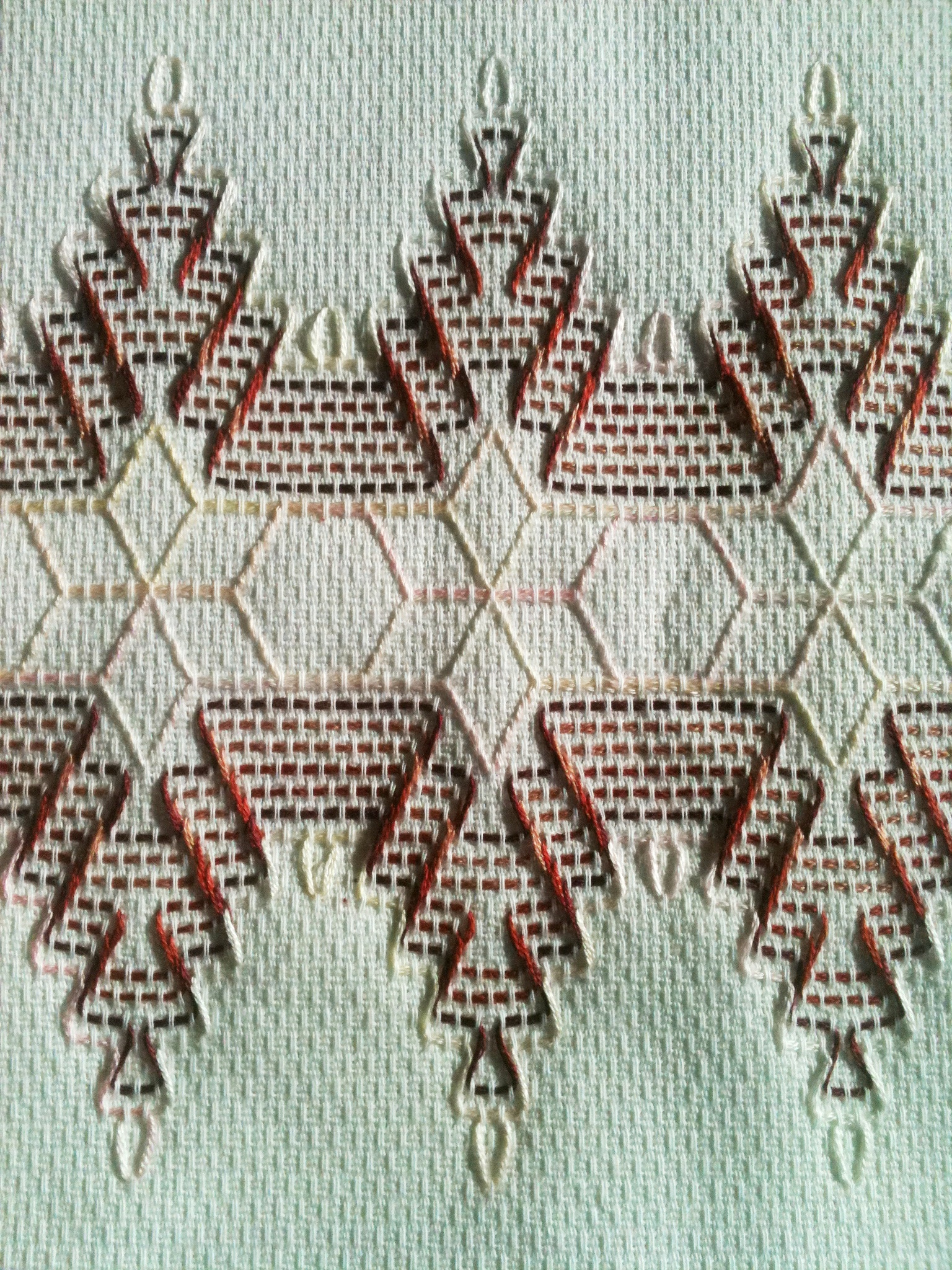
Huck Arizona Pine Trees and Snowflakes

Arizona Pondersa Pines

Arizona Tall Pines

Arizona is – land of deserts and saguaro cactus.

Arizona also has beautiful Ponderosa Pine covered mountains!

This time of year, those mountains are also covered with snow!

Friends invited us to spend some time in their mountain lodge earlier this month.

These simple huck towels were embroidered for the hostess gift.   Huck fabric and embroidery thread were found in The Stash.

eSnowflakes on the Arizona Mountains

Snowflakes on the Arizona Mountains

The snowflake design is based on Snowflake Design by Mildred V. Krieg (c. 1930-40).

However, it appears the geometry of the floats has changed in the intervening 70+ years.  So the the snowflake points had to be redesigned to avoid being skewed vertically.

The mountains of Arizona are browns and reds so were stitched using those colors.

The Arizona Pines used a variety of the green embroidery thread found in the Stash.

Huck Embroidery is quite simple.  Threads are run under “floats” woven into the towel fabric.  Instructions can be found in an earlier post.  Warning:  Huck Embroidery is addictive!

Arizona Tall Pines

Arizona Tall Pines in Huck Embroidery

Snowflakes on the Arizona Mountains

Snowflakes on the Arizona Mountains in Huck Embroidery

Posted in Home Decor, Huck Towel | Tagged , | 14 Comments

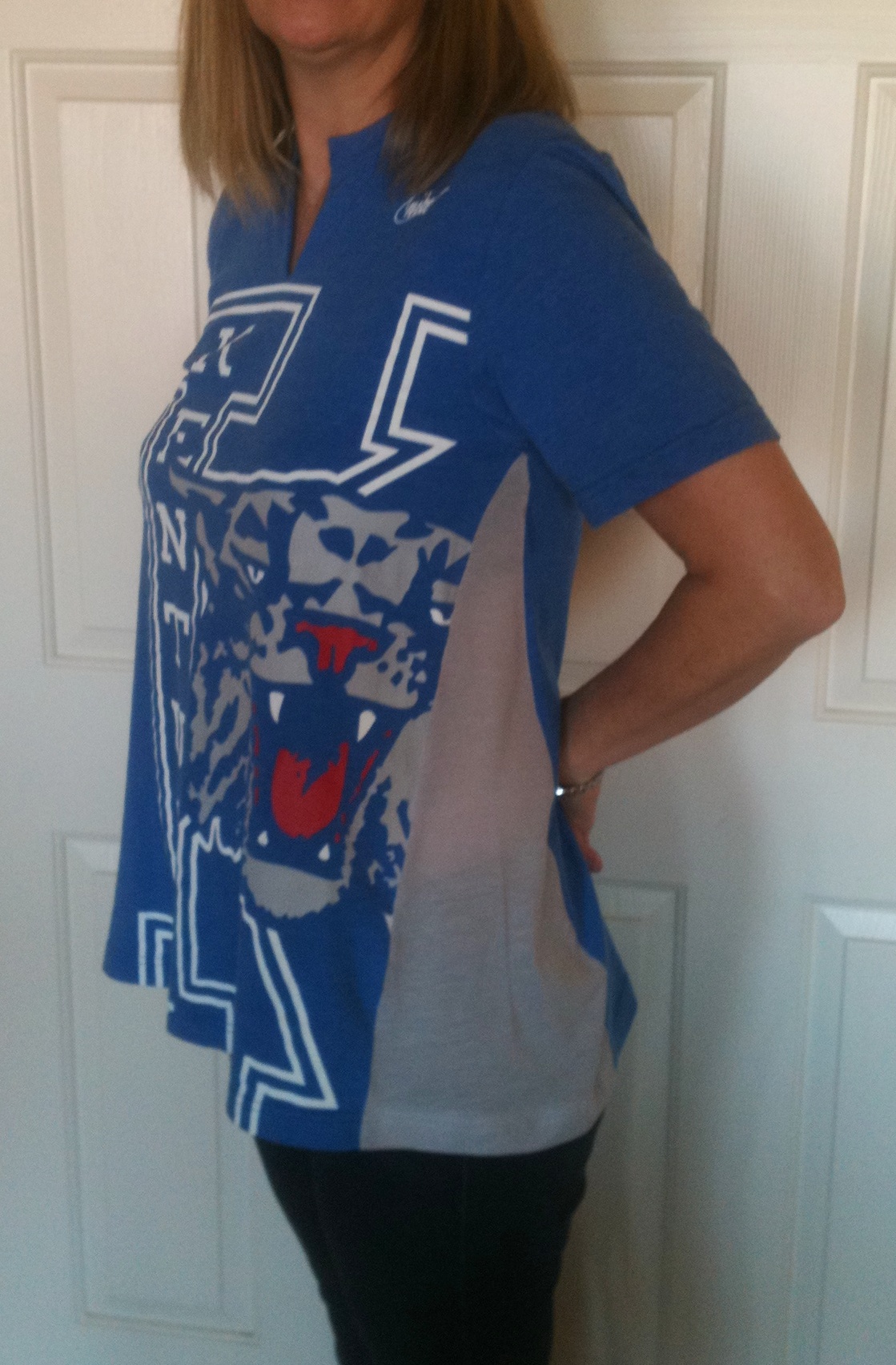
Another “Cool Mom” Team Logo T-shirt

Cool Mom Logo T-shirt

Cool Mom Logo T-shirt

Our children’s activities provide many pleasures – and innumerable logo T-shirts.

Shapeless Logo T-shirt

Logo t-shirts are rather shapeless and, well, none too flattering.

The original Logo T-shirt remake included an empire waist and a surplice top.

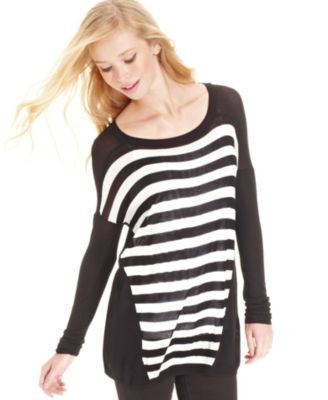
Tunic with Side Seam Inserts

Tunic with Side Seam Inserts

Tunics with side seam inserts like this striped one provided the inspiration for a more modern and very simple T-shirt remake.

Easy to sew – just cut t-shirt along side seams.  Sew in triangular fabric pieces.

To make the neck more comfortable, a 3″ slit was cut in the center front.

Cool Mom T-Shirt Remake

Cool Mom T-Shirt Remake

The result is a much more flattering logo tunic!

Just perfect for a Cool Mom!

Posted in Beginner Sewing Projects, Clothing, Sewing, T-shirt remake, Tutorial | Tagged , | 1 Comment

Lace Knit Guest Bathroom Towel

Lace Guest Towel

Lace Guest Towel

Destashification New Year’s Resolutions include:

  1. Organizing the Yarn Stash
  2. Knitting from the Yarn Stash

Goal #1 has been accomplished.  During that somewhat archeological process, skeins and hanks of beautiful yarns were unearthed.

So onto Goal #2.

 Lavender Guest Towel being blocked

Lavender Guest Towel being blocked

A full skein of Grace – 100% cotton sport weight yarn in lavender – left over from baby sweater knitting – was found in one of the nooks or crannies….. and the color matches a relative’s bathroom decor perfectly.

Bathing Beauties Pattern by Evelyn Clark

The pattern used is Bathing Beauties by Evelyn A. Clark with just one or two minor modifications.

I love the small lace projects this pattern contains.  The edgings give the simple patterns an elegant finish.

The newly organized Yarn Stash also contains a few skeins of light weight linen yarn.

In keeping with Goal #2, there may be a few more guest towels knit this year!

Posted in Accessories, Knitting, Lace Knitting, Stash Couture | Tagged , , | 3 Comments

The DD 2-Seam Infinity Scarf Tutorial

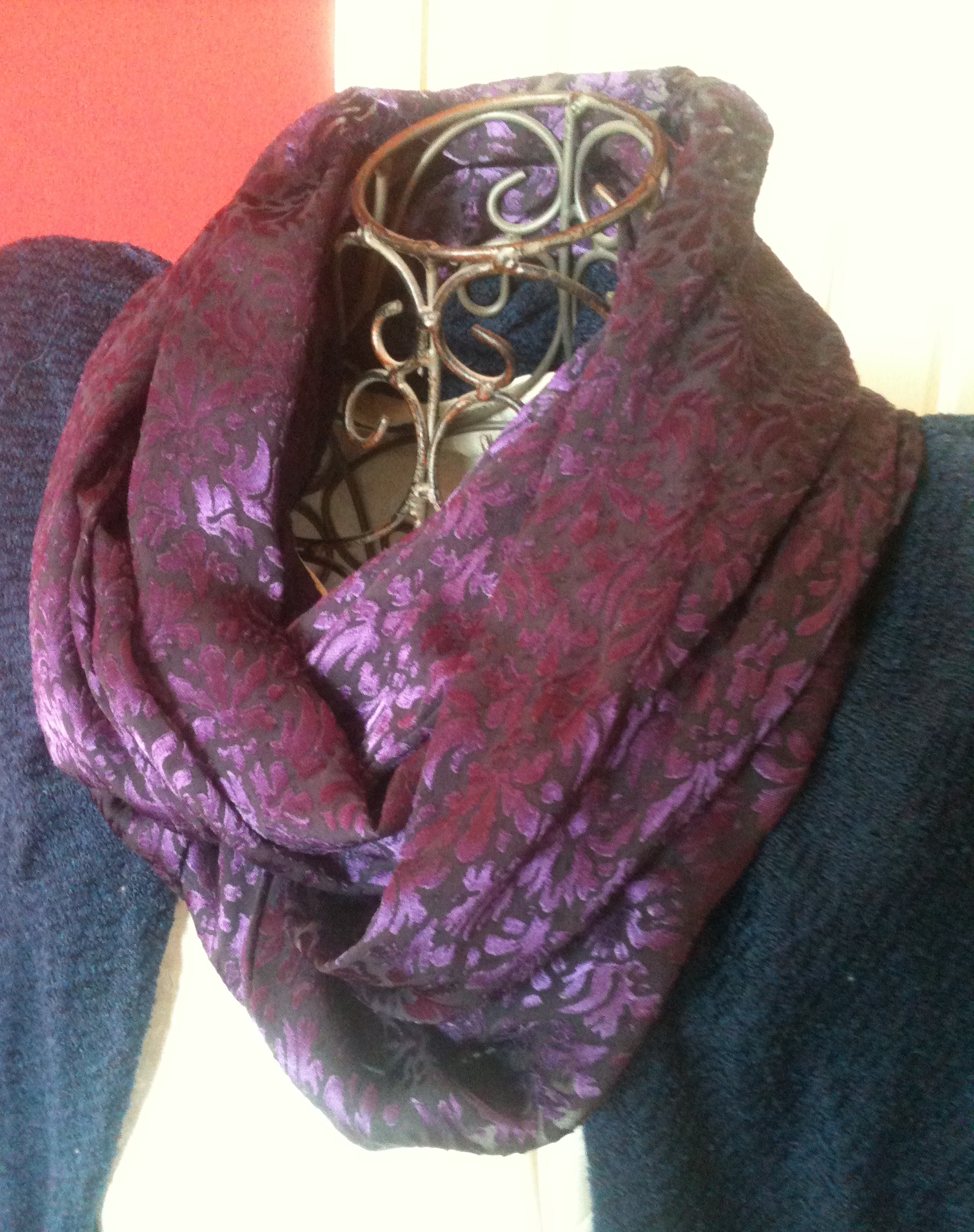
Purple Burnout DD Infinity Scarf

Purple Burnout DD Infinity Scarf

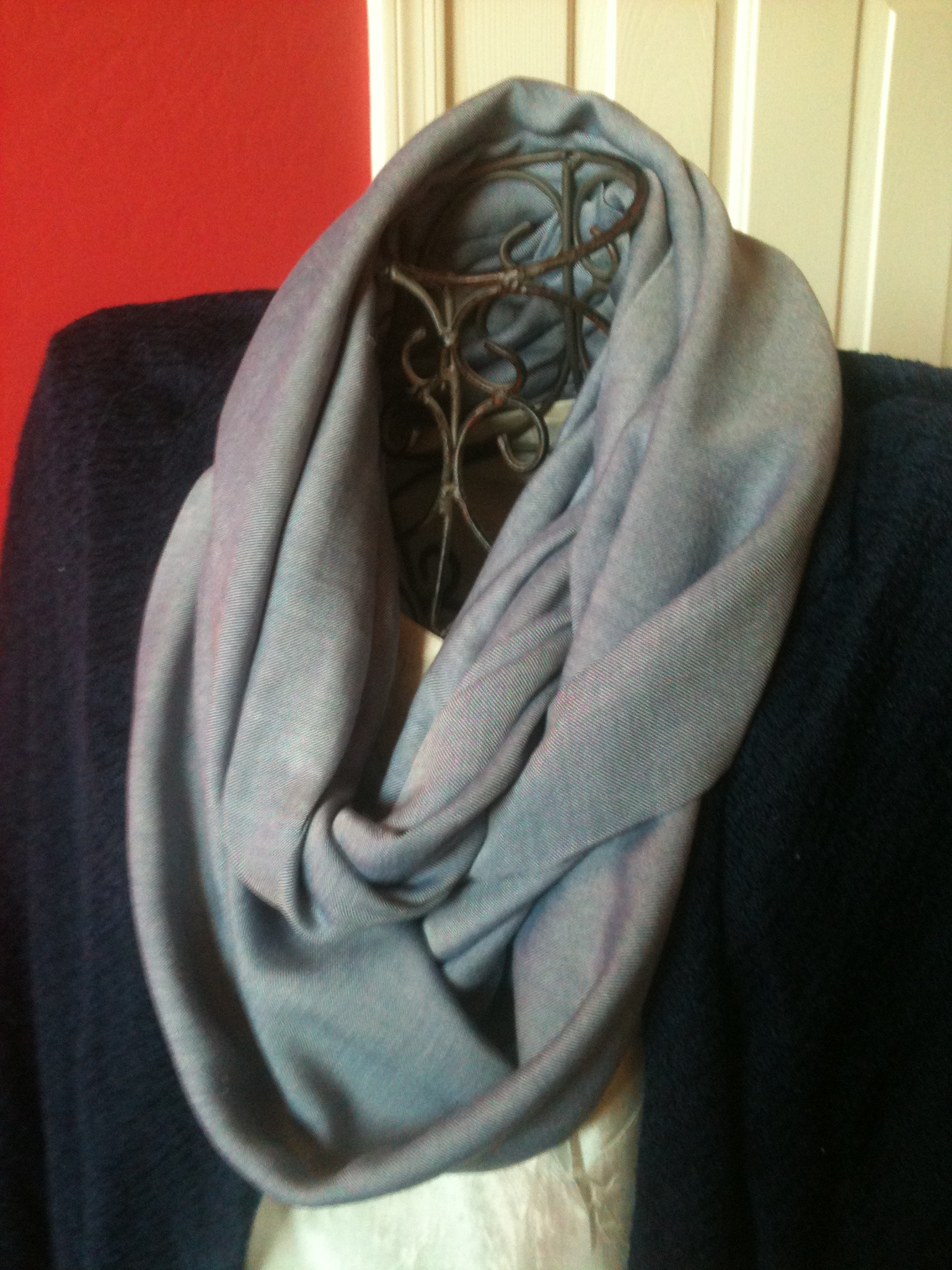
The DD (Daughter of Destashifier), enjoys sewing gifts.  She developed the Stash Couture Infinity Scarf for Christmas gifts this year.

She sewed this beautiful scarf for me using a purple burnout fabric which has been in The Stash for years.

We put together this simple tutorial  – only TWO (Really. Just 2) seams!

  1. Pick a fabric.  Chiffon, tencel, rayon, even soft knits will work for the scarf.  (Corduroy and quilting cottons will not.  The tutorial scarf is a denim weave tencel – so soft!)   >>>>>>>>>              >>>
  2. Rectangle of fabric 30" by 60".

    1.  Rectangle of fabric 30″ by 60″.

    Cut the fabric into a rectangle 60″ long by about 30″ wide.  (If the selected fabric is 60″ wide then 1 yard will be more than enough.  If the fabric is only 45″ wide, then 1 3/4 yards will be required.)  ……………….   

  3. Fold fabric in half (the long way) RIGHT SIDES together and pin the long edges together.  (OK…so pinning is not all that much fun, but fabrics that flow also tend to move while sewing, so yes…..pinning.)    ……………………………………………..          ……………….
  4. One seam done!

    5.  One seam done! Rectangular tube.

    Sew the pinned edge using a 1/2″ seam allowance.

  5. Turn right side out and press.  One seam done!  The scarf should now be a rectangular tube 60″ long by 14″ wide………………………………………………………………………….   …………………                                                                           …..    …………..
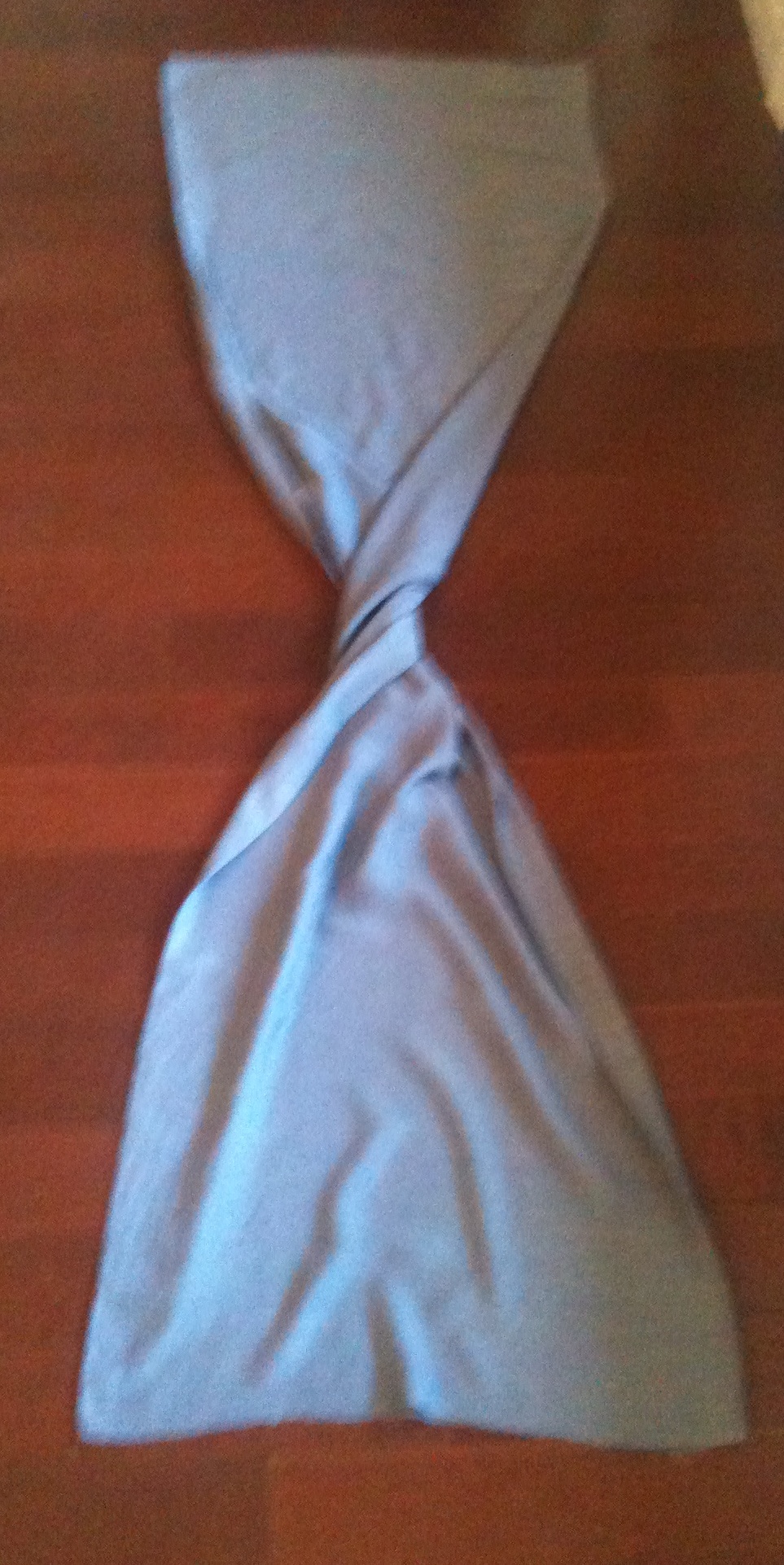
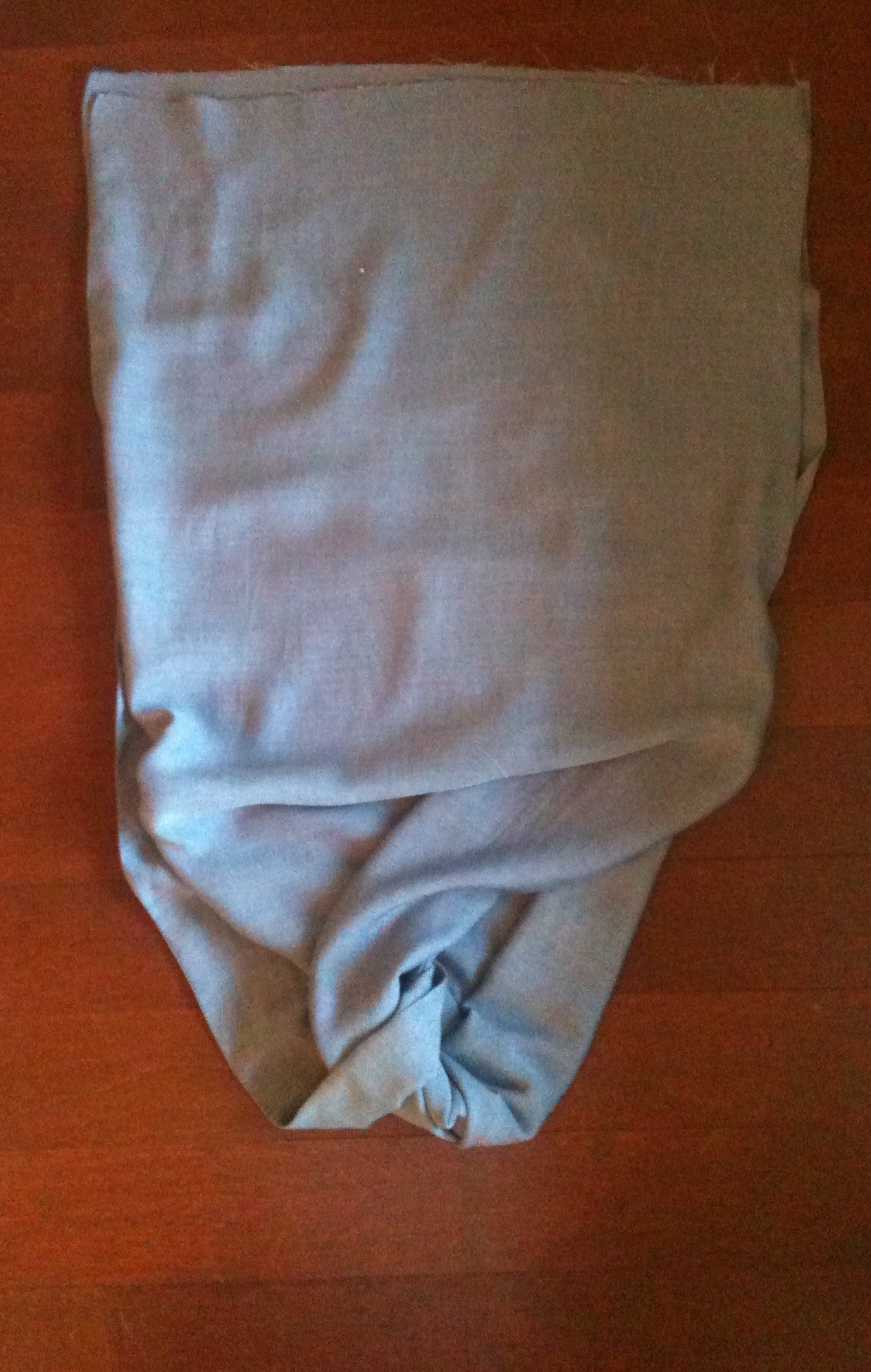
  6. Flip lower edge over.

    6.  Flip lower edge over.

    Lay scarf flat.  Pick up lower narrow edge of scarf and flip it over.  This will twist the scarf as shown in Picture 6.     ……………        ……………..

  7. 7.  Double Twist

    7. Double Twist

    Pick up lower edge and flip again.  This will create the “double twist” shown in Picture 7.

  8. Bring lower edge to upper edge.

    8.  Bring lower edge to upper edge.

    Pick up the lower edge and bring it to the upper edge as shown in Picture 8.    ………………………      ………………   

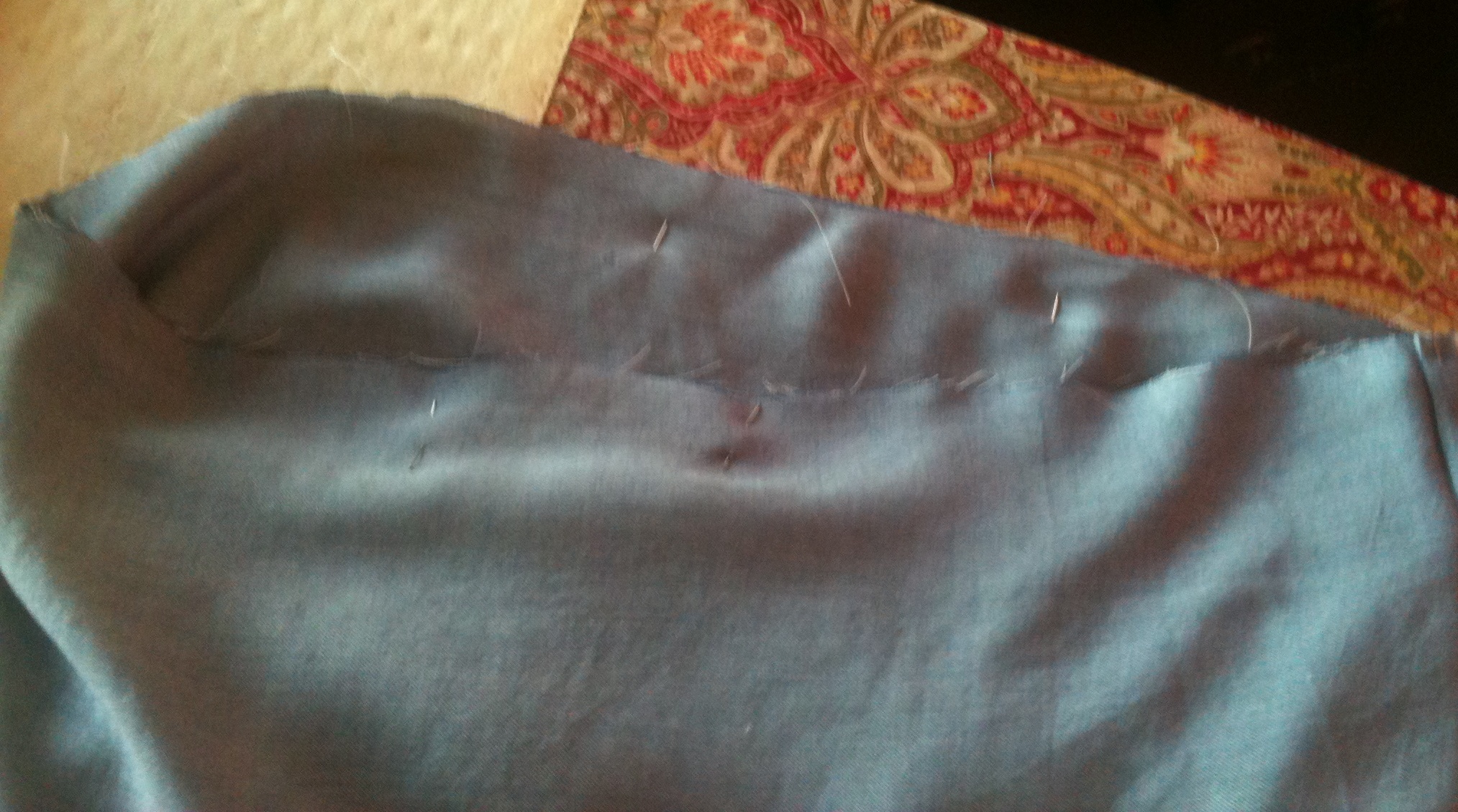
  9. Pull top layer out of the way and pin second layer to third layer.

    9.  Gently pull top layer out of the way and pin second layer to third layer.

    There are now 4 layers of fabric at the top.  Gently pull the uppermost layer down to expose the second layer.  Pin the second layer to the third layer.  Match side seams.

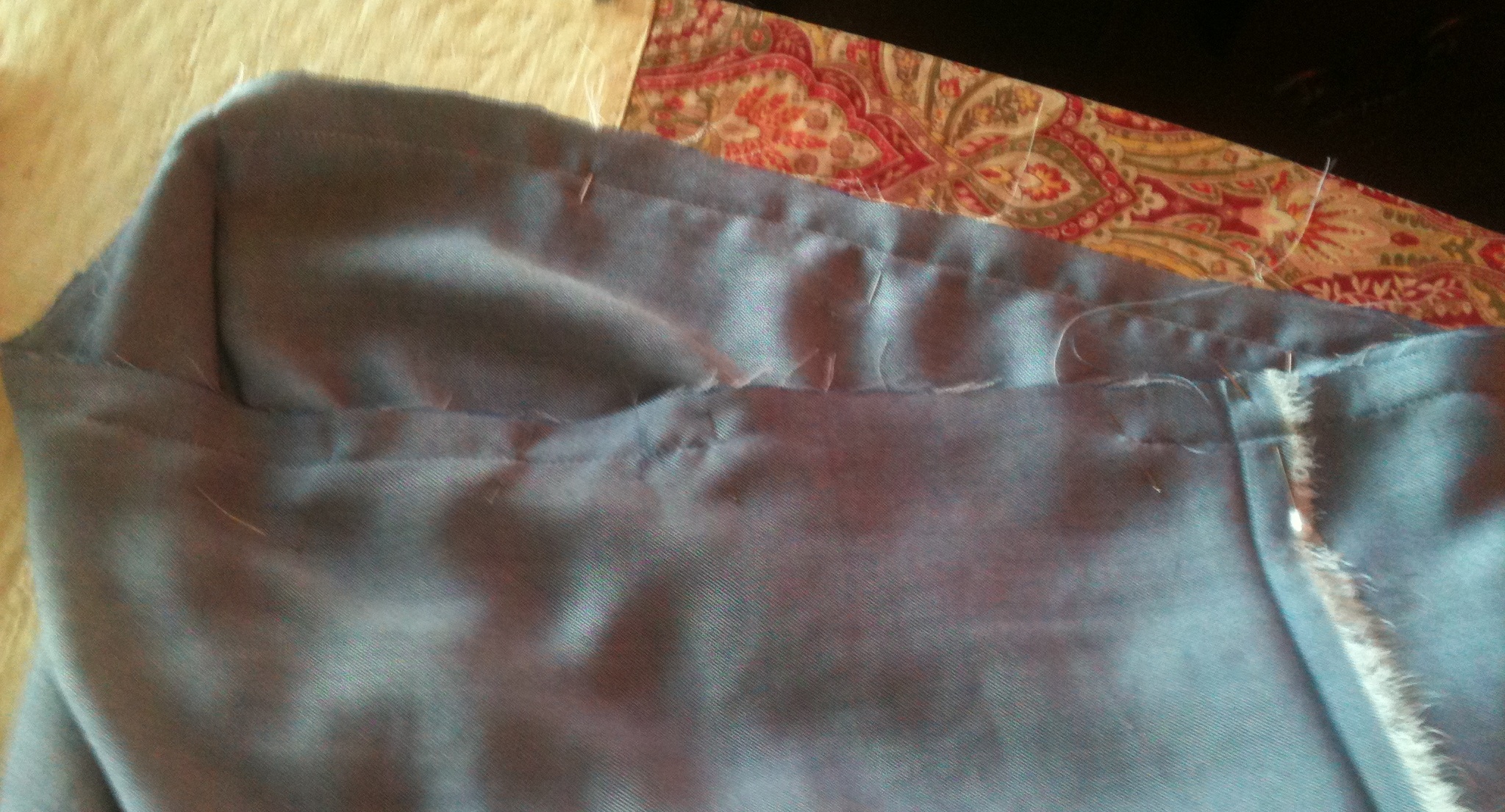
  10. Top edge completely pinned.

    10.  Top edge completely pinned.

    Continue pinning until a space about 10″ wide remains unpinned.  Turn scarf inside out through that space.  Then continue pinning all the way around.                                           …………………………………..    …………………………………..            

  11. 11. Upper edge stitched leaving 5" space unsewn.

    11. Upper edge stitched leaving 5″ space unsewn.

    Stitch the pinned edge leaving a 5″ space unsewn.    ………………………………….      ……….

  12. Press 5" unsewn section open.

    12.  Press 5″ unsewn section open.

    Place scarf on ironing board and press the 5″ space open as if it were sewn.  This will create a nice finished edge when stitching the opening closed in the Step 14.       .  ………………………    …….

  13. Turning scarf right side out through 5" opening.

    13.  Turning scarf right side out through 5″ opening.

    Reach into the 5″ opening and pull scarf right side out.  Press seam.  Second seam completed!    .

  14. stitch 5" opening closed.

    Hand stitch 5″ opening closed.

    Pin 5″ opening closed and stitch closed by hand.

Done!

Tutorial Scarf completed!

Tutorial Scarf completed!

Two seams and so Stash Couture!

Posted in Accessories, Beginner Sewing Projects, Clothing, Sewing, Stash Couture, Tutorial, Uncategorized | Tagged , , | 4 Comments

This year’s UnFinished Gift – Finished

Finished UFG!

Finished UFG!

Every year there is the one UFG.

From what I understand it is a common occurrence among knitters.

This year several hats and 2 scarves were wrapped.  But one of the scarves was still on the needles!

Two days later – finished, blocked and ready to make the trip to the snow country come the end of Winter Break.

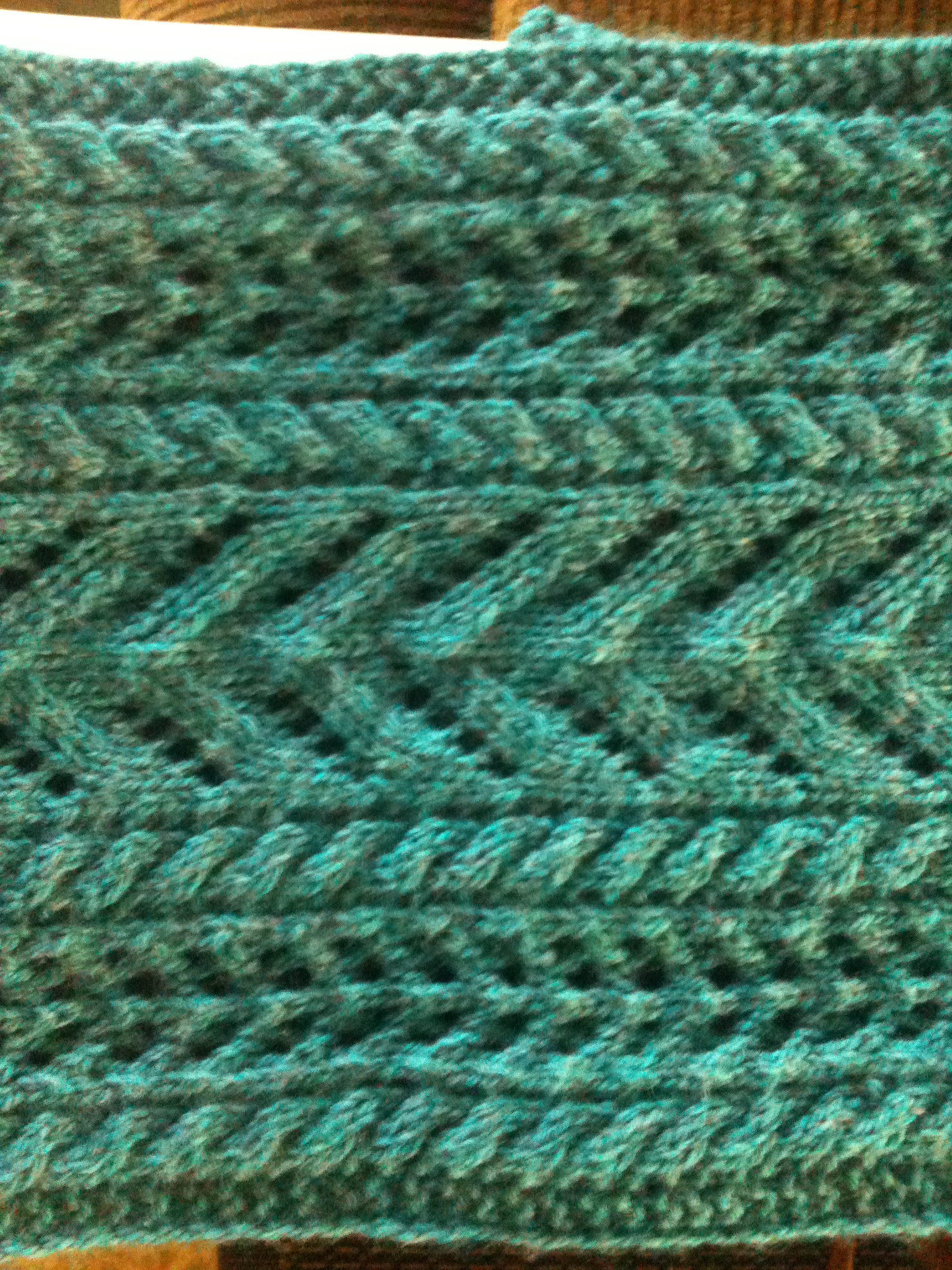
The pattern is Easy as Pie Scarf, by Megan Delorme.  It is the same one used for the Cashmere Scarf.

I modified the pattern by using a “Resting Row” – Purl Every Stitch on the wrong side.  Doing so requires the pattern only be counted on the right side rows – allowing the brain to “rest” on wrong wide rows!

Vintage DK

Vintage DK

Two skeins (288 yards each) of Vintage DK by Berroco were knit on size 7 needles.

Vintage DK

Vintage DK

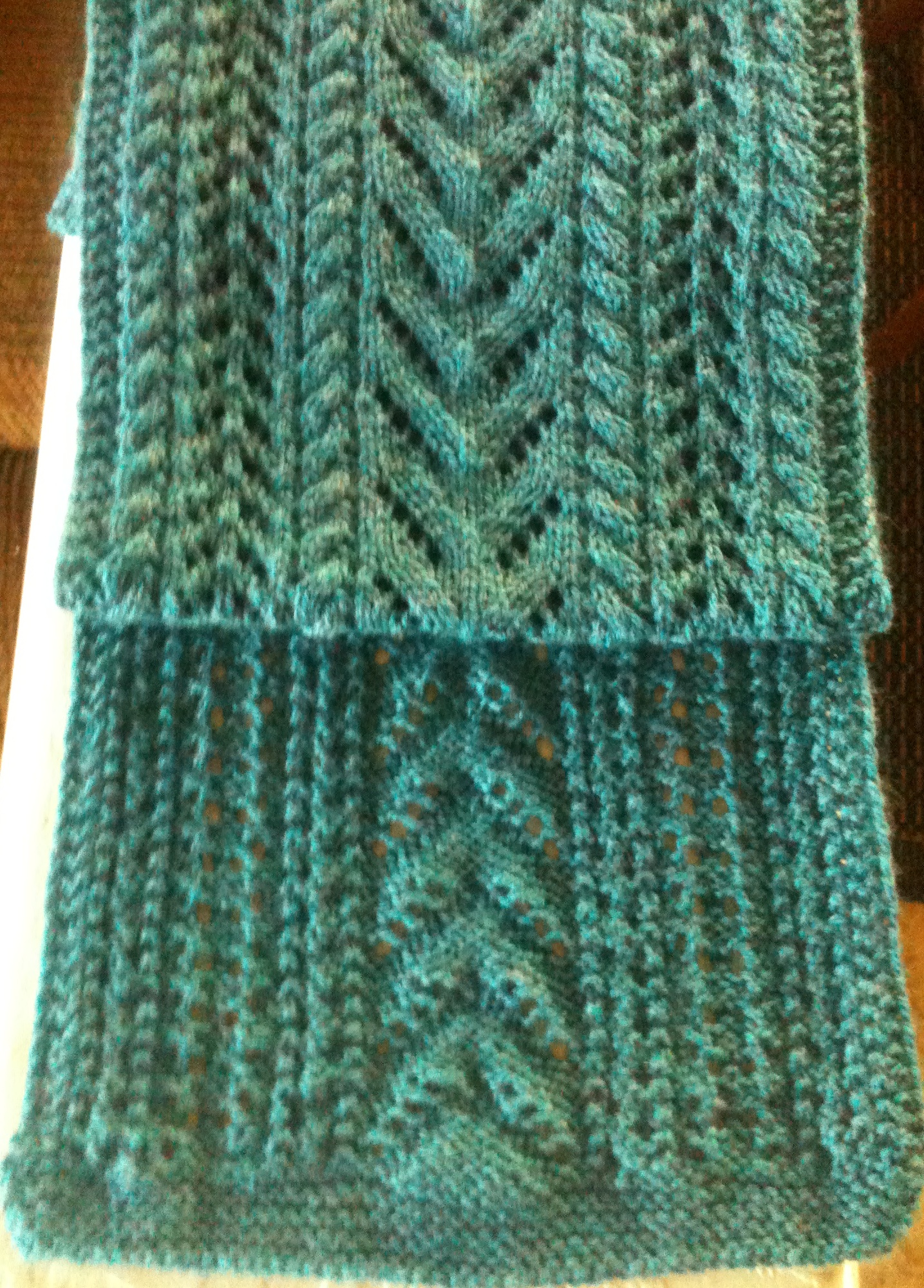
The heathered teal/grey yarn is a machine washable blend of acrylic, wool, and nylon.  It knit easily, but did not block as well as the cashmere blend.  The lace pattern quickly returned to its pre-blocking distortion once dry.

Teal/Grey Scarf

Teal/Grey Scarf

However, machine washable yarn was a must for scarves headed to a college campus!

One stripe of the Striped Destashification Slouch Hat was knit with this scarf yarn so they can be worn together.


Posted in Accessories, Cables | Tagged , | Leave a comment