Ohio Star: Math-Free Version. Part 1: Double HST.

quilt top and squareI envy those quilters that can turn a perfect “scant” 1/4 inch seam.

The engineer in me cannot compute the term “scant.”  Engineers use calipers.  Engineers measure 3/16″ or 7/32″ or 5.55625 millimeters, but “scant” is not in our vocabulary.

I was asked for a quilt by one of my children.  Even if it weren’t Mother’s Day the answer would still have been “Of course – what colors?”

The timeline is a bit restrictive, so intricacy and curved piecing were out.  Something about the simplicity and angles of the Ohio Star Block has always spoken to me.
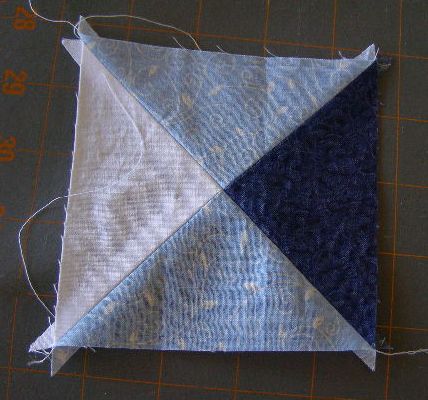
One set of "Points"

One set of “Points” – each block requires 4 of these.

Part 1 of this tutorial describes the steps to make the “points” of the star using a Math-Free Half Square Triangle method.  Part 2 will describe putting the block together (also Math-Free)

Only four seams are required to make the 4 sets of points required for each block!

And all seams a done following a straight line drawn on the fabric!

Sew Simple!
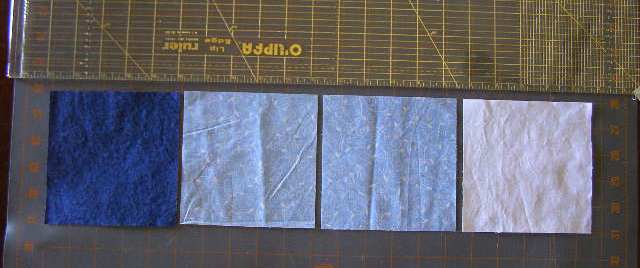
Start with four 5" squares

Start with four 5″ squares

Required for each set of points for a finished 9″ block:

  • One 5″ square of white fabric
  • Two 5″ squares of light blue fabric
  • One 5″ square of dark blue fabric

Why 5″?  Well, we could do the math.  It involves square roots, fractions, and angles…but this is Math-free quilting.  And besides, my ruler was 5″ wide.
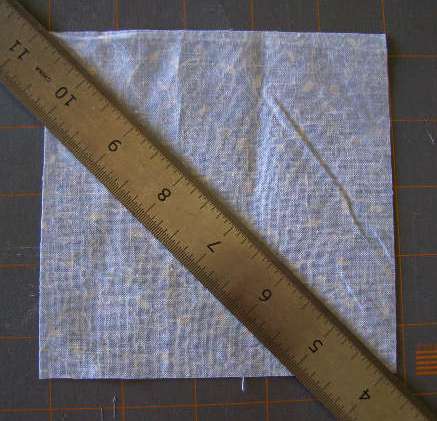
draw a diagonal line one THE BACK of each light blue square.

Use a straight edge to draw a diagonal line one THE BACK of each light blue square.

1.  Take the two light blue squares and turn them BACK SIDE UP.
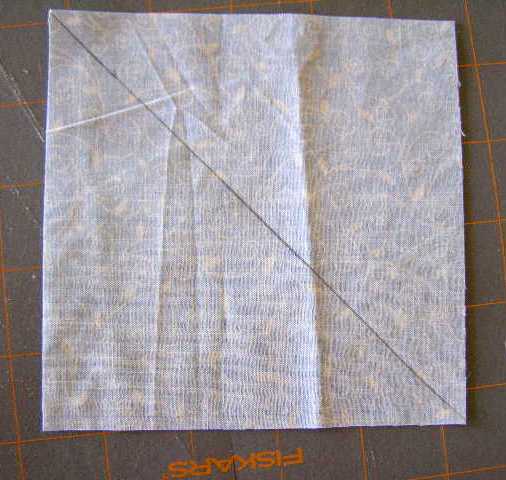
Diagonal line drawn on BACK SIDE of light blue square.

Diagonal line drawn on BACK SIDE of light blue square.

2.  Using a straight edge, ON THE BACK, draw a diagonal line across each one. (I used a ruler, any straight edge will do – there is no measuring.)

A ball  point pen or a pencil (engineers prefer mechanical pencils) will do.  I do not recommend gel pens, crayons, glitter pens or permanent markers.
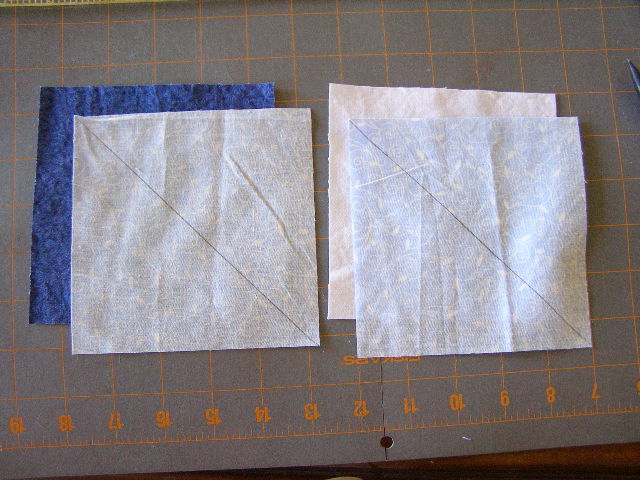
Place light blue squares on top of other squares - right sides together.

Place light blue squares on top of other squares – right sides together.

3.  Place one light blue square on top of the white square and the other on top of the dark blue square.

In the photo the underlying fabric is showing so the colors of the fabric can be seen.  Place the light blue squares directly on top of the underlying fabric aligning edges.
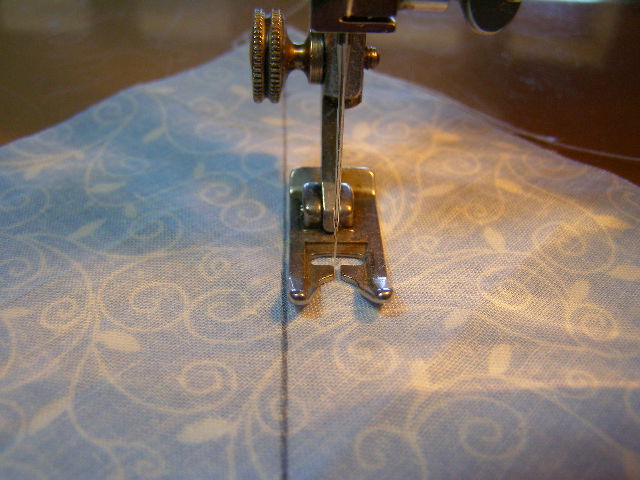
Sew approximately 1/4" from line - on each side of line.

Sew approximately 1/4″ from line – on each side of line.

4.  Take a square set to the sewing machine and sew approximately 1/4″ (I use the width of my pressure foot – it is close enough!) from the drawn line.  Then turn square around and sew 1/4″ from the line – on the other side of the line!
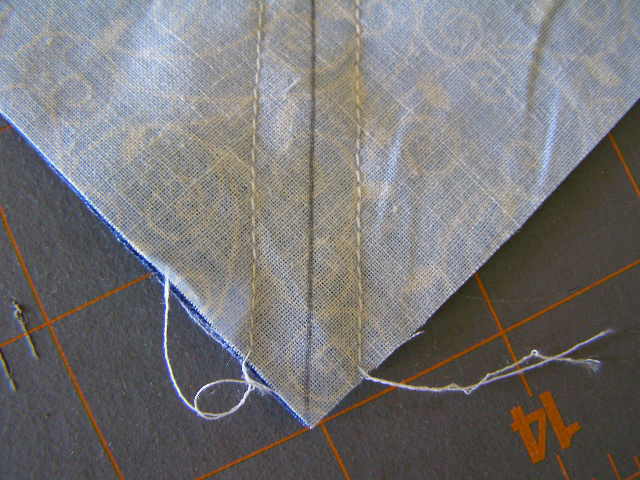
Seams 1/4" on both sides of the drawn line.

Seams 1/4″ on both sides of the drawn line.

Love a pressure foot that is approximately 1/4″ !

5.  Repeat for second set of squares.
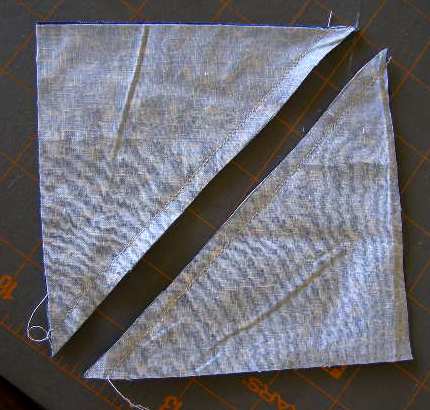
Cut along drawn line!

Cut along drawn line!

6.  This is the exciting part:  Cut along the drawn line!
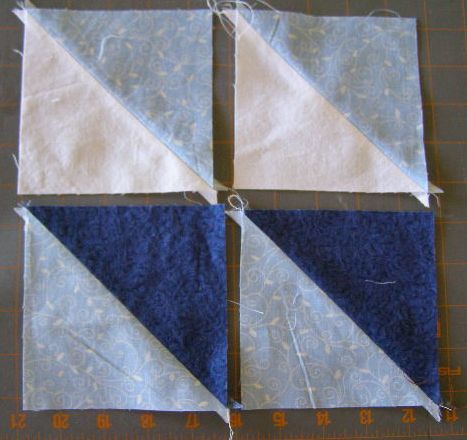
Viola!  Four triangle squares!

Viola! Four triangle squares!

7.  Open both to reveal four squares of triangles!  Press seams open.

Congratulate yourself!  You are half done!
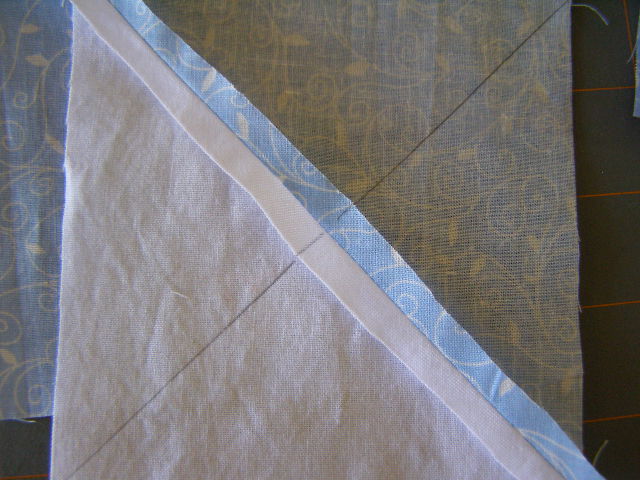
Draw diagonal lines across the BACK of the white/light blue square

Draw diagonal lines across the BACK of the white/light blue squares.

8.  Take the two white/light blue squares and drawn diagonal lines across THE BACK, using a straight edge.
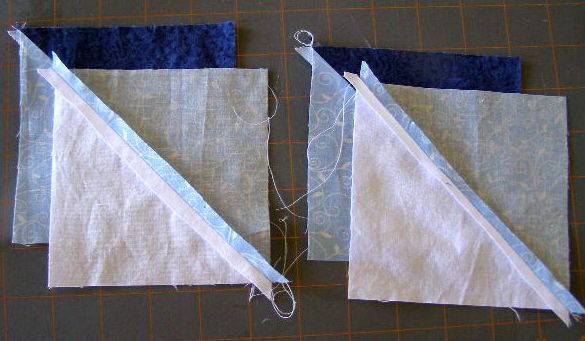
Layering squares.  Light blue triangles should not touch.

Layering squares. Light blue triangles should not touch.

9.  Place each white/light blue on top of one of the dark blue/light blue squares.  The light blue fabrics should NOT be on top of each other.

Again, in the photo the underlying fabrics are shown to show color placement – the edges of the squares should align prior to sewing.
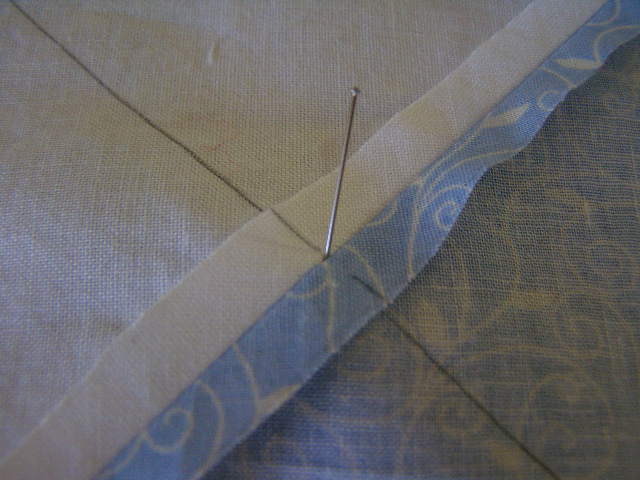
Poke a pin straight through

Poke a pin straight through

10.  Poke and Pin:  Poke a pin straight up and down through the point the drawn line crosses the seam of the white/light blue square.  Then make sure it pokes straight through the seam line of the dark blue/light blue square – in approximately the middle of the square.

This ensures the two seams align – resulting in those perfect points!
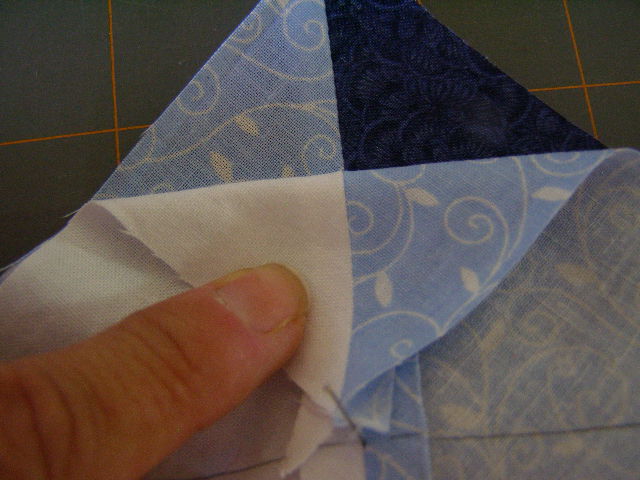
Lift top square edge to verify seams align.

Lift top square edge to verify seams align.

11.  Without moving the Poked Pin – lift the edges of the squares to verify seams align (and also to verify that the light blue fabrics are on opposite sides.)
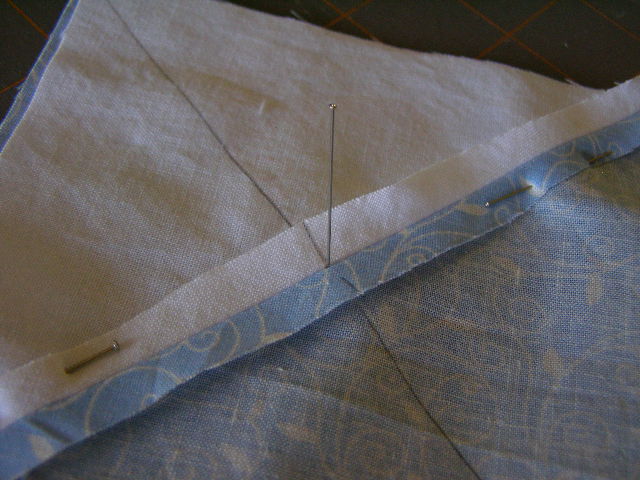
Poked and Pinned.

Poked and Pinned.

12.  Without moving the Poked Pin – pin the square together – but no closer than 1″ from Poked Pin.

Why no closer than 1″ from the Poked Pin?  It took me a while to figure this out, but the act of pinning actually slides the top fabric.  The Poked Pin is marking the “points” which are to match.  Pinning too close to it will pull the top fabric away causing the “points” to no longer align. (See Trouble Shooting at end of this post)
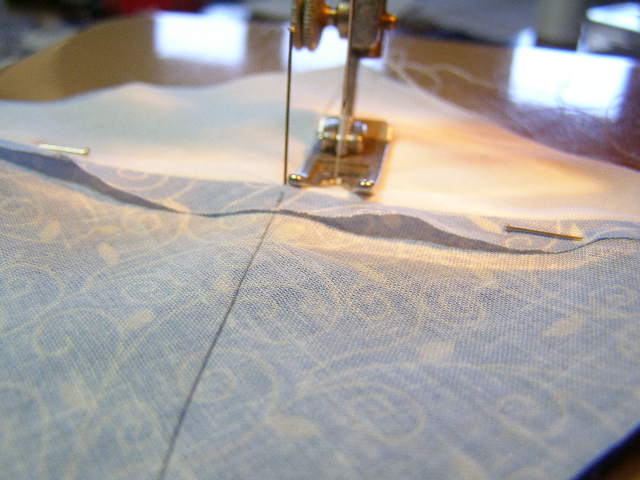
Leaving Poke Pin in until pressure foot is very close.

Leaving Poke Pin in until pressure foot is very close.

13.  Return to sewing machine and sew 1/4″ (or pressure foot width) from the drawn line.

I leave the Poked Pin in and vertical until it approaches the pressure foot.  Pulling it out too early may allow the top fabric to slide.

14.  Turn square around and sew 1/4″ from drawn line on other side of line.
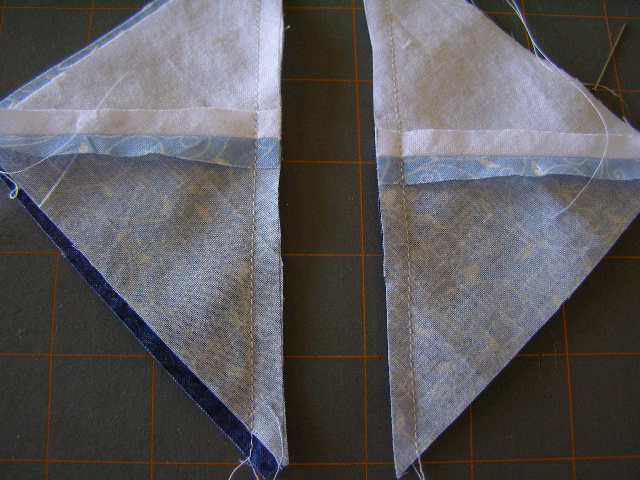
Cut along drawn line.

Cut along drawn line.

15.  Open to double check that points align – then cut along drawn line. (Scroll down to Trouble Shooting if they do not align)
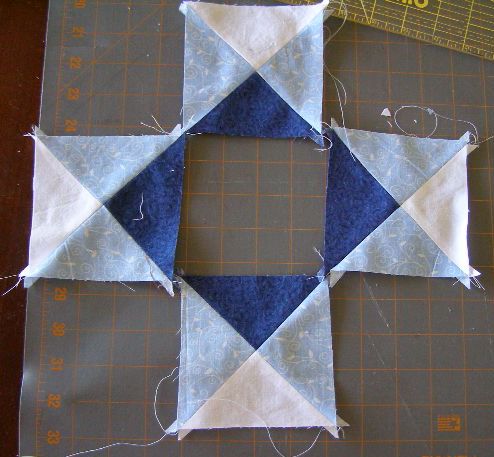
Four Perfect Points all set for Part 2:  Math Free Ohio Star Finishing.

Four Perfect Points all set for Part 2: Math Free Ohio Star Finishing.

16.  Press seam allowances open.

17.  Celebrate! 

Four Seams = Four Points!
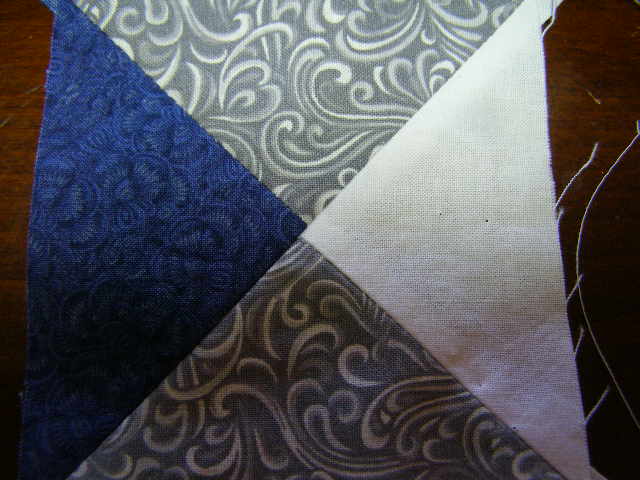
When Points do not align

When Points do not align

Trouble Shooting:

If the points do not align, remove the seams prior to cutting triangles apart.

Press with iron.

Reposition the Poked Pin carefully ensuring it passes through the seams of both squares and restitch.

If the points do not align and the triangles were already cut apart – remove seam and loose threads carefully.  Press with iron.  Place scotch tape over the stitching line (it will prevent the bias edges of the triangles from distorting).  Carefully Poke a Pin through the seams of both squares.  Pin and restitch. Remove scotch tape prior to pressing (or you will need a new iron for Mother’s Day!)

Click here for Part 2.

Posted in Beginner Sewing Projects, Quilting, Sewing, Tutorial | Tagged , , | 2 Comments

From Beige to Better. Stash Couture Skirt.

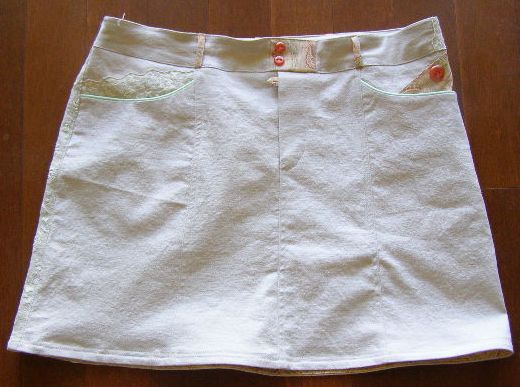
beige fabric

Some very beige fabric.

This Stash Fabric does not seem to have much to offer.

It is, well, beige.

A whole lotta beige.

Beige + Print

Beige + Print = More Options

However – it does have promise…It is stretch linen.  Even when beige, stretch linen has promise.

Perhaps if a Stash Print were added to break up that sea of beige…

OLYMPUS DIGITAL CAMERAAnd possibly some Stash Lace….

Now the beige is no longer quite so blah!

McCalls 5429 (discontinued)

Pattern Stash provided McCalls 5429 (discontinued) and some Stash Mining produced piping and a few buttons.

Summer Skirt

Summer Skirt

Thanks to the lycra, the finished product is a VERY comfortable summer skirt.

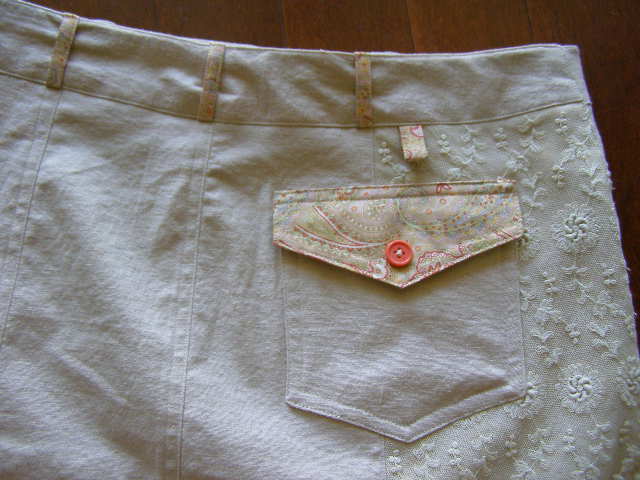
Back Pocket and Lace Skirt Panel Detail

Back Pocket and Lace Skirt Panel Detail

Stretch Linen is a great fabric for the body of a garment, especially in the heat of the Arizona Desert.  But it does offer a two main challenges: a monolithic look and it does not crease or fold well.

Embellishments help overcome both of these challenges.

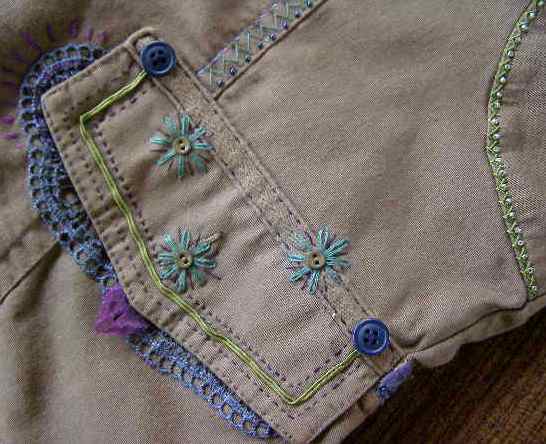
A lace overlay was added over the back right skirt panel.  The antique lace was in exceptional condition, except for one small stain.  The pocket covered the discoloration.  The placket and button added color.

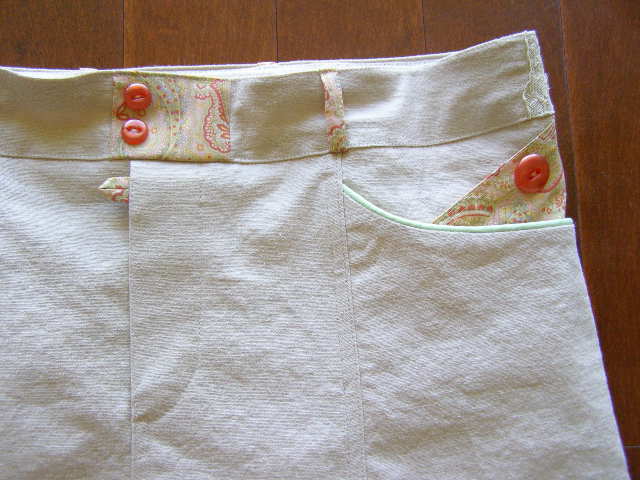
Front Detail

Front Detail

Other embellishments, including the belt loops and change pocket were created from the cottons.  The quilting weight cotton folds and creases much easier and more precisely than the linen.

Left Front Detail

Left Front Detail

The placket and the waistband are faux openings. The fabric stretches sufficiently to just pull the skirt on!

To reduce bulk, only the visible portion of the pocket was sewn from the linen.  The linings are both cottons.  Light green mini-piping edges the pocket.

Skirt Back View

Skirt Back View

The cotton was also used to face the hemline.

All seams were topstitched.

The stretch makes the skirt so comfortable, but the embellishments make it “Stash Couture!”


Posted in Clothing, Embellishment, Sewing, Sewing for a Teenager, Stash Couture | 1 Comment

SOS: Save Our Shorts!

We all have them.

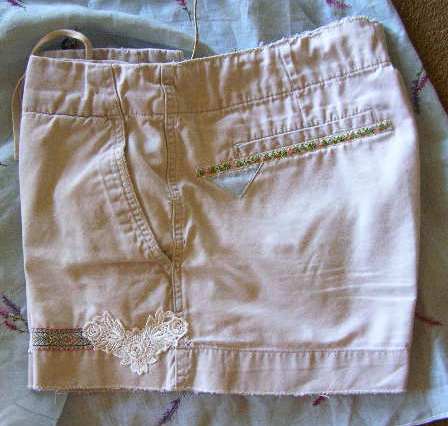
Saved Comfort Shorts

Saved Comfort Shorts

That one pair of shorts (or pants) that fit “just right.”  The waistband is not too tight, nor is it too high or too low.

We wear them around the house, maybe to the mailbox, possibly to the grocery store – and might have even slept in them a time or two.

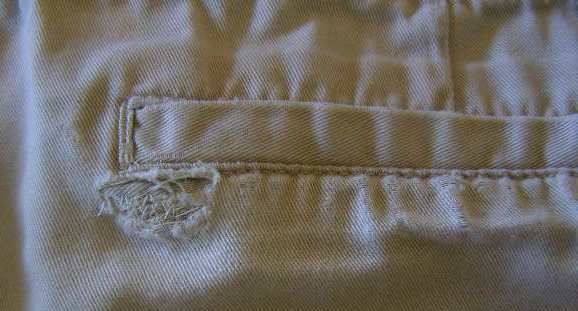
Pocket strain.

Pocket strain hole – Before.

They may have, at some point, been in style.  But as the years passed, comfort became more important than style!

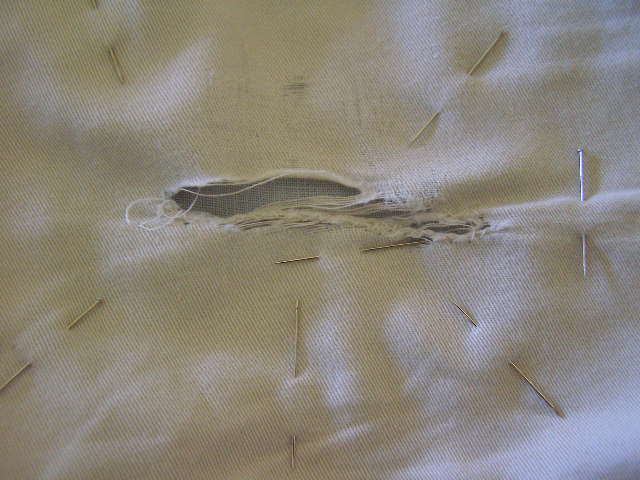
And these “favorites” have developed a hole in the seat and another in the pocket and a few worn seams – but they are still SOOOO comfortable!

Hole in the Seat

Hole in the Seat

Pocket Detail

Pocket Detail

We who sew cannot immediately cast off such comfort. We have to keep them wearable until we find a replacement pair with at least a hint of the same comfort level.

My comfort shorts are a pair of 100% cotton khaki’s that have served me well for over 7 years.

Hole in the Seat - After

Hole in the Seat – After

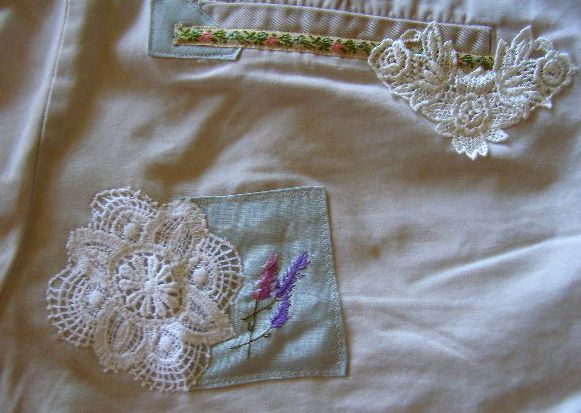
Linen was selected as the patching of choice. Then a few ribbons and some lace from The Stash – and the shorts are good to go!

To strengthen the wear spots, they were first zig-zagged and then the embellishments sewn on by machine.

Because the fabric had worn so thin (and soft) linen patches were stitched both to the outside and the inside to reinforce the wear area and hole in the seat.

The hem stitching had worn completely through on one leg, so ribbon was used to cover the zig-zag repair.

Shorts renewed!

Shorts renewed!

The worn lower edges of the legs were reinforced with zig-zag stitches so the hanging threads could be trimmed.

Not necessarily “Art-to Wear,” these shorts are rejuvenated shorts are ready to provide at least one more summer of comfort!


Posted in Clothing, Embellishment, Sewing, Sewing for a Teenager | 2 Comments

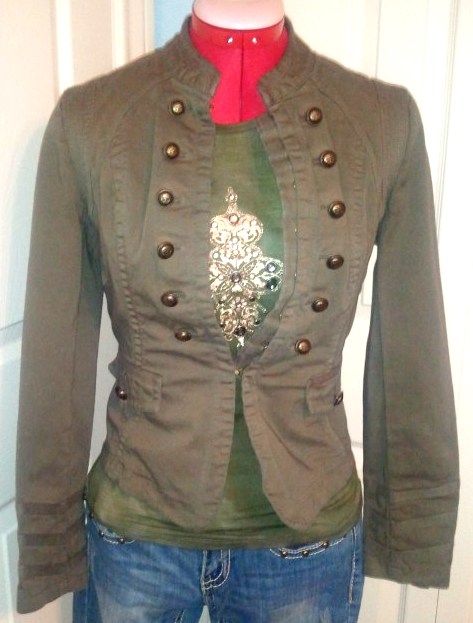
Embellished Military Jacket – Take 2

After

After

Before

Before

Found a military jacket on clearance – it was missing a few buttons.

The jacket had princess seaming and some sleeve detail that just screamed out “Embellish Me!”  Not being one to deny a screaming jacket, it came home with me.

Lower Back

Lower Back

Embellishments do not always “work.”  The first attempts was too garish – which can happen with greens and purples.

The back included a band of the wide green embellished ribbon that eventually found its home on the lower right sleeve and the purple silk semi-circle. The two colors were too saturated and just seemed to clash when placed adjacently.

So, the jacket was hung in the closet waiting for a new wave of inspiration to tackle me.

Right Sleeve and Front

Right Sleeve and Front

Inspiration was scheduled by a foolish back injury that dictated a few days of couch time.

Beads, threads and small fabric scraps in the blue, green and purple colors scheme were extricated from The Stash and piled next to me.  A heating pad was placed under my back – and the fun began!

Jacket Fronts

Jacket Fronts

The original jacket front had buttons on both sides, but I wanted the “band jacket” embellishments.  Many colors of ribbon were auditioned for this role, but the military green grosgrain that was just subtly different that the jacket color worked best.

A tiny prairie point adds an unexpected touch.

The blue runched ribbon from The Stash was just the right length for the front inner placket!

Although difficult to see in the photo, the collar is embellished with  curlicue embroidery.

The beaded face cabochon had been attached to the back as part of the first embellishment attempt.  Adding the grey-blue lace piece and the beaded “crown” prevented it from “floating” on the upper back.

Face Cabochon Detail

Face Cabochon Detail

Beading and simple lazy daisy stitch were added to the upper edge of the lace.

The same lace was also added under the front pockets and on either side of the lower back.

Gimp, beads and simple embroidery embellished the hem and all seams.

Embellished Front and Sleeves

Embellished Front and Sleeves

The original jacket had three cotton twill ribbons on the lower sleeves.  The first embellishment attempt included 1/8″ ribbon over these.  It did not lay flat so was removed and replaced with other ribbons and embroidery.  Another prairie point was also incorporated.

Back View

Back View

The full back picture shows the face cabochon and the lower back.  The antique lace and prairie points create an abstract sunrise motif.

Left Front

Left Front

Pocket Detail

Detail of Pocket and Seam Treatments

The end results are all positive – my back is better and the jacket is a fun casual – and not garish – piece to wear!


Posted in Clothing, Crazy Quilting, Embellishment, Stash Couture | Tagged , , | 2 Comments

Seven Feet of Angora Scarf

7 Feet of Angora Scarf

7 Feet of Angora Scarf

The Yarn Stash contains various beautiful (both in color and feel) yarns.  So when a niece asks for a long scarf, a beautiful Destashification yarn was easy to find.

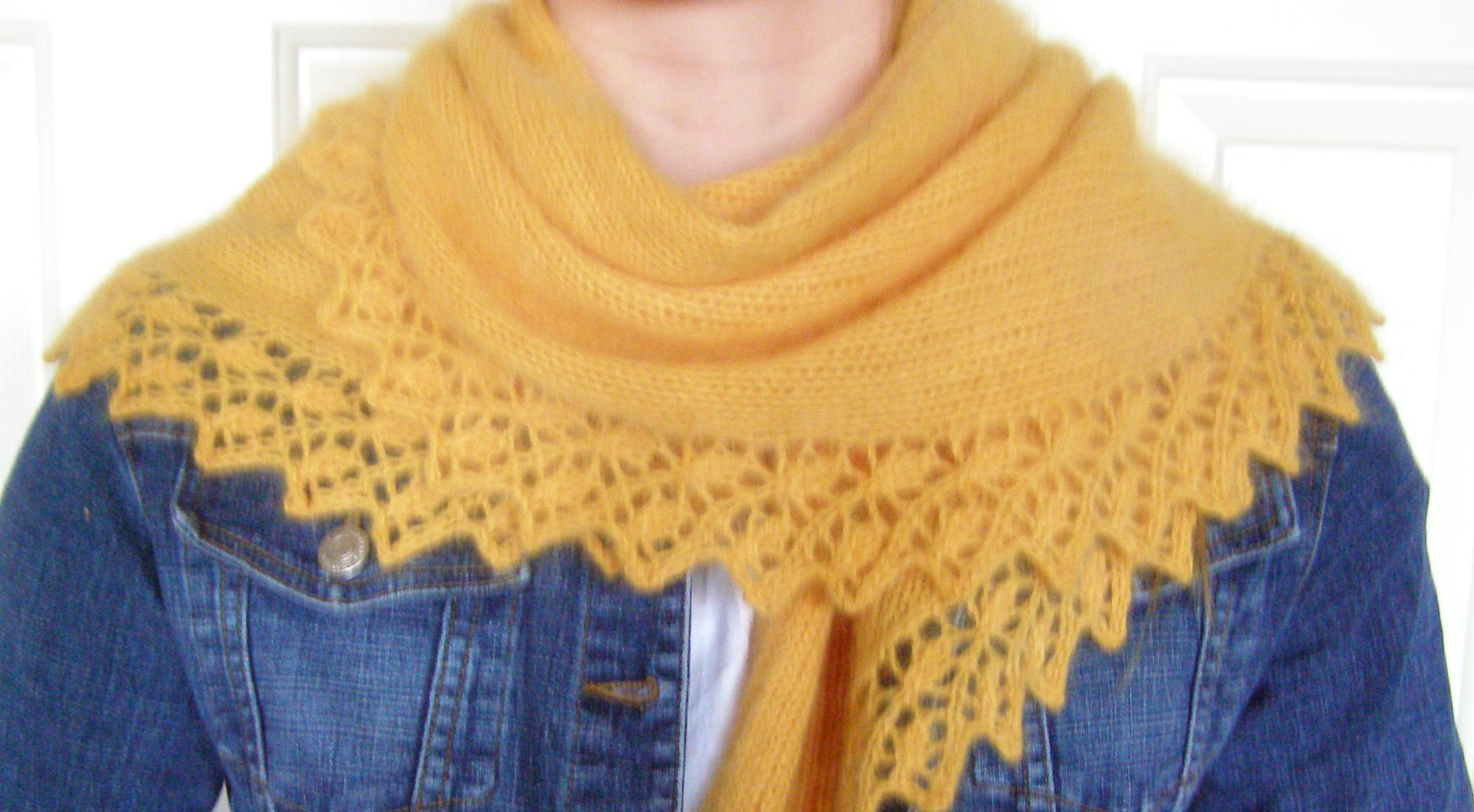
In The Stash was 5 skeins of this angora yarn of long forgotten origin.  It is a sunshine yellow and indescribably soft.

Angora yarn does “shed” quite a bit, but the “bloom” creates a very warm scarf – which my niece in Northern Europe really needs right now!

Angora Yarn from The Stash

Angora Yarn from The Stash

The pattern is Garden City Scarf (Worsted Weight) by Shelly Greenfield (Ravelry Link).  The lace pattern is an easy to memorize 4 row repeat that is only on one side.

My niece requested “a long scarf that can be wrapped a few times,” so I just kept knitting through all those NFL playoof games (and the pre-game shows and the post-game shows.)  Seven feet of knitting later… the scarf was long enough to wrap 3 times!

Chaise Lounge as a Blocking Board

Chaise Lounge as a Blocking Board

Blocking all seven feet posed a challenge.

The only thing I had long enough to use as a blocking board was the pool chaise lounge  – even the swim towels were not long enough.  I had to use two – and about a zillion pins!

Blocking Lace Points

Blocking Lace Points

Each lace point had to be individually blocked, but the end result was well worth the effort.

The Arizona sun may make it too hot to ever wear such a scarf, but it is nice for blocking – the scarf was completely dried in a few hours!

The lace pattern and the triangular ends created a gentle curve to the scarf which allows it wrap nicely.

7 Feet of Angora Scarf

7 Feet of Angora Scarf

Now, I am on a new mission….

I need to determine how much scotch tape will be required to successfully remove the angora “halo” off my once brown, but now yellow (and furry) couch!


Posted in Accessories, Knitting, Stash Couture | Tagged , , , | 1 Comment

Grandpa’s Ties Pillows

When Grandpa passed, his ties became a quilt for his daughter, but there were small scraps left over.

Grandpa's Ties Pillow - stripes

Grandpa’s Ties Pillow – stripes

When fabric has a sentimental value, a project can be found for even the smallest scraps.

The long narrow pieces of fabric from the “neck” portion of the ties were foundation pieced into this striped pillow.

Using a fabric with 1/2″ stripes make this foundation piecing simple and precise.

60 Degree Triangles

Grandpa’s Ties Pillow – 60 Degree Triangles

The second pillow used the few remaining “larger” pieces (2″ – 5″) to create 60 degree triangles.

Size of the scraps dictated that some of the triangles be pieced.  One triangle was foundation pieced of four smaller triangles (lower right – includes the small yellow triangle).

Although beautiful, silk tie fabric is very lightweight, so each of the fabric pieces for this pillow was fused to a lightweight interfacing prior to cutting.  Even with the interfacing though, the bias seaming resulted in considerable stretching.

It took quite a while to decide upon the fabric for the back and framing for these pillows.  They were for Grandpa’s son, who describes his decor as “black, brown and boring.”

Grandpa's Tie Pillow

Grandpa’s Tie Pillow

The Stash still has a few pieces of silk dupioni (and I just found more earlier this week – YAY!) and this gold/black silk worked well with the tie fabrics.

The pieced sections were backed and framed in silk dupioni from The Stash following the same process outlined in Tutorial for Flanged Pillow with Frustration-Free Zipper.


Posted in Home Decor, Modern, Quilting, Repurpose, Sewing, Stash Couture | Tagged , , | 1 Comment

CD Quilt Tutorial

CD Quilt

CD Quilt

Circle Quilts are a great way to use scraps of fabric – and stay warm while stitching during these colder evenings!

Pottery Barn used to have one, Garnet Hill has one currently – they seem to be available commercially in a number of high end stores.

So, I found a piece of  wide muslin and a CD, fabric scraps in the coral-brown-gold colors and followed this simple process to put the quilt together.

Use a CD to create 10 or so cardboard patterns

Use a CD to create 10 or so cardboard patterns

1.  Trace a CD on cardboard to make several CD patterns – cut them out.  For cardboard, cereal boxes or old manilla folders work well – I made 10 using old green folders.

Trace pattern on BACK of fabric.

Trace pattern on BACK of fabric.

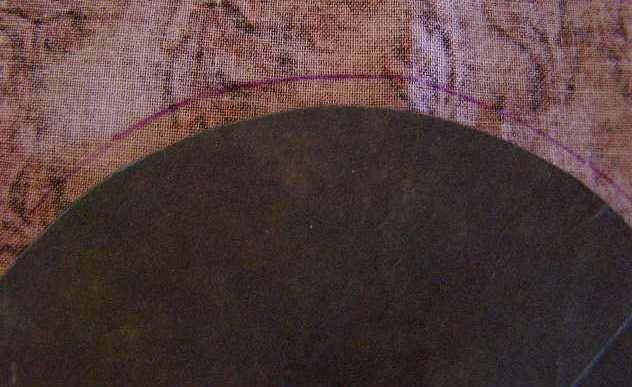
2.  Trace around the cardboard on the BACK side of the fabric.  I used a dark colored ink pen on the dark fabrics and a pencil on the light fabrics.  If tracing several at a time, leave at least an inch between circles.

3.  Cut out the fabric circles, 1/4″ to 3/8″ BIGGER than the traced circle line.

4.  Using a running stitch, stitch around circle between the edge and the line. Do not secure the end of the thread when finished – leave a tail (and the needle if possible!)

Back side of fabric showing running stitch gathers.

Back side of fabric showing running stitch gathers.

5.  Place the cardboard circle against the backside of the fabric circle and pull the thread tail until the fabric gathers around the cardboard circle.  Secure thread by taking a few small stitches.

6.  Take circle to ironing board and steam on front and again on back.

7.  Being careful not to distort gathers, remove cardboard circle.

Steamed Fabric Circle

Steamed Fabric Circle

8.  Steam again front and back.

One Circle ready!  Many more to go!  (Cardboard pattern may be reused.)

Prepare quilt top:

1.  Determine size of quilt  (sheets, especially those of high thread count are not recommended).  Quilting stores (and my stash) have muslin and other fabrics in wide widths, if desired.  A crib quilt can be created using 45″ wide fabric.

2.  Determine center lines (horizontally and vertically) of fabric.  Press to identify.

Circle placed in grid square.

Circle pinned in grid square.

3.  Starting from the center of the fabric, draw a grid on the fabric using a pencil.   These are the quilting lines – and  determine placement of the fabric circles.

CD circles are about 4.75 inches.  I wanted 1/2″ between the circles, so I used a 5.25″ or 5 and 1/4″ grid.  If more space is desired between circles, draw the grid lines further apart.

4.  Place circles within grid squares and pin.  Safety pins are recommended, but if one is immune to pin pricks, straight pins will work. 

If one is creating a specific pattern with the circles, it is recommended that a photo of the layout of the circles be taken.  There is always an errant circle or two (or 6) that seem to escape no matter how securely pinned.

CIrcles appliqued on.  Hand quilted along grid lines.

CIrcles appliqued on. Hand quilted along grid lines.

5.  Using an invisible stitch, applique each circle to the fabric.

6.  Sandwich quilt batting between quilt top and back.  Using safety pins, pin at least once in each circle through all layers.  Also pin frequently at edges.

7.  Quilt through all layers following grid lines.  This can be done by hand (great way to stay warm on cold nights) or by machine.

8.  Trim and bind edges.

If desired, additional quilting can be added – even after adding the binding.

Additional quilting within circles.

Additional quilting within circles (coral solid and small floral print).

Many of the commercially available circle quilts have a circle of quilting about 1/4″ – 3/8″ in from the edge of the fabric circle.

Adding these is simple to accomplish and a great way to stay warm!

My CD quilt has about 20% of its circles quilted.  If the weather stays cold, that number will increase!


Posted in Home Decor, Modern, Quilting, Tutorial | 3 Comments

Vogue Tunic Top

Collar and Button Detail

Collar and Button Detail

Vogue 8854 looked like the perfect cold weather comfort top.

Just the right amount of “style.” Long enough to wear with leggings and boots.  Comfortable enough for knitting on the couch.

Vogue indicates it is designed for knits, but I found a very stretchy winter white woven.

Vogue 8854

Vogue 8854

For a bit of interest, a polymer clay face cabochon was embellished with iridescent violet and ruby colored beads to create a large button at the collar.

I may add a pin back to the button  – for ease of removal for washing.

Vogue 8854

Vogue 8854


Posted in Clothing, Embellishment, Goddess, Sewing, Stash Couture | Tagged , , | 1 Comment

When Fabric Grows on Trees

I have always been warned that “Money doesn’t grow on trees,”  but apparently, there are a few times trees actually sprout fabrics!

Temperatures here in Arizona can reach over 110 degrees in July and August – but this week, temperatures here are proving they can fall well below freezing

Trees "growing" Fabric

Trees “growing” Fabric

Trees and shrubs that can tolerate 115 can rarely tolerate sub-freezing temps.

To prevent frost kills, trees are wrapped in sheets, blankets and all sorts of finery.

Although not a true Destashification Project,  large pieces of fabric from the Stash were used to save our trees.

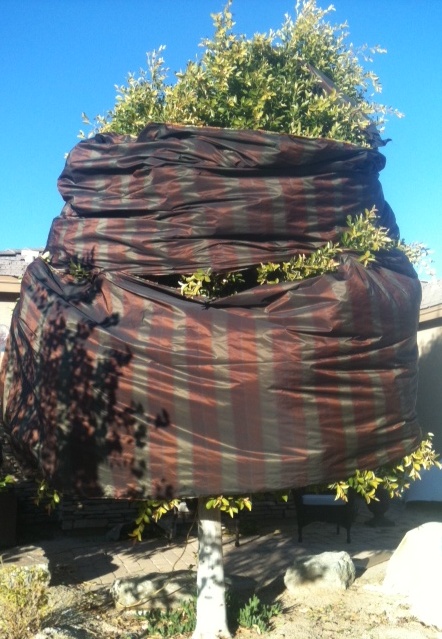
This 30 foot ficus  tree (fig tree) is the hit of the neighborhood in its earth-toned stripes.

Its neighbor, the lemon tree, is more bohemian – wearing both a cabbage rose print (left over from bedroom decor a few years back) and a copper and black damask (left over from a shower curtain that is still hanging).

Trees sprouting fabrics.

Trees sprouting fabrics.

The shrubs and low lying plants were covered with a variety of fabrics.  Ivory and tan fabrics can be seen in the lower right hand side of the second picture.

Underneath their finery the trees are being heated by large Christmas lights.

After two frigid nights, it appears the branches not covered by fabric were damaged – but the trees themselves should make it!  One more cold night (22 degrees) is predicted.

I knew that Fabric Stash would prove useful!

Posted in No Sewing Fabric Projects | Tagged , | 1 Comment

Ghosts of Christmas Past

Visiting family for the Christmas Holidays is always fun.

While there I noticed many of the past Christmas presents are still being used, so I snapped a few pictures.

Pillows from Christmas Past

Pillows from Christmas Past

These pillows were made several years ago to coordinate with a gold/olive green/rosey red Victorian decor.

The monogram is an “M” in a cranberry red and a “H” (lower case) in an olive green.

It was hand stitched using back stitch and satin stitch on white dupioni silk.  I remember the silk was remnant from the then much larger Stash.

Monogram Pillow MH

Monogram Pillow MH

The “dots” are beads.

A twisted satin cord was used to edge the pillow.

The Crazy Quilted pillow was one of my early Crazy Quilting Projects.  It includes many Stash fabrics, including some green velveteen that had been in my mother’s Stash.

The pillow motifs includes the names or initials of everyone in the family.

CQ Pillow Details

CQ Pillow Details

Each of the seams is embellished with embroidered and beaded typical CQ stitches.

The pillow is edged with a loopy gold fringe.

It is very gratifying to know that handmade gifts are still enjoyed!


Posted in Accessories, Crazy Quilting, Crazy Quilting, Embellishment, Home Decor, Sewing | Tagged , , | Leave a comment